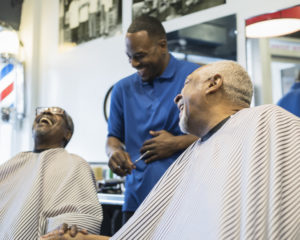
Hundreds of black men recently discovered they could get more than a lining or a fresh fade at their local barbershops. They were offered diabetes testing, too.
A new study offered customers diabetes screenings at eight New York City barbershops. Among those who took the test, 10 percent learned they had average blood sugar levels that indicated type 2 diabetes. And almost 30% appeared to have prediabetes.
Why The Barbershop?
“For a long time, barbershops have been a place of trust, especially for black people. Because we had the barbers on board with us, people trusted us. Barbers are often important health advocates,” said the study’s senior author, Dr. David Lee. He’s an assistant professor of emergency medicine at the NYU School of Medicine.
Lee and his colleagues said it’s important to reach out to black men in this way because their diabetes diagnosis is often delayed, and black men have significantly higher rates of diabetes complications once diagnosed. Black men are also less likely to live into their 70s than are men in other racial and ethnic groups.
Dr. Anthony Clarke, an internal medicine doctor in Detroit, said, “Not seeking medical care is a common problem in men, and it’s worse in the black community. With a lot of men in general, they think, if you don’t know about a problem, it’s OK. A lot of men tell me, ‘My wife made me come in.'”
Clarke, of Detroit Medical Center’s Harper University Hospital, was not involved in the current study.
“I think the barbershop was a good way to do this. If patients aren’t coming to you, you go where the patients are. The barbershop is a gathering place for men,” Clarke said.
The researchers partnered with eight Brooklyn barbershops, all owned by black people. The neighborhoods were chosen because they had a higher prevalence of poor blood sugar control.
From September 2017 through January 2019, nearly 900 black men were offered the free finger-stick blood test for diabetes.
The researchers ended up testing 290 men. Their average body mass index (BMI) was 29.3. BMI is a rough estimate of body fat based on height and weight measurements. A BMI between 24.9 and 29.9 is considered overweight. A BMI of 30 or more is considered obese.
Of those who had undiagnosed diabetes, about 62% were obese, the study found. The average age of the men with undiagnosed diabetes was 41.
More than half of the men who didn’t take the test were willing to tell the researchers why. About half said they knew their health status or had been checked by their doctor, and 35% said they were healthy or they didn’t want to know their status. Eight percent said they were afraid of needles, Lee’s team noted.
“The symptoms of type 2 diabetes are relatively few. A lot of people feel fine and think they’re healthy. Other research has shown that if you find diabetes from a screening test rather than symptoms, you’ll have half the premature mortality rate than those who find out later,” Lee said.
“I usually meet people late in the disease process at the [emergency department]. We need to start figuring out ways to detect chronic diseases like diabetes earlier,” he added.
Lee said he’s not sure if this approach would work in other cities or in more rural areas.
The study results were published as a letter in the Jan. 27 online edition of JAMA Internal Medicine.
Learn more about screening for prediabetes from the U.S. National Institute of Diabetes and Digestive and Kidney Diseases.


By subscribing, you consent to receive emails from BlackDoctor.com. You may unsubscribe at any time. Privacy Policy & Terms of Service.