Yes, you read that right – Black people are flourishing and thriving in these U.S. cities. We’re not gatekeeping this information and want to share the latest findings on safe spaces brimming with wellness, wealth, and longevity with you.
The U.S. life expectancy across all ethnicities has hit record levels since 2019, just before the pandemic. Equally important, deaths from heart disease, cancer, and diabetes decreased from 2021 to 2023, according to a KFF report. People in the U.S. are getting healthier, and it’s positively affecting lifespan. With life expectancy on the rise, how is this affecting Black communities? What cities are the healthiest with the highest life expectancy rate for Black Americans?
Researchers from the Brookings Institution, in partnership with the NAACP, sought to answer this question with one goal in mind: to empower Black communities. Together, they developed a powerful resource, the Black Progress Index, to understand the various conditions that shape Black health and well-being. Let’s dive into the data from this index and take a closer look at this new boost in lifespan.
While the average lifespan is increasing across all ethnicities, there’s still a strikingly large gap for Black Americans. The CDC recently released data from its National Vital Statistics System stating that the average U.S. life expectancy at birth was 79 years old in 2024 – a record high for the U.S. For Black Americans, it was 74 years old in 2023, according to a 2026 study investigating racial disparities in lifespan. That’s five years below the U.S. average.
Researchers in this study explained that some of the driving factors contributing to this gap could include differences in healthcare coverage, income levels, historical housing regulations such as redlining, and lower educational attainment rates. While this recent study may shed light on the disparities, ongoing research is needed to fully understand the social and economic patterns that affect health.
RELATED: Life Expectancy Is Rising, but Black Americans Still Face a Gap
Any guesses on what those cities may be? We’ll give you a hint, it’s not Los Angeles, San Francisco, or New York City. While metropolitan cities offer diverse career and social opportunities, great medical care, and top access to education, these cities didn’t make the list. This list is called the Black Progress Index – an index that classifies and measures Black life expectancy at birth through different social conditions. According to the Black Progress Index, the researchers believed that identifying both non-biological and biological social influences can measure a person’s well-being.

At the top of this 2022 index were Manassas Park, Virginia and Weld County, Colorado. Together, they had the highest life expectancy among Black Americans, at 96 years old. The next highest-performing county was Scott County, Minnesota, with a life expectancy of almost 90 years. Counties with average lifespans approaching 86 years old include Collier County, Florida; Dallas County, Iowa; and Putnam County, New York. Other states that had top-performing counties on this index include Indiana, Minnesota, Maine, Washington, Ohio, Oregon, Georgia, Maryland, and Massachusetts.
RELATED: Your Zip Code Is a Diagnosis: NYC Data Shows the Health-Wealth Gap
Here are some of the other cities that round out the bottom half of the top 20 list.
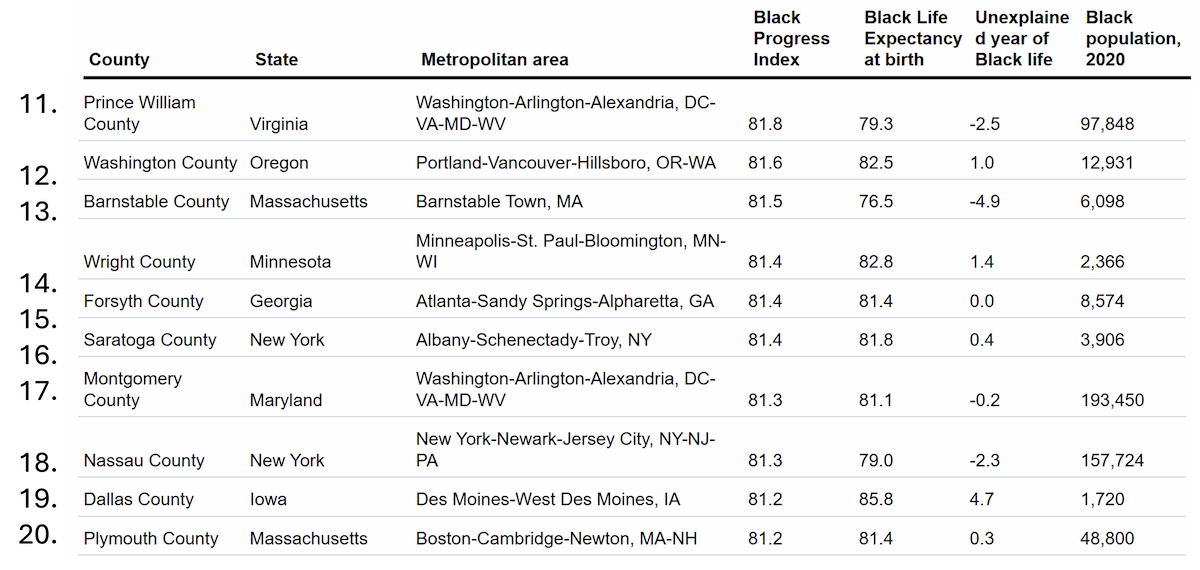
Researchers examined 13 social factors across five categories to build the Black Progress Index. The big categories were wealth, safety, family health, environmental quality, and social and human capital. They discovered that these essential factors could positively or negatively impact Black life expectancy.
According to the index, key contributors to increasing life expectancy in terms of wealth and safety included homeownership, average household income, business ownership, and commuting to work by biking or walking. When it came to family health, the researchers discovered that Black children who had fathers present at home had a greater life expectancy as a community.
Education also plays a big role in health. This relationship has been well established across various studies. One 2011 study explains that people with higher education are less likely to smoke, drink heavily, and be obese. Instead, they’re more likely to live in safe neighborhoods and use preventive care. This strong correlation was also found in the index. The biggest education factors were public school performance and college completion rate.
Other social factors that contributed to a boost in life expectancy were friendship diversity, religious membership, and being born in a foreign country. It’s still unclear in this study why non-native Black people tend to live longer–up to 10 years for men and nearly eight years for women–than those born in the U.S.
On the other hand, several safety and environmental factors negatively affected life expectancy. Gun fatalities had the second-highest impact on the index, right below foreign-born adults. Other conditions that caused the expectancy rate to drop were air pollution and population density. Air pollution is especially harmful because it can be a silent killer. In other words, you can’t see the pollutants generated from power plants, highways, refineries and other industrial buildings easily with the naked eye. These pollutants may damage long-term health and are often linked to increased risks of cancer, respiratory illness, and cardiovascular disease.
Living a long, healthy life is something we all strive for. It goes without saying that the counties and cities listed in the index offer significant benefits. While some people might be able to pack up their things and move to one of these lovely cities, many of us can’t. From family responsibilities and community obligations to work and loving where you live, home is home. Luckily, there are still small steps you can take today to improve your longevity at home.
Some of the best ways to improve your longevity include getting regular exercise, scheduling your annual check-ups, and eating a healthy diet high in fruits, veggies, protein, and complex carbohydrates. According to Harvard Health, maintaining a positive mindset, engaging in frequent social outings, prioritizing sleep, hydrating often, quitting smoking, and limiting your alcohol intake can all increase your lifespan.


By subscribing, you consent to receive emails from BlackDoctor.com. You may unsubscribe at any time. Privacy Policy & Terms of Service.