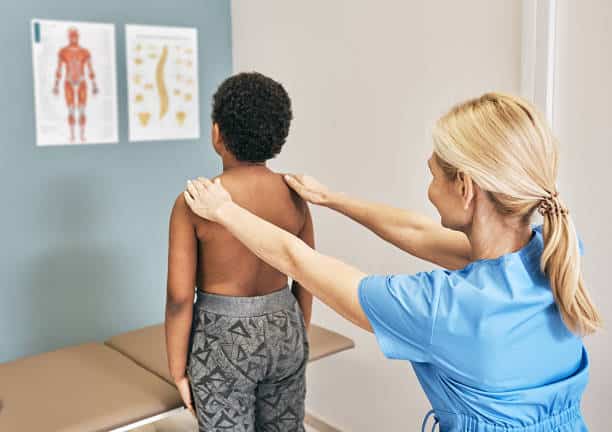
The most natural response parents have when they see their child going through something is to fix it. For parents whose children are living with scoliosis—a spine that curves and twists to the side— it may be difficult to hear that surgery or a corrective brace worn throughout the day are the only treatment options, your child may have for correcting scoliosis. However, the good news is if scoliosis is caught early enough, the condition can often be treated in a less invasive or awkward way.
“We have a new understanding of bracing from recent studies that showed wearing a brace just at nighttime does some good,” says David Skaggs, MD, executive vice chair of the Department of Orthopaedics at Cedars-Sinai and director of Pediatric Orthopaedics at Cedars-Sinai Guerin Children’s. “So, we are now more aggressive about trying to prevent scoliosis from getting to the point where you need surgery or even that you would need to wear a brace to school as a teenager.”
Scoliosis can develop in infancy or early childhood, affecting more than 100,000 children in the United States each year. Early detection is key as is following the condition throughout a young person’s life.
“One of the unique features of the Pediatric Spine Program at Cedars-Sinai Guerin Children’s is we have nurse navigators who will follow you from before your first appointment to after you go away to college, guiding you through your journey,” Skaggs shares. “You’re also not just gaining access to pediatric treatment but to all of Cedars-Sinai Spine, one of the largest spine centers in the nation. We can offer continuity of care for the rest of your life.”
During Scoliosis Awareness Month in June, the Cedars-Sinai Newsroom spoke with Skaggs about the latest developments in pediatric scoliosis, treatment options and how to identify it.
“Scoliosis in the simplest form is a curved spine of 10 degrees or more. In reality, it’s a bit more complicated because the spine is not only curved, but it’s twisted. That’s important because one, it might make somebody look like they have a big hump in their back, and two, it twists around the lungs, so it compromises someone’s ability to take a full breath.”
“The most common type of scoliosis is teenage scoliosis, which is called adolescent idiopathic scoliosis. That is what people are generally screened for in schools and it’s the most common reason why a patient is referred to a specialist for scoliosis. Parents can also look for a lack of symmetry in a child’s back when they’re bent over at the waist and raise any concerns with their pediatrician or a spine specialist, who will use an X-ray to make a definitive diagnosis.”
RELATED: What Causes Back Pain in Children and Teens?
“Most of the time when someone has scoliosis, they don’t even know they have it because there’s no symptoms, no pain or other issues going on. They start to notice their body looks just a little bit sideways, maybe one shoulder is a little bit higher, or one side of the chest protrudes a little bit. It’s quite subtle the body changes that take place over time and the lack of pain or other problems often mean that the scoliosis is not diagnosed for years.”
“There are only two options to treat scoliosis that are scientifically proven. One is surgery, and that’s the last resort. Any teenager or person in their early 20s, if the curve is over 45 to 50 degrees, surgery should be considered unless there are
extenuating circumstances. What we want to do is prevent the need for surgery. The other is bracing and what a brace does in general is stop the scoliosis from progressing.”
“From a recent study we learned that in patients who are less than 10 years old, even with a small amount of scoliosis like 15 or 20 degrees, starting part-time bracing at night only can actually reverse or improve the scoliosis. So, one of the ways that we’ve changed how we treat patients at Cedars-Sinai Spine, is we’re more likely to recommend part-time bracing earlier for smaller curves. It’s understandable that many patients don’t want to wear a brace to school, and it’s probably better to wear it at night than not wear it at all.”
“One newer option for some eligible patients allows us to correct the spine’s curve without fusing the spine—vertebral body tethering. It allows motion and growth over time. You take a curve and around the outside of the curve, you basically put in screws and a rope. Then, you allow the inside of the curve to grow, and the outside doesn’t grow, it straightens. While it can shorten recovery time for those who qualify, it’s not right for everyone who needs surgery.”
RELATED: Good Posture Matters! 8 Tips To Teach Your Child Today!
There are three main types of scoliosis that you should be aware of. Some are present at birth, while others develop during childhood or adolescent growth spurts. Your child’s doctor can help you identify the cause of your child’s scoliosis. The cause of your child’s scoliosis may also help determine the best type of treatment. The three types of scoliosis are:
As mentioned earlier, those living with scoliosis often experience no pain causing symptoms to go undetected. Because of this, it is important to watch for any of the following symptoms in your child:
If you are concerned about your child showing any of these symptoms, consider scheduling an appointment with a pediatric spine specialist.
By Cedars-Sinai


By subscribing, you consent to receive emails from BlackDoctor.com. You may unsubscribe at any time. Privacy Policy & Terms of Service.