
COVID news has remained relatively gloomy whether it’s news of an Omicron surge, Flurona (testing positive for COVID and the flu at the same time), Deltacron (a hybrid of the Delta and Omicron variant) or the rise in COVID-related hospitalizations. However, the latest Omicron developments are proving to be encouraging.
Deltacron: Is it Real and How Worried Should You Be?
New COVID-19 cases are plummeting in a growing list of places, according to The New York Times. Statistics show that percentage of cases causing severe illness is much lower than it was during the surge of the Delta variant. The data also shows that vaccines — particularly after a booster shot — are doing their job and remain extremely effective in preventing hospitalization and death.
So what exactly does the latest data show?
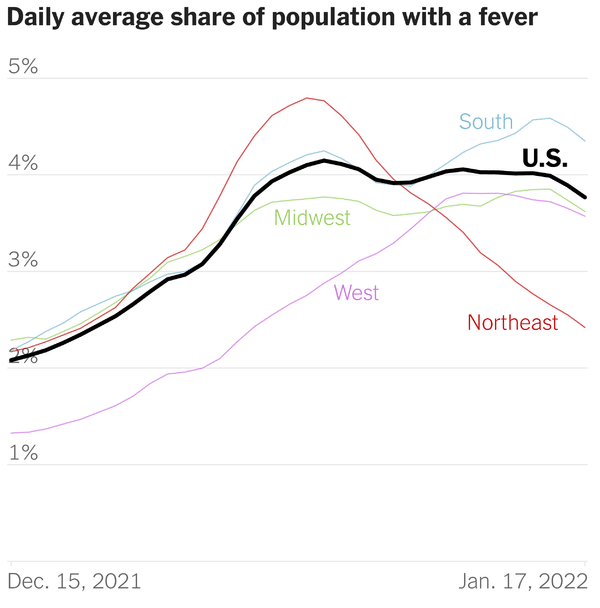
New cases in Connecticut, Maryland, New Jersey and New York have fallen by more than 30 percent since early last week, according to data provided by Kinsa, a San Francisco company that tracks how many Americans have a fever everyday. In Colorado, Florida, Georgia, Massachusetts and Pennsylvania cases are down 10 percent. The data also shows that COVID cases in California have peaked.
“Let’s be clear on this — we are winning,” Mayor Eric Adams of New York said yesterday. Kathy Hochul, the governor of New York State, said during a budget speech, “We hope to close the books on this winter surge soon.”
If anything, the official COVID numbers probably understate the actual declines, because test results are often a few days behind reality, The Times reports.
This type of data suggests that we may be on the verge of Omicron’s retreat.
Flurona: What Happens When You Test Positive for the Flu and COVID at the Same Time?
South Africa, Britain and several other countries followed an Omicron pattern that included a rapid surge that lasted for about a month, followed by a rapid decline — first in cases, then hospitalizations and lastly deaths. Data suggests that the U.S. may be heading down that same path.
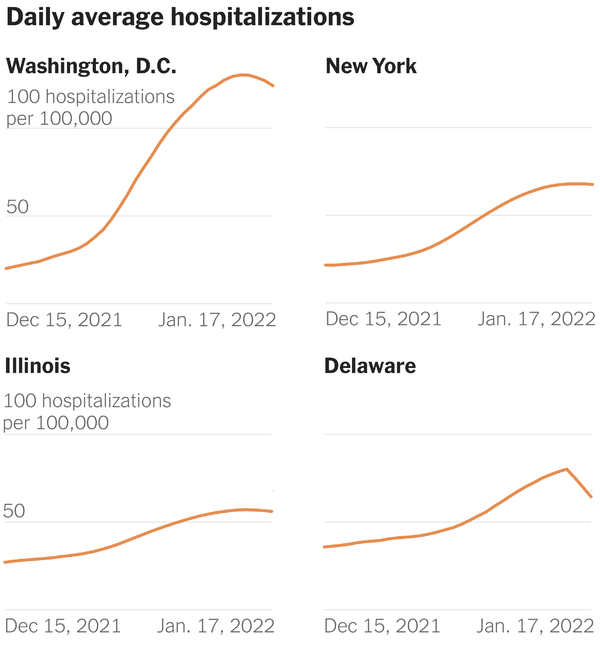
Despite many hospitals still coping with a large number of patients, the number of people hospitalized with COVID have begun to decline over the past few days.
In Utah, the percentage of cases leading to hospitalization among vaccinated patients has been only about half as high in recent weeks as it was last summer.
A team of British researchers led by Dr. Julia Hippisley-Cox of the University of Oxford created an online calculator that allows you to
enter your age, vaccination status, height and weight and your major COVID risk factors. The data is based on an analysis of British patients, however, the conclusions it draws can be relevant to anyone.
For example, your average 65-year-old American woman with a height of five foot three inches tall and a weight of 166 pounds would only have a 1 in 872 chance of dying after contracting COVID if she’s been vaccinated and didn’t have an operation such as an organ transplant that would make her high risk, according to the calculator. For a typical 65-year-old man, the risk would be 1 in 434.
For a 75-year-old, the risk would be 1 in 264 for a typical woman and 1 in 133 for a typical man.
Of course, any risk is a cause for concern, especially in older patients, but the calculator shows that the risks are no larger than the typical risks that come with old age.
Because the British calculator uses data through the first half of 2021, when the Delta variant was more severe than Omicron appears to be, the risk factor may be even lower than the calculator suggests, according to the Times.
However, the data doesn’t negate the fact that the Omicron variant is highly contagious. It has infected tens of millions of Americans in a matter of weeks. But the data does suggest that if you do contract this highly contagious variant, your symptoms may be no worse than the flu if you are vaccinated.
Although there has been some hesitancy, booster shots are highly effective at preventing severe illness from Omicron. The protection is “remarkably high,” Dr. Eric Topol of Scripps Research wrote.
The first two shots of the Moderna or Pfizer vaccine or the one shot of the Johnson and Johnson vaccine still provide a lot of protection against the Omicron variant, but the booster makes a meaningful difference, Edouard Mathieu and Max Roser of Our World in Data noted.
RELATED: U.S. COVID Hospitalizations Pass Last Winter’s Peak
As previously stated, COVID news has remained relatively grim throughout the pandemic and will likely remain that way until early February, The Times predicts.
Despite numbers potentially declining in the future, hospitals remain overwhelmed as of now with nearly 2,000 deaths a day. Many communities are still experiencing high numbers of cases (death trends typically lag case trends by three weeks).
However, if you look at the full picture, there’s hope for a brighter future.
Omicron appears to be in retreat, even if the official national data doesn’t yet reflect that reality, The Times reports. The majority of Omicron cases have been mild, especially for those that are vaccinated. This shows that if we keep down this path, the U.S. may be only a few weeks away from the most encouraging COVID situation since early last summer, before the Delta variant emerged.
It is important to note that this is speculation. There is no guarantee that this will happen. However, if it does, Katherine Wu of The Atlantic explains — it will be time to ask how society can move back toward normalcy and reduce the harsh toll that the pandemic isolation has inflicted, particularly on children and disproportionately on low-income children.
This suggests that we may have to start asking the tough questions that we haven’t been able to ask due to the surge of the Omicron variant.
When should schools resume all activities? When should offices reopen? When should masks come off? When should asymptomatic people stop interrupting their lives because of a COVID exposure? When does COVID prevention do more harm — to physical and mental health — than good?


By subscribing, you consent to receive emails from BlackDoctor.com. You may unsubscribe at any time. Privacy Policy & Terms of Service.