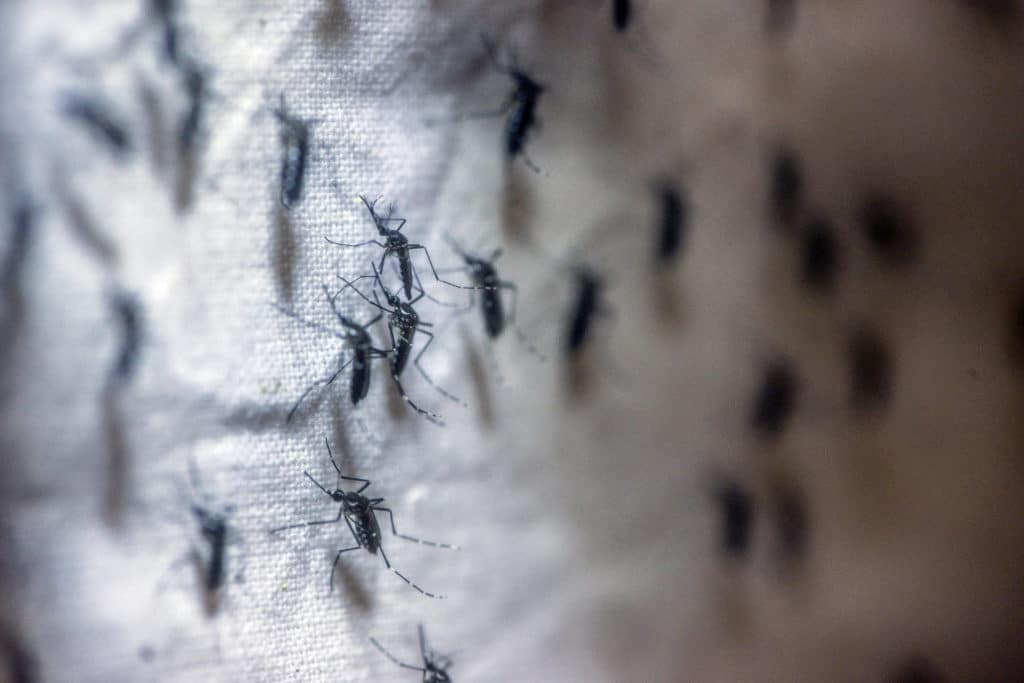
Approved by the Environment Protection Agency earlier this year, a project to release 750 million genetically-engineered mosquitoes is ready to be released and fly in the skies of Florida in 2021.
You may ask, why in the world is someone creating genetically-modified mosquitoes, don’t we have enough mosquitoes already? And that would be a great question.
These mutant bugs are designed to test if a genetically modified mosquito is a viable alternative to spraying insecticides to control the Aedes aegypti. It’s a species of mosquito that carries several deadly diseases, such as Zika, dengue, chikungunya and yellow fever.
The Aedes aegypti is invasive to southern Florida, and are commonly found in urban areas where they live in standing pools of water. In many areas, including the Florida Keys, they have developed a resistance to pesticides.
Activists against this project warn of possible damage to ecosystems, and the potential creation of hybrid, insecticide-resistant mosquitoes. One group even went as far as to condemn the plan as a public “Jurassic Park experiment”.
Some argue that the Oxitec mosquitoes, themselves, may also harm local wildlife in unintended ways. “An ecosystem is so complicated and involves so many species, it would be almost impossible to test them all in advance in a lab,” Max Moreno, an expert in mosquito-borne diseases at Indiana University who is not involved with the pilot project, told the Associated Press.
But the company involved says there will be no adverse risk to humans or the environment, and points to a slate of government-backed studies.
The biotech company Oxitec, which designed the modified pests, did so by introducing a “lethal gene” into male Ades aegypti mosquitoes, Live Science previously reported. In theory, the modified males should mate with female mosquitoes and pass the lethal gene on to female offspring, causing the offspring to die before reaching maturity because they cannot properly build an essential protein. This same genetic change does not affect male survival, so the Oxitec mosquitoes survive to mate with females, according to Science Magazine.
An Oxitec scientist told AP news agency: “We have released over a billion of our mosquitoes over the years. There is no potential for risk to the environment or humans”.
Only female mosquitoes bite humans because they need blood to produce eggs. So the plan is to release the male, modified mosquitoes who will then hopefully breed with wild female mosquitoes.
However, the males carry a protein that will kill off any female offspring before they reach mature biting age. Males, which only feed on nectar, will survive and pass on the genes.
Over time, the aim is to reduce the population of Aedes aegypti mosquitoes in the area and thereby reduce the spread of disease to humans.
One of main diseases they are targeting is the Zika virus. The Zika virus is a mosquito-borne flavivirus that was first identified in Uganda in 1947 in monkeys. It was later identified in humans in 1952 in Uganda and the United Republic of Tanzania.
Outbreaks of Zika virus disease have been recorded in Africa, the Americas, Asia and the Pacific. From the 1960s to 1980s, rare sporadic cases of human infections were found across Africa and Asia, typically accompanied by mild illness.
The first recorded outbreak of Zika virus disease was reported from the Island of Yap (Federated States of Micronesia) in 2007. This was followed by a large outbreak of
Zika virus infection in French Polynesia in 2013 and other countries and territories in the Pacific. In March 2015, Brazil reported a large outbreak of rash illness, soon identified as Zika virus infection, and in July 2015, found to be associated with Guillain-Barré syndrome.
In October 2015, Brazil reported an association between Zika virus infection and microcephaly. Outbreaks and evidence of transmission soon appeared throughout the Americas, Africa, and other regions of the world. To date, a total of 86 countries and territories have reported evidence of mosquito-transmitted Zika infection.
Signs and symptoms
The incubation period (the time from exposure to symptoms) of Zika virus disease is estimated to be 3–14 days. The majority of people infected with Zika virus do not develop symptoms. Symptoms are generally mild including fever, rash, conjunctivitis, muscle and joint pain, malaise, and headache, and usually last for 2–7 days.
Zika virus infection during pregnancy is a cause of microcephaly and other congenital abnormalities in the developing fetus and newborn. Zika infection in pregnancy also results in pregnancy complications such as fetal loss, stillbirth, and preterm birth.
Zika virus infection is also a trigger of Guillain-Barré syndrome, neuropathy and myelitis, particularly in adults and older children.
Research is ongoing to investigate the effects of Zika virus infection on pregnancy outcomes, strategies for prevention and control, and effects of infection on other neurological disorders in children and adults.
Q&A: Zika virus and complication
Transmission
Zika virus is primarily transmitted by the bite of an infected mosquito from the Aedes genus, mainly Aedes aegypti, in tropical and subtropical regions. Aedes mosquitoes usually bite during the day, peaking during early morning and late afternoon/evening. This is the same mosquito that transmits dengue, chikungunya and yellow fever.
Zika virus is also transmitted from mother to fetus during pregnancy, through sexual contact, transfusion of blood and blood products, and organ transplantation.


By subscribing, you consent to receive emails from BlackDoctor.com. You may unsubscribe at any time. Privacy Policy & Terms of Service.