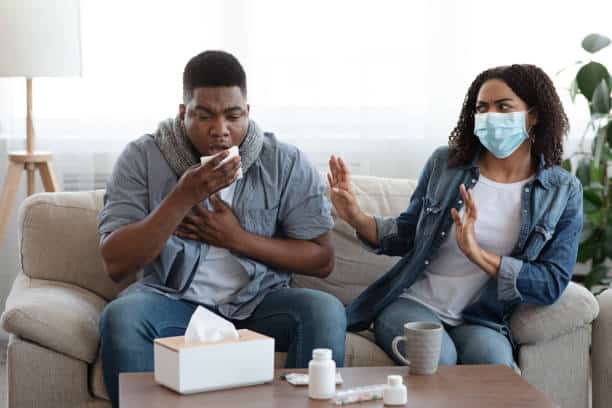
Telling people to isolate themselves in a bedroom when COVID-19 strikes may not be enough to keep the virus from spreading to others in the household, a new study suggests.
Airborne coronavirus particles were found both inside and outside the rooms of people with COVID-19 who were supposed to be self-isolating at home, according to researchers from Rutgers University in New Jersey.
“Our indoor air sampling data clearly demonstrated that measurable airborne SARS-CoV-2 RNA was present in the air in the homes of most infected people, not only in the isolation room, but, importantly, elsewhere in the home,” study lead author Howard Kipen, a professor in the Rutgers School of Public Health. SARS-CoV-2 is the virus that causes COVID-19 says.
Compounding the problem, many of the infected people didn’t restrict themselves to their isolation room, spending varying amounts of time in an adjacent common room, the researchers note.
RELATED: Omicron Lasts Longer on Skin, Plastic & Other Surfaces (How to Clean Omicron)
“We discovered that many did not strictly adhere to self-isolation, with eight of the 11 infected study participants reporting spending from a few hours to 14 hours in the common room and five of 11 participants reporting spending time in other areas of the home,” Kipen said in a Rutgers news release.
For the study, the researchers collected air samples from rooms in 11 homes where a newly infected person was isolating, as well as in the adjacent common room. The samples were analyzed for the presence of three SARS-CoV-2–specific genes in airborne particles. Participants were also asked how much time they spent isolating in their room.
Air samples with at least one of the three virus genes were found in six of the 11 isolation rooms and in six of the nine common rooms.
Also, other residents in four of the homes were either
positive for the coronavirus or had symptoms, according to the study.
The results were published recently in the journal Annals of the American Thoracic Society.
The study sought to document coronavirus air contamination under typical daily living conditions in a household with an infected person.
Airborne transmission in crowded living conditions may be one reason for higher rates of COVID infection among people with lower incomes, according to the researchers.
RELATED: What to do if Your Rapid Antigen Test Comes Back Positive After Isolation
“Risk of infection from larger respiratory droplets that rapidly settle onto surfaces, typically within two meters of the source, can be reduced by hand-washing, social distancing and face masks, but the tiny respiratory particles that stay suspended in air for hours, require air filtration, ventilation or better masks for prevention,” Kipen shares.
According to the CDC, anyone that is sick or infected should separate from others, or wear a well-fitting mask when they need to be around others for at least 5 full days (day 0 is the first day of symptoms or the date of the day of the positive viral test for asymptomatic persons).
The CDC offers the following tips if you or someone in your household is self-isolating:


By subscribing, you consent to receive emails from BlackDoctor.com. You may unsubscribe at any time. Privacy Policy & Terms of Service.