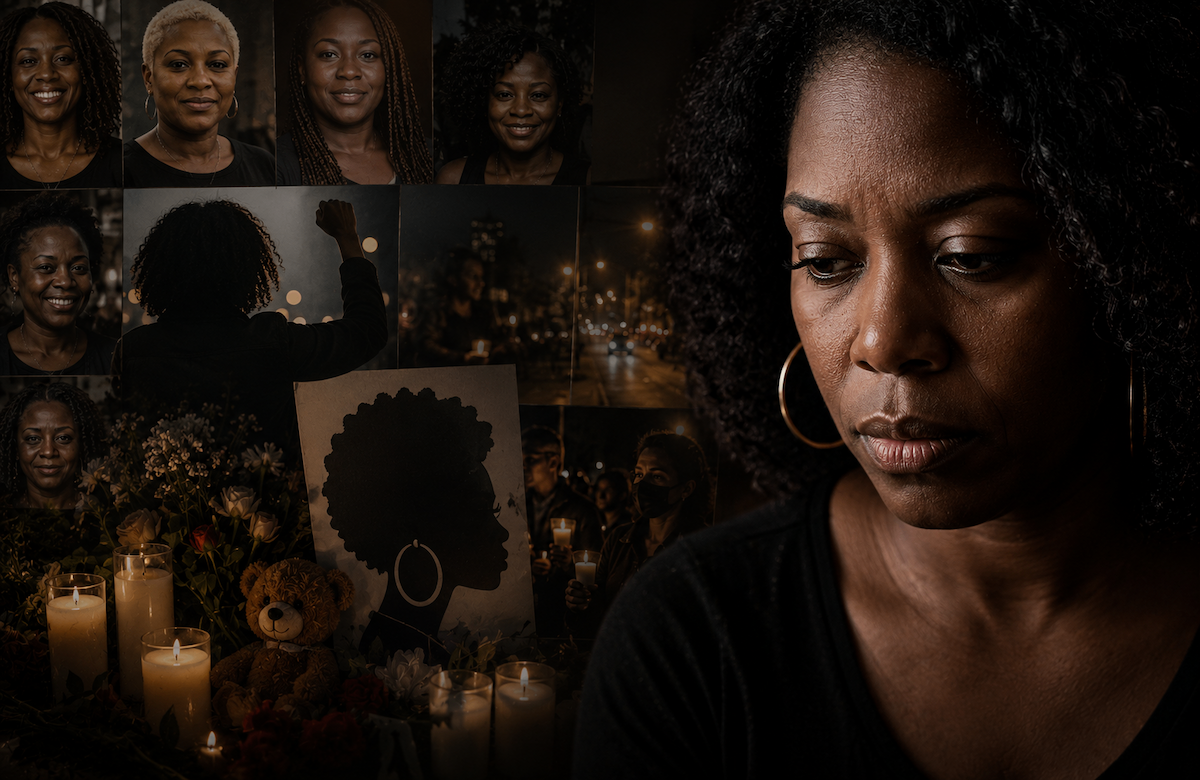
Black women’s safety has consistently been a cause for concern in America, as decades and generations past have demonstrated just how abused, misused, mistreated, and undervalued they are.
Sadly, not much has changed regarding how Black women are treated and viewed, as evidenced by the current Trump administration. However, there has been an alarming rise in Black femicide that has gone far beyond passing headlines and hashtags — it’s become a devastating crisis that can no longer be ignored.
Within the last few weeks, the news has been dominated by the deaths of Black women at the hands of their domestic partners, such as Coral Springs Vice Mayor Nancy Metayer Bowen, Dr. Cerina Wanzer Fairfax, Pastor Tammy McCollum, and rapper Qualeisha Barnes. Influencer Ashlee Janae is also included on the list, as her family and many others suspect foul play in her alleged suicide.
These tragic and brutal deaths point to a heartbreaking trend that has only increased since the COVID-19 pandemic — the rise of Black femicide.
Per research from Dr. Tameka Gillum, an associate professor at the University of New Mexico, and her colleagues, Black femicide is not only a call to action, but also a public health crisis.
According to their findings, in 2020, the year the pandemic began, “Black women were murdered at a rate of 11.6 per 100,000 people, while white women were murdered at a rate of three homicides per 100,000 people, that same year.”
RELATED: 5 Silent Signs of Domestic Violence to Look Out For
Per Dr. Gillum, the majority of these deaths were at the hands of a romantic partner or by someone the victim knew, as “more than half of Black women murdered in 2020 were killed by current or former romantic partners” and “90% of Black women who were murdered knew the person responsible.”
Research also revealed that pregnancy, which is supposed to be one of the happiest times in a woman’s life, is when many Black women face an increase in domestic violence and murder.
In the 19-year period between 2000 and 2019, “homicide became a leading cause of death for Black women both during and after pregnancy, per the research. Additionally, studies also determined that 42% of Black women who died from non-childbirth-related causes died by a form of violence.
Following the recent deaths of Black women due to domestic violence, Paméla Tate, executive director of Black Women Revolt Against Domestic Violence, noted, while speaking with CNN, that deep-seated skepticism towards police and government child services agencies due to institutionalized racism makes Black women reluctant to seek help when dealing with domestic violence issues.

Tate’s point of view directly correlates to Dr. Gillum’s research, which found that, dating back to 2015, 20% of Black women are killed by police, despite only being 13% of the U.S. population. Of that number, over half of the black women killed were unarmed.
As the deaths of Black women make the rounds on social media with calls for justice and receive limited news coverage, there are many opinions that largely rely on mental health issues as the reasoning for Black femicide.
While that is certainly an underlying issue and a problem in the Black community, there has been an alarming sense of using mental health issues to excuse those who commit violent murders of Black women.
“To say they’re mentally ill, that doesn’t cut it,” Tate told CNN. “There are people who are depressed or people who have schizophrenia and don’t harm … their partners, much less kill them. The mental illness is not what we’re talking about here.”
Despite research like Dr. Gillum’s and activism by the likes of Paméla Tate, Black femicide is not treated with the severity that it deserves, which further makes the lives of Black women even more at risk.
“For any other health disparity of this magnitude, we would be drawing due attention and investing appropriate resources,” Dr. Gillum said. “But since it is Black women’s lives at stake, the issue fades to the background.”
Dr. Gillum continued, adding, “These findings show a clear and severe disparity. The consistently higher homicide rates for Black women represent a critical public health issue that merits a focused response.”
You can log on to social media at any given point and see the popular hashtag #ProtectBlackWomen, but the rising rates of Black femicide make you wonder if anyone is truly putting the safety of Black women at the forefront, or if it merely sounds good to say or portray.
The deaths of these Black women also severely impact the loved ones they left behind, specifically their children. A generation of Black children are now being raised without the love, comfort, and nurturing of their mother, a mother who was taken from them due to violence.
According to the National Organization of Women (NOW), the U.S. does not have an official crime category specifically for femicide. In contrast, homicides, domestic violence, and intimate partner violence are all tracked by local law enforcement and the FBI, but femicide is not included.
The result is femicide erasure in the public conversation, “policy discussions, misclassified in databases, and misunderstood by the public.”
It should be noted that the most murders of Black women are committed via gun violence, but that shocking fact has yet to inspire legislation for protection; in fact, quite the opposite is currently in play.
In June 2025, a proposal by the Trump administration could allow domestic abusers to have a restoration of their gun rights, according to The 19th.
The proposal, led by the Department of Justice (DOJ), would shift the responsibility for determining if someone gets their gun rights back from the Bureau of Alcohol, Tobacco, Firearms and Explosives (ATF) to the Office of the Attorney General, per the outlet.
Critics of the proposal say that if approved, it would create “an apparent lack of an objective, holistic process for making” the decisions for gun rights restoration.
In response, the DOJ said the attorney general can grant such restoration if they believe “the applicant will not be likely to act in a manner dangerous to public safety and that the granting of relief would not be contrary to the public interest.”
For generations, Black women have been the backbone of the Black community, and yet they are the most unprotected, harmed, and killed.
It’s well past time that we look at the rising deaths of Black women as more than just the “headline of the day,” and do our part, however big or small, to protect one of our greatest resources — the Black woman.


By subscribing, you consent to receive emails from BlackDoctor.com. You may unsubscribe at any time. Privacy Policy & Terms of Service.