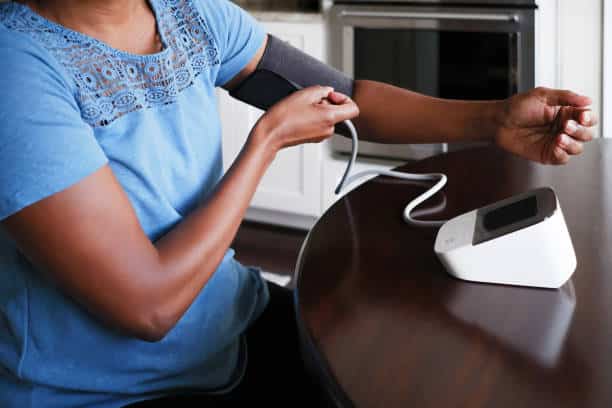
It’s a standard part of any medical visit. Someone, typically a nurse, wraps a cuff around your arm and asks you to sit quietly while the cuff squeezes to the point of discomfort, then slowly eases its grip. Some numbers get jotted down in your chart.
“136 over 79.”
What does that even mean?
“The top number – the systolic – tells us how much pressure there is from blood pushing against the walls of your arteries when the heart beats,” says Dr. Niteesh Choudhry, a professor of medicine at Harvard Medical School and a hospitalist at Brigham and Women’s Hospital in Boston. “The bottom number – known as diastolic – is the amount of pressure from blood pushing against the artery walls when the heart is at rest” between heartbeats.
When either number is too high for too long, “it causes all kinds of bad things,” Choudhry adds. That can include strokes, heart attacks, kidney failure and other chronic illnesses. “High blood pressure is a major cardiovascular risk factor, leading to bad outcomes in the heart and brain, and that’s why it’s gotten so much attention for so long.”
Nearly half of U.S. adults have high blood pressure, or hypertension. Because there are often no symptoms, if people aren’t checking for it, many don’t know they have it.
According to the American Heart Association and American College of Cardiology, a normal blood pressure for adults is a systolic measurement of less than 120 mmHg and a diastolic reading under 80 mmHg. Blood pressure is elevated when the systolic consistently reaches 120-129 mmHg and the diastolic is less than 80 mmHg. It is considered stage 1 hypertension when systolic blood pressure consistently hits 130-139 mmHg or the diastolic reaches 80-89 mmHg, and stage 2 hypertension when the readings consistently reach 140 mmHg or 90 mmHg or higher, respectively. Blood pressure readings that suddenly exceed 180 systolic and/or 120 diastolic are considered a hypertensive crisis that requires immediate medical attention.
Choudhry says much of the focus has centered on the top number (systolic) because there’s a larger body of research tying it to poor cardiovascular outcomes. “But both numbers matter. If one is high but the other isn’t, we use the one that’s abnormal.”
RELATED: 5 Things to Know About Blood Pressure Before It’s a Problem
When blood pressure gets too high, arteries begin to stiffen, according to Dr. Elizabeth Jackson, director of the Cardiovascular Outcomes and Effectiveness Research Program at the University of Alabama at Birmingham. “They are supposed to be flexible. Think about arteries being like a garden hose. If you push a lot of fluid through and the pressure is high, the hose gets stiff and doesn’t work as well.”
Hypertension develops over time and can be caused by many things. Some risk factors can be controlled, while others cannot. Factors that may influence blood pressure levels include being overweight, not getting enough physical activity, eating a poor diet or too much sodium, smoking, or not getting good sleep.
Some people are at greater risk than others, Jackson shares.
“African American women in the U.S. have some of the highest rates in the world,” she notes. Historical and systemic factors play a
major role in this statistic.
Increasing age, family history, health conditions such as kidney disease and diabetes, and gender also can affect hypertension risk. Until they reach 64, men are at higher risk than women. That reverses at 65 and beyond.
The good news, Choudhry says, is hypertension is treatable, regardless of which number is too high. The treatment is the same for each.
Making lifestyle changes is the first step, Jackson says. This can include losing weight if needed, becoming more physically active, limiting alcohol consumption, managing stress, quitting smoking if the person smokes and eating a healthier diet.
“Keep processed foods to a minimum,” she adds. “We know they can be high in sugar and salt. Make your plate colorful by eating a variety of fruits and vegetables.”
It’s also important to get enough and good quality sleep, Jackson notes. The AHA recommends adults get seven to nine hours of sleep each night to optimize cardiovascular health, more for children depending on age.
RELATED: Children Can Have High Blood Pressure, Too. Here’s What to Know.
If lifestyle changes alone don’t do the trick, medications also may be needed, Choudhry says.
RELATED: 10 Common Symptoms Of Low Blood Pressure You Shouldn’t Ignore
Low blood pressure is less common but still dangerous, Choudhry adds. It can happen when people are overtreated with medication for hypertension or when people are dehydrated or have another illness.
Unlike with high blood pressure, people whose blood pressure drops too low will usually feel ill, he says. “They’ll get dizzy or lightheaded. The treatment is dependent upon the underlying cause.”
But what’s too low for one person may be perfectly fine for another, Jackson shares. “It really is tailored to what the person’s other conditions are.”
None of these conditions can be treated if blood pressure isn’t being checked regularly, she concludes. “That’s why it’s important to know those numbers.”
By the American Heart Association


By subscribing, you consent to receive emails from BlackDoctor.com. You may unsubscribe at any time. Privacy Policy & Terms of Service.