Menu

Cataract

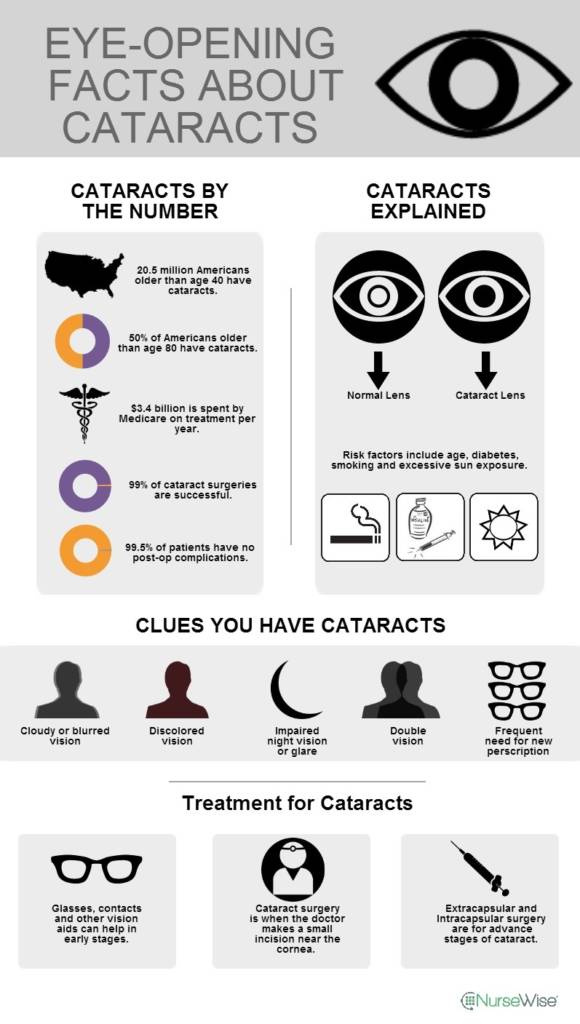
cataracts infographic
Cataract

A cataract is a clouding of the lens in the eye that affects vision.
Most cataracts are related to aging. Cataracts are very common in older people.
By age 80, more than half of all Americans either have a cataract or have had
cataract surgery.

A cataract can occur in either or both eyes. It cannot spread from one eye to
the other.


Featured on BlackDoctor
How do cataracts develop?

Age-related cataracts develop in two ways:

1. Clumps of protein reduce the sharpness of the image reaching the
retina.

The lens consists mostly of water and protein. When the protein clumps up, it
clouds the lens and reduces the light that reaches the retina. The clouding may
become severe enough to cause blurred vision. Most age-related cataracts develop
from protein clumpings.

When a cataract is small, the cloudiness affects only a small part of the
lens. You may not notice any changes in your vision. Cataracts tend to “grow”
slowly, so vision gets worse gradually. Over time, the cloudy area in the lens
may get larger, and the cataract may increase in size. Seeing may become more
difficult. Your vision may get duller or blurrier.

2. The clear lens slowly changes to a yellowish/brownish color, adding a
brownish tint to vision.

As the clear lens slowly colors with age, your vision gradually may acquire a
brownish shade. At first, the amount of tinting may be small and may not cause a
vision problem. Over time, increased tinting may make it more difficult to read
and perform other routine activities. This gradual change in the amount of
tinting does not affect the sharpness of the image transmitted to the
retina.

If you have advanced lens discoloration, you may not be able to identify
blues and purples. You may be wearing what you believe to be a pair of black
socks, only to find out from friends that you are wearing purple socks.


Who is at risk for cataract?

The risk of cataract increases as you get older. Other risk factors for
cataract include:

  • Certain diseases (for example, diabetes).
  • Personal behavior (smoking, alcohol use).
  • The environment (prolonged exposure to ultraviolet sunlight).


What are the symptoms of a cataract?

The most common symptoms of a cataract are:

  • Cloudy or blurry vision.
  • Colors seem faded.
  • Glare. Headlights, lamps, or sunlight may appear too bright. A halo may

    appear around lights.
  • Poor night vision.
  • Double vision or multiple images in one eye. (This symptom may clear as the

    cataract gets larger.)
  • Frequent prescription changes in your eyeglasses or contact

    lenses.

These symptoms also can be a sign of other eye problems. If you have any of
these symptoms, check with your eye care professional.


Are there other types of cataract?

Yes. Although most cataracts are related to aging, there are other types of
cataract:

  • Secondary cataract. Cataracts can form after surgery for other eye

    problems, such as glaucoma. Cataracts also can develop in people who have other

    health problems, such as diabetes. Cataracts are sometimes linked to steroid

    use.


  • Traumatic cataract. Cataracts can develop after an eye injury,

    sometimes years later.


  • Congenital cataract. Some babies are born with cataracts or develop

    them in childhood, often in both eyes. These cataracts may be so small that they

    do not affect vision. If they do, the lenses may need to be removed.


  • Radiation cataract. Cataracts can develop after exposure to some

    types of radiation.


How is a cataract detected?

Cataract is detected through a comprehensive eye exam that includes:

  • Visual acuity test. This eye chart test measures how well you see at

    various distances.


  • Dilated eye exam. Drops are placed in your eyes to widen, or dilate,

    the pupils. Your eye care professional uses a special magnifying lens to examine

    your retina and optic nerve for signs of damage and other eye problems. After

    the exam, your close-up vision may remain blurred for several hours.


  • Tonometry. An instrument measures the pressure inside the eye.

    Numbing drops may be applied to your eye for this test.

Your eye care professional also may do other tests to learn more about the
structure and health of your eye.


How is a cataract treated?

The symptoms of early cataract may be improved with new eyeglasses, brighter
lighting, anti-glare sunglasses, or magnifying lenses. If these measures do not
help, surgery is the only effective treatment. Surgery involves removing the
cloudy lens and replacing it with an artificial lens.

A cataract needs to be removed only when vision loss interferes with your
everyday activities, such as driving, reading, or watching TV
. You and your
eye care professional can make this decision together. Once you understand the
benefits and risks of surgery, you can make an informed decision about whether
cataract surgery is right for you. In most cases, delaying cataract surgery will
not cause long-term damage to your eye or make the surgery more difficult. You
do not have to rush into surgery.

Sometimes a cataract should be removed even if it does not cause problems
with your vision. For example, a cataract should be removed if it prevents
examination or treatment of another eye problem, such as age-related macular
degeneration or diabetic retinopathy.

If you choose surgery, your eye care professional may refer you to a
specialist to remove the cataract.

If you have cataracts in both eyes that require surgery, the surgery will be
performed on each eye at separate times, usually four to eight weeks apart.


Is cataract surgery effective?

Cataract removal is one of the most common operations performed in the United
States. It also is one of the safest and most effective types of surgery. In
about 90 percent of cases, people who have cataract surgery have better vision
afterward.


Are there different types of cataract surgery?

There are two types of cataract surgery. Your doctor can explain the
differences and help determine which is better for you:

  • Phacoemulsification, or phaco. A small incision is made on the

    side of the cornea, the clear, dome-shaped surface that covers the front of the

    eye. Your doctor inserts a tiny probe into the eye. This device emits ultrasound

    waves that soften and break up the lens so that it can be removed by suction.

    Most cataract surgery today is done by phacoemulsification, also called “small

    incision cataract surgery.”


  • Extracapsular surgery. Your doctor makes a longer incision on the

    side of the cornea and removes the cloudy core of the lens in one piece. The

    rest of the lens is removed by suction.


Aft

SHARE
Related Stories
Answer the question below

Gout Survey

People with gout often have sudden, painful flares of joint swelling and redness. How many gout flares have you experienced in the last 12 months?
Have you ever received intravenous medicine for your gout?

Get our Weekly Newsletter

Stay informed on the latest breakthroughs in family health and wellness. Sign up today!

By subscribing, you consent to receive emails from BlackDoctor.com. You may unsubscribe at any time. Privacy Policy & Terms of Service.

More from BlackDoctor

Where Culture Meets Care

BlackDoctor is the world’s largest and most comprehensive online health resource specifically for the Black community. BlackDoctor understands that the uniqueness of Black culture - our heritage and our traditions - plays a role in our health. BlackDoctor gives you access to innovative new approaches to the health information you need in everyday language so you can break through the disparities, gain control and live your life to its fullest.
✦ AI Search Disclaimer
This AI-powered search tool helps you find relevant health articles from the BlackDoctor.org archive. Please keep the following in mind:
✦ For Informational Purposes Only
The information provided through this AI search is for general educational and informational purposes only. It is not intended as a substitute for professional medical advice, diagnosis, or treatment.
✦ Always Consult a Healthcare Provider
Never disregard professional medical advice or delay seeking it because of something you have read through this search tool. If you have a medical emergency, call your doctor or 911 immediately.
✦ AI Limitations
This search tool uses artificial intelligence to help match your queries with articles in our archive. While we strive for accuracy, AI-generated results may occasionally be incomplete, outdated, or not fully relevant to your specific situation.
✦ No Doctor-Patient Relationship
Using this search tool does not create a doctor-patient relationship between you and BlackDoctor.org or any healthcare provider.
Explore over 35,000 articles and videos across black health, wellness, lifestyle and culture
Full AI Search Experience >
×

Download PDF

Enter your name and email to receive the download link.

BlackDoctor AI Search