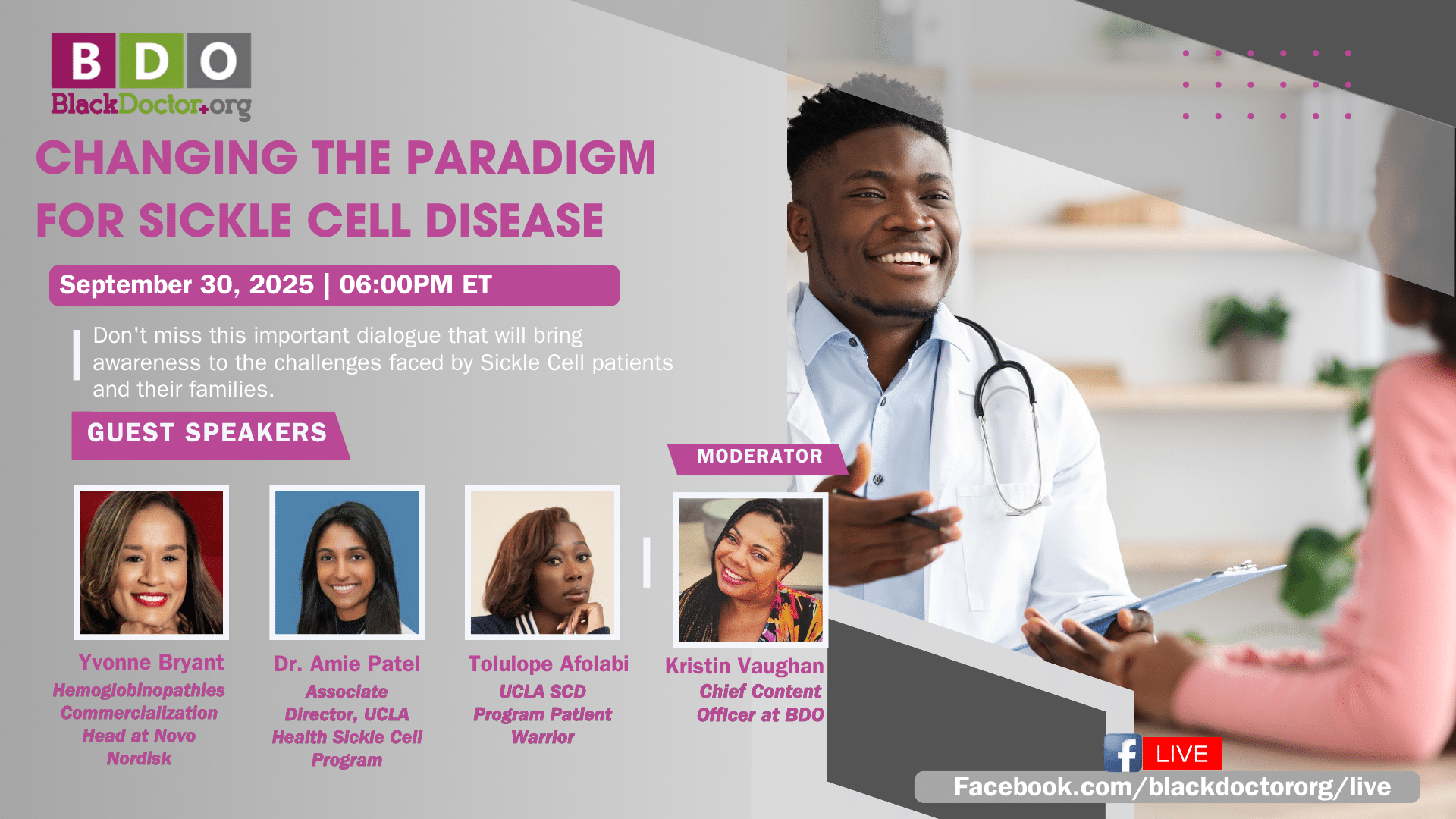
On the final day of Sickle Cell Disease Awareness Month, a distinguished panel gathered for a Facebook Live event on BlackDoctor.org (BDO) to discuss the inherited rare blood disorder’s care, advocacy, and research. The panel included Yvonne Bryant, head of hemoglobinopathies at Novo Nordisk; Dr. Amie Patel, Associate Director of the UCLA Health Sickle Cell Program; and Tolulope Afolabi, UCLA Sickle Cell Disease Program advocate and “sickle cell warrior.”
The event opened with moderator Kristin Vaughan, BDO Chief Content Officer, introducing the panelists and setting the tone for an evening focused on empathy, education, and action. “It impacts thousands of people and far too long there hasn’t been enough conversation,” said Bryant. “Sickle cell disease patients and their families… have had to advocate for themselves.”
Afolabi shared her personal journey, describing both the resilience and challenges that come with living with Sickle Cell Disease. “It’s impacted my daily life in the sense of making sure I cherish each moment along with the people that I have around me,” she said. “It’s also taught me to be very resilient, not just in health, but in all aspects of my life.”
Living with Sickle Cell Disease means navigating not only intense physical pain, but also the social and emotional burdens that come with an often invisible illness.
As Afolabi described, “Sometimes you feel the fatigue or the pain and you just can’t live up to your commitments. So maybe you have plans to go out with people and you have to flake on them. And so some people that don’t understand will be like, ‘Oh my God, she’s just flaking on me again, she’s not reliable.’”
This misunderstanding can lead to feelings of isolation and frustration, as many warriors become adept at masking their pain. “I don’t look like any of the pain that I’m feeling now and I definitely don’t look like anything that I’ve been through. And that’s common for a lot of warriors,” Afolabi explained.
Dr. Patel addressed the complexity of Sickle Cell Disease and the gaps in medical education. “Sickle Cell is a very complicated disorder. It’s one point mutation, but yet it causes complete dysfunction all throughout the body. It affects every single organ system, and I don’t think that a lot of individuals know that, including physicians,” she explained.
The panel discussed the historical lack of investment in Sickle Cell research, particularly as it disproportionately affects Black and brown communities. “There’s been a lack of investment in funding for a long time,” Dr. Patel noted. “We’re well behind most other diseases in terms of funding and research and what we know about this disease.”
Self-advocacy and community engagement emerged as central themes. “Patient voices are incredibly powerful,” said Bryant. “They’re telling a story, their lived experience, their perspectives, and they quite honestly help us to understand the unmet need.”
Afolabi emphasized the importance of speaking up: “Nobody knows your body better than you. Once you are able to advocate for yourself, then it makes a difference in how people see others.”
She shared the challenges she faces navigating SCD due to the invisible nature of the disease and the importance of community – both in and outside of the U.S. – whom she attributes meeting to being online during the pandemic: “I didn’t know other warriors like I know today… Now I have so many friends and we can relate to each other and experience similar pains or journeys. It’s made life a lot better.”
The conversation also touched on the role of industry and collaboration. “The collaborations between industry, such as Novo Nordisk, healthcare providers, it’s essential. It breaks down silos and barriers when you work together as a team,” Bryant said.
Looking to the future, Dr. Patel expressed optimism: “We have a lot of industry interest and support for creating new treatments and understanding of Sickle Cell Disease. There’s a lot of change that’s going to come and a lot of change that already has been brought to the table.”
The stigma is compounded in medical settings, where some SCD patients may be underdosed for pain or face skepticism about the severity of their symptoms.
To combat pain and prejudice, Afolabi emphasized the importance of having a supportive team with her and a pain plan: “I do have a pain plan that tells the doctors in the ER what I need. I typically try to go to my ER that is in the hospital that I [am used to] versus a different ER, because once you start going to ERs that don’t know you, [that] is when things start to get tricky.”
The nearly hour-long event closed with a call for empathy and understanding. “Having grace for people and knowing that you never know how this person is feeling or what they’re dealing with… goes a long way,” Afolabi said.
Dr. Patel echoed the sentiment: “Listening to your patients, caring for them, being as empathetic as possible will speak volumes.”

By subscribing, you consent to receive emails from BlackDoctor.com. You may unsubscribe at any time. Privacy Policy & Terms of Service.