A commonly ordered blood test may help doctors predict which sickle cell patients might develop serious complications, such as pulmonary hypertension and leg ulcers, and who’s at risk for early death, a new study says.
When the enzyme lactate dehydrogenase (LDH) is present in high levels in the blood of someone with sickle cell anemia, the risk of pulmonary hypertension (high blood pressure in the lungs) is quadrupled compared to someone with low levels of LDH.
“This is a very simple screening marker for those who are at the highest risk and need more careful surveillance and specific follow-up testing,” said the study’s lead author, Dr. Gregory Kato, director of the Sickle Cell Vascular Disease Unit in the Vascular Medicine Branch of the National Heart, Lung, and Blood Institute.
Results of the study will appear in the March 15 issue of the journal Blood.
Sickle cell anemia affects about 72,000 Americans, according to the National Heart, Lung, and Blood Institute (NHLBI). Those most at risk of the disease are blacks and people of Mediterranean and Middle Eastern descent.
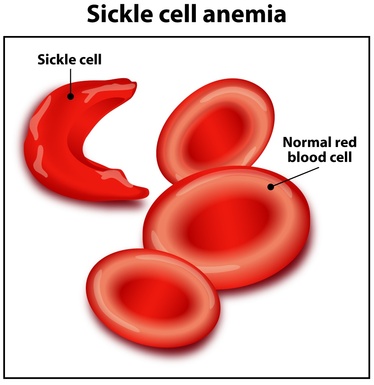
Normally, red blood cells, which carry oxygen throughout the body, are round and smooth. In sickle cell anemia, the red blood cells are sickle-shaped, which causes them to get caught up in smaller blood vessels, sometimes blocking blood flow. The complications of sickle cell anemia are numerous and include pain, infections, gallstones, leg ulcers, priapism in males (sustained and painful erections), pulmonary hypertension and stroke.
LDH is an enzyme found in many cells throughout the body. Red blood cells, the heart, the kidneys, the liver and muscles are especially rich in LDH. Usually, the upper limit of LDH in healthy adults is 200 international units per liter (IU/L). However, when organs become diseased, LDH is released in increasing amounts.
In the new study, the researchers checked the LDH levels of 213 adults with sickle cell anemia. The researchers then separated the results into three categories — low, medium and high LDH.
The low group consisted of 20 people with LDH levels between 121 and 189 IU/L. The medium group was the largest with 162 people with LDH levels between 190 and 511 IU/L, while the high group contained 31 people with LDH levels above 512 IU/L.
The researchers found that low LDH levels conferred the lowest risk of developing leg ulcers, priapism and pulmonary hypertension.
“There was double the risk to the high group compared to the average group and about quadruple the risk from the low group to the high group,” said Kato.
The researchers also collected information on deaths for 49 months after the study began. Nineteen of the study participants died during that time. “Those with the highest LDH levels also have an increased risk of earlier mortality,” said Kato.
He added that the researchers suspect that the early mortality is connected to the higher incidence of pulmonary hypertension in those with high LDH levels.
“If you have sickle cell anemia, you should encourage your doctor to check the levels of LDH in your blood, and propose further testing, like echocardiography, if you have high LDH,” noted Kato. He said that early treatment of pulmonary hypertension might make it easier to control.
“This is an interesting study because LDH is a simple test that we do all the time already,” said hematologist Dr. Jay Brooks, chief of staff at Ochsner Clinic Foundation in Baton Rouge, La.
“It’s a very helpful marker that may let us know early who might get into trouble,” Brooks added.


By subscribing, you consent to receive emails from BlackDoctor.com. You may unsubscribe at any time. Privacy Policy & Terms of Service.