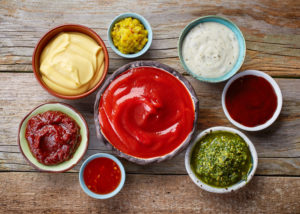
When it comes to food and diabetes, most people think bland and boring. Those little extras like salad dressing, ketchup, mayo, mustard, relish and salsa that make our taste buds dance are mistakenly banned from the diet. It’s true if you’re not careful and using them mindlessly; those little flavor enhancers can bankrupt your calorie, carbohydrate, fat and sodium budgets. The good news is, it doesn’t have to be that way—it’s really a matter of quantity and quality. The following tips will help you put condiments back on your table.
Control portions. Many condiments, when used sparingly, provide so few calories, fat, and carbohydrate, that the American Diabetes Association (ADA) list them as “free food.” According to the ADA, free food is one that contains less than 20 calories or less than 5 grams of carbohydrate per serving. For example, one tablespoon yellow mustard, salsa, horseradish or ketchup is considered free.
Read the label. Reading the ingredient list on the food label is key to finding out what might be lurking in your condiments. Ingredients used in the greatest amounts are listed first, followed by those used in smaller quantities. Added sugar in the form of high fructose corn syrup can be found—often as the first ingredient, in ketchup, honey mustard, sweet relish and many salad dressings. You may also see artificial color in salad dressings, honey mustard, and other condiments. Always refer to the actual package for the most complete and accurate ingredient information.
Go for natural. When you are shopping for condiments, look for natural or organic varieties. Typically, organic condiments don’t have artificial colors or high fructose corn syrup added to them. But, they may have added sugar and be high in fat and sodium. So be sure to read the ingredient list and nutrition facts panel.
Reduce it. To save on fat calories, choose “light,” “reduced-fat,” “low calorie,” or “fat-free salad dressings and mayonnaise. These dressings have up to 5 grams of carbohydrate per tablespoon compared to their regular counterparts with zero carbohydrates. The calorie difference issignificant too. Regular salad dressing has 94 calories per tablespoon compared to just 13 calories in fat-free dressing. Condiments such as soy sauce, teriyaki sauce, chili sauce, and marinades are notoriously high in sodium. Look for the “reduced-sodium” varieties.
Have it your way. When eating out don’t hesitate to make a special request. Ask for condiments such as salad dressing and barbecue sauce on the side. This way you can control how much you use. Cut down on calories, carbs, fat and sodium even more by only using half the portion and adding vinegar to taste. Vinegar is a “free food” you can use in unlimited quantities.
Do it yourself! Save money and worry by making your condiments. Chef Catherine Brown, Organic Grower, Culinary Nutritionist at A Seat at My Table says making your condiments can not only be more economical but also puts you in complete control of the ingredients. “Those you make yourself will be more flavorful and can be tailored to your tastes and dietary needs,” says Chef Brown.
Below is one of Chef Brown’s DIY recipes for salad dressing.
ORANGE GINGER DRESSING
Here’s what you’ll need to make ~1.5 cups
1/2 cup cashews soaked in hot water for 2 hours
2 navel oranges, zested, peeled and cut into chunks
2″ piece of fresh ginger root, peeled
1/3 cup white wine or champagne vinegar
2 Medjool dates soaked in 1/4 cup hot water
1/4 cup fortified nutritional yeast (optional)
Dash of sea salt & ground black pepper (optional)
Chef Brown prefers to use fortified nutritional yeast whenmaking salad dressing. “It’s a good source of B vitamins, including vitamin B12 and it lends some body and flavor to the dressing—although it is not absolutely necessary,” says Chef Brown.
Here’s the Process for the dressing
1. Place cashews in a bowl and pour enough HOT water over them to cover by 1/2″. Set aside for two hours, occasionally stirring to submerge those floating on the surface.
2. Zest the oranges. Cover the zest and refrigerate until needed. Peel the oranges, chop into chunks and put them in your freezer while waiting for the cashews to soak.
3. Remove the seeds from the dates, place in a small bowl and pour 1/4 cup HOT water over them. Set aside.
4. Keep the ginger and vinegar cold until needed.
5. Add the partially frozen orange chunks, 2/3 of the zest, the soaked and drained cashews, the dates AND their soaking liquid, the nutritional yeast, ginger, vinegar, and S&P to your high-speed blender. Blend until completely smooth, scraping down sides if necessary.
This recipe has been tested for deliciousness. But of course, deliciousness is in the taste buds of the beholder. So, taste and adjust seasoning if needed. Chef Brown says the dressing should be slightly thick, creamy and pourable. Refrigerate until needed (can be stored up to 1 week).
One tablespoon of Orange Ginger Dressing without added salt or pepper provides approximately 40 calories, 1.5 g fat, and 7 g carbohydrate. You can thin the dressing with water if necessary, which will not change the nutrition information. For more great recipes follow Chef Brown on social media @aseatatmytable
Bon Appétit!

Constance Brown-Riggs, MSED, RD, CDE, CDN is a registered dietitian, certified diabetes educator, national speaker and author of The African American Guide to Living Well with Diabetes. Her new book “Diabetes Guide to Enjoying Foods of the World” will be released in January 2018. She is a spokesperson for OneTouch.



By subscribing, you consent to receive emails from BlackDoctor.com. You may unsubscribe at any time. Privacy Policy & Terms of Service.