If you’ve ever found yourself lying in a dark room with a migraine, scrolling your phone for relief, you’ve probably come across a daith piercing. Migraines affect over 37 million Americans, and the search for solutions — conventional or unconventional — is constant.
It’s a small cartilage piercing tucked deep inside the ear, often suggested online as a possible remedy for chronic headaches. But does it really work?
Before committing to the needle, it’s important to understand what a daith piercing is, how painful it can be, the healing process, potential risks, and what medical experts actually say about its supposed benefits. Here’s a clear, evidence-based guide to daith piercings and migraines.
A daith piercing passes through the innermost fold of cartilage in the ear, right above the ear canal. It’s deeper and more curved than standard ear piercings like the helix, lobe, or tragus.
A trained piercer should use a curved hollow needle, not a gun, to reduce cartilage trauma.
This kind of piercing can be tricky to place and takes longer to heal because cartilage has less blood flow than soft tissue. Choosing an experienced professional is essential.
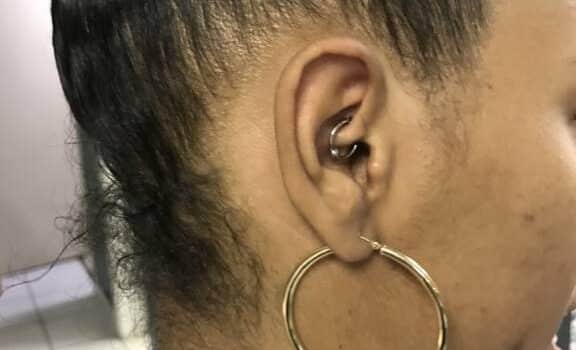
Online buzz often centers on daith piercing for migraines, with some suggesting that it stimulates pressure points or nerves similar to acupuncture. While anecdotal stories are common, experts warn that this is not a medically proven treatment.
Black Doctor spoke with a woman who says she wishes she had gotten her piercing sooner. Read her first-hand story here.
But what does medical science actually say?
Although some individuals report feeling relief after a daith piercing, there is no clinical evidence that it treats or prevents migraines. Major migraine organizations, including the American Migraine Foundation, and headache specialists do not recommend it as a treatment.
The American Migraine Foundation notes that reported improvements are likely placebo effects rather than physiological changes.
Cleveland Clinic headache specialist Emad Estemalik, MD, says, “There’s no medical research to support the theory that a daith piercing helps prevent migraines, and perceived improvement may reflect temporary placebo effects.”
WebMD emphasizes that there’s no proof that this kind of piercing reliably reduces migraine pain and cautions that its placement is not the same as therapeutic acupuncture.
While some people report improvement, daith piercings should not replace evidence-based migraine care.
RELATED: 5 Massages For Common Headaches

Cartilage piercings, like the daith, tend to be more uncomfortable than earlobe piercings.
Many describe a sharp, quick pinch followed by dull soreness.
Healing can be long and slow, lasting several months.
Pain tolerance varies, but many piercers rate daith piercings as moderate to above-average in discomfort.
Tips to reduce discomfort:
Use a professional piercer experienced in cartilage piercings
Avoid aspirin before the appointment
Follow aftercare instructions meticulously
Avoid sleeping on the pierced side during early healing
Healing a daith typically takes 6–12 months. Cartilage heals more slowly than soft tissue, so patience is key. Proper care, avoiding unnecessary touching, and choosing lightweight jewelry can reduce complications.
These piercings usually range from $40 to $100, depending on location, piercer experience, and jewelry type. Prices can be higher in major cities or specialty studios. The cost often includes sterilization and basic aftercare instructions, but check for additional fees for premium jewelry.
Not everyone is a good candidate:
People with immune deficiencies or chronic illnesses
Those with blood-clotting disorders
Individuals prone to keloid or hypertrophic scarring
Anyone unwilling or unable to follow long-term aftercare
Consult a healthcare provider if you have concerns about your health before getting any cartilage piercing.
RELATED: 5 Natural Remedies to Remove Keloids
If your main goal is aesthetic or self-expression, benefits include:
Unique, eye-catching look that works with minimalist or statement jewelry
Fits well into layered ear piercings
Some individuals report feeling more in control of migraine management, even if scientifically unproven
Experts emphasize it should not be considered a migraine treatment.
Legitimate risks include:
Long healing time: several months
Higher infection risk than lobes
Pain, swelling, tenderness
Healing complications such as bumps, scarring, or delayed closure
No guaranteed migraine relief
Daith piercings are generally better suited for body art rather than migraine therapy.
RELATED: Why Do My Body Piercings Stink?
There’s no evidence that either piercing prevents or treats migraines. Experts suggest sticking to proven therapies like medications, trigger avoidance, and lifestyle changes.
Captive bead rings
Horseshoe barbells
Clicker rings (once healed)
Best materials:
Implant-grade titanium
Solid 14k–18k gold
Nickel-free surgical stainless steel
Avoid heavy decorative pieces during healing since they can irritate the piercing.
Clean gently twice a day with saline
Avoid touching or twisting jewelry
Do not sleep on the pierced side initially
Avoid swimming in communal water
Do not change jewelry too early
Seek professional help if redness, swelling, or discharge worsen
A daith piercing is a stylish cartilage piercing, not a proven migraine treatment.
While some report subjective relief, scientific evidence does not support its effectiveness for headaches, and experts recommend evidence-based migraine care first.
If you’re considering it for aesthetics, it can be a bold, stylish addition.
Just go in informed, prepared, and ready to follow aftercare.


By subscribing, you consent to receive emails from BlackDoctor.com. You may unsubscribe at any time. Privacy Policy & Terms of Service.