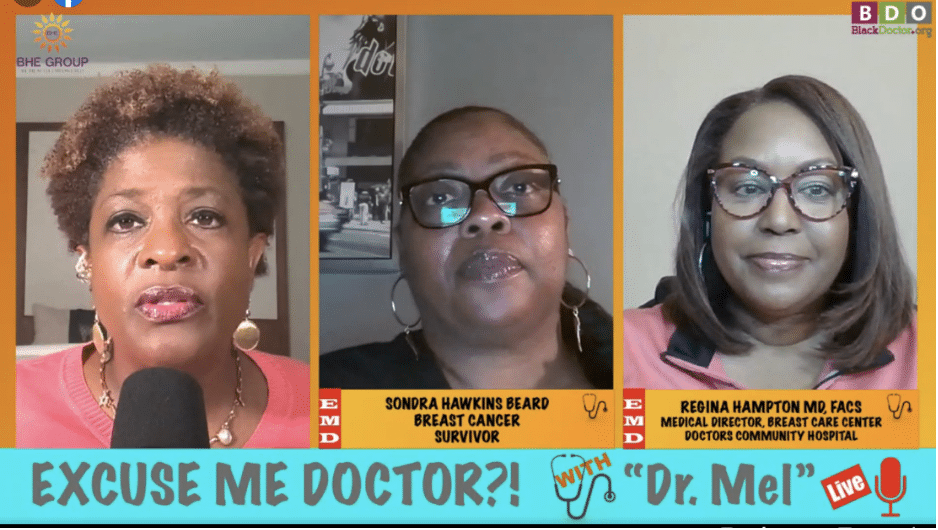
“Breast cancer… after the diagnosis.” Millions of women are diagnosed with breast cancer in the United States and black women are diagnosed at younger ages and with more aggressive forms. But what do you do after you hear that dreaded diagnosis? Join us during our conversation with renowned breast cancer surgeon Dr. Regina Hampton.
What are the statistics on black women and breast cancer? Do black women get breast cancer more than other women or not?
Dr. Hampton: We actually get breast cancer less than our white counterparts. However, our mortality rates or the death rates in black women are higher. It’s about 40% higher when compared to white women. And so those statistics for me have always been troublesome because I think if we get less breast cancer, we should die at lower rates. We have cancers that are actually slightly different. We tend to get breast cancer at younger ages; under the age of 50 when compared to our white counterparts. And we have a different type of breast cancer known as triple-negative breast cancer that seems more commonly in younger black women. That cancer is a more aggressive form of breast cancer. It is often found at a later stage because many times our women can go in, in their thirties, and providers may think you’re too young to have breast cancer.
Why do black women have these more aggressive forms of breast cancer? And at younger ages?
Dr. Hampton: That’s the question that we’re trying to answer. We think there’s some genetics involved. But this leads into what we see across all disease states is there just aren’t enough of us getting involved in clinical trials so that we can find out those answers and find out if maybe there are different medications that work for us. Maybe we need different screening guidelines. I really am a big advocate that we as African Americans and people of color have to get involved in these trials so that we can get the answers for generations to come.
Since black women get breast cancer at earlier ages, what ages should we be getting screened at?
Dr. Hampton: In general everyone should be getting mammograms starting at age 40 and should be getting them every year. However, the American College of Radiology has deemed that black and Jewish women are at a higher risk for breast cancer. And so they are recommending that starting at age 30, black women and Jewish women start getting what we call a risk assessment. What that means is that you go to a doctor, to a breast specialist, talk about family history, talk about breast density, talk about some other risk factors that you may have. And then we may decide that that woman may need to start getting mammograms at age 30, or we may say she needs to start at age 35. And so it’s really doing a personalized assessment and then making a decision there.
Listen to the facebook live and learn more about breast cancer by clicking the link.


By subscribing, you consent to receive emails from BlackDoctor.com. You may unsubscribe at any time. Privacy Policy & Terms of Service.