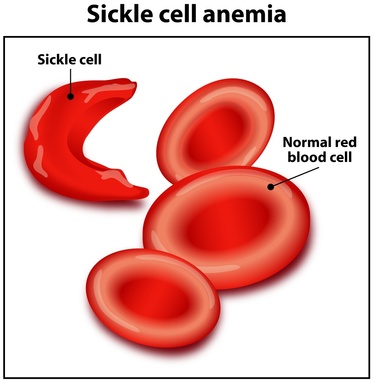
Sickle cell occurs in about 1 in every 500 African-American births. About 2 million Americans, or 1 in 12 African Americans, carry the sickle cell trait.
BlackDoctor.org was honored to host a sickle cell Q&A session featuring Dr. Althea Grant, the CDC’s Chief of the Epidemiology and Surveillance Branch in the Division of Blood Disorders, NCBDDD. The dialogue was both engaging and extremely informative, and we’d like to thank both Dr. Grant and everyone who took the time to ask questions.
Below is a recap of this exciting information session:
Question: Why do so many people with sickle cell have to have so many blood transfusions? Isn’t that unhealthy?
Answer: Transfusions are used for treating some of the complications of sickle cell disease like worsening anemia and are used as a treatment to prevent strokes in patients with sickle cell disease whose medical tests suggest that they are at high risk of having a stroke. Read more…
Question: “If I’m healthy now, can I still contract sickle cell disease or the trait?”
Answer: Sickle cell disease or trait cannot be spread to another person like a cold. Also, sickle cell trait will not become sickle cell disease. You must be born with sickle cell disease or trait. Read more…
Question: I had an aunt that passed from sickle cell complications when I was young, what are the major issues somebody with sickle cell has to worry about to keep healthy?
Answer: The most important thing is to get regular health care, see your doctor regularly, keep a good diet, exercise, and drink plenty of water. For more, see our Living Well Toolkit.
Question: I have the trait, my older son does not, but my younger daughter does. Why did the trait skip?
Answer: If you have trait, there is a 50% chance of passing trait onto your child for each pregnancy. Read more…
Question: I was born with sickle cell trait and was always told there are no symptoms or health concerns. Has that changed?
Answer: CDC Most people with SCT do not have any symptoms of SCD, although — in rare cases — people with SCT might have complications of SCD, such as problems with their spleen, as well as an inability to concentrate urine and, in extreme circumstances, sudden exercise-related death. Read more…
Question: What is the future of funding for sickle cell? We need more money. Given the current limited funding, how can persons receive good healthcare who cannot connect with large sickle cell centers? What can NIH do to educate the masses (doctors, medical staff) so the sickle cell patient can be treated and we can end this role reversal of the patient educating the doctor. I want doctors who can tell me something rather than doctors I can only scrutinize due to their lack of knowledge of my disease.
Answer: You’re right, there are too few qualified providers for people with sickle cell disease and so patients often have to come to the emergency room for care. But there are certain cities with day clinics and 24-hour clinics to help these patients. Unfortunately it’s not everywhere. NIH is currently developing guidelines for healthcare providers to help them better serve people with SCD. These are expected to be distributed in 2013. Read more…
Part of the goal with the NIH guidelines that are currently being developed is to educate more providers including primary care physicians. This will increase the pool of providers trained to give care to people with Sickle Cell disease. We are not certain of what the future holds for funding of sickle cell research.
Question: On a recent ER visit I found I was slightly anemic. My baseline hemoglobin is 12 but it was 11.3. The e.r. doctor did not know the cause. He suggested iron. That didn’t sound right to me being postmenopausal. In point of fact with my earlier comment regarding knowlegeable doctors, my hemotologist told me of my anemia a few weeks ago but did not schedule a follow up, in fact before doing the bloodwork, told me he didn’t need to see me for one year and because I have the trait (although I have the disease). So what about the iron issue?
Answer: There are many causes of anemia that are unrelated to sickle cell. You should consult your doctor, but also join us this Thursday for a Twitter chat with March of Dimes about blood disorders and carrier status.
Lastly, the disease itself remains the same as you age, but some conditions that come with the disease can change. For example, pain may become chronic instead of happening once in a while.
Question: “I heard sickle cell patients have a higher amount of iron in their blood. How can that affect you and what can be done about it?”
Answer: No, it is not the same for people with sickle cell trait.
Question: “What is the main difference between sickle cell in blacks and other races? Does it hurt us more?”
Answer: While sickle cell disease mainly affects African-Americans in the US, the effects of the disease can be the same for all people that have it. The gene that that causes sickle cell disease came from places where malaria was common, so it actually has nothing to do with skin color. Read more…
Also, there are 2 additional haplotypes and one is Arab-Indian. In fact there are parts of India with sickle cell rates as high as Africa, while there are some parts of Africa that have very little sickle cell disease.
Question: “Can people with sickle cell be a blood donor or organ donor?”
Answer: People with sickle cell trait can give blood, but those with sickle cell disease cannot. Get the most up-to-date information at the American Red Cross blood center nearest you. People with sickle cell disease and…
… the sickle cell trait can donate organs on a case-by-case basis. Discuss this with your doctor. Read more…
Althea Grant, PhD, is the CDC’s Chief of the Epidemiology and Surveillance Branch in the Division of Blood Disorders of the National Center on Birth Defects and Developmental Disabilities. Dr. Grant has specifically been recognized for her contribution to developing public health programs and resources for sickle cell disease and sickle cell trait. She also serves as CDC’s Project Director for the RuSH program, the first population-based public health surveillance system for sickle cell disease and thalassemia.
Dr. Grant has received a Commendation Medal from the US Public Health Service in recognition for developing programs to improve the health of individuals affected by sickle cell disease.


By subscribing, you consent to receive emails from BlackDoctor.com. You may unsubscribe at any time. Privacy Policy & Terms of Service.