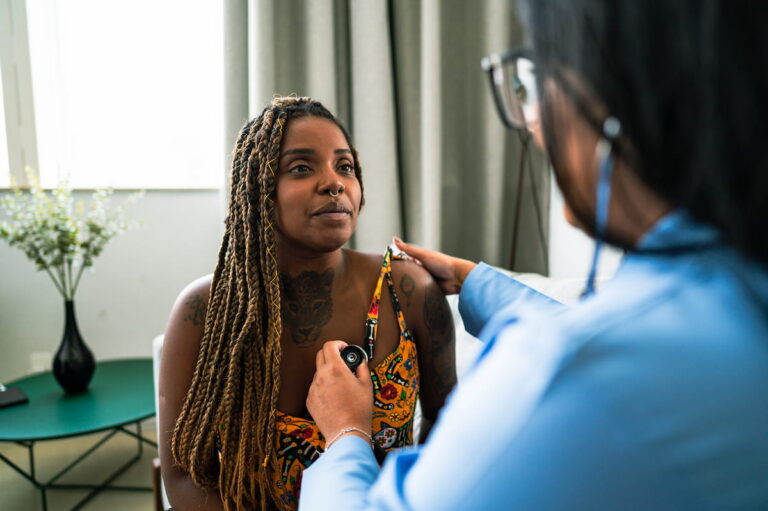
Arm and shoulder pain are common for women after breast cancer surgery, but exercising soon afterward can go a long way to easing the discomfort, new research suggests.
Restricted shoulder movement and chronic pain or swelling in the armpit area can really impact a patient’s recovery and quality of life.
However, “we found robust evidence that early, structured, progressive exercise is safe and clinically effective for women at higher risk of developing shoulder and upper limb problems after non-reconstructive breast surgery,” the team led by Julie Bruce shares.
“Exercise is a valid rehabilitative measure, as well as a safe and effective tool to empower cancer patients to thrive in their recovery,” Dr. Paul Baron, chief of breast surgery at Lenox Hill Hospital in New York City adds.
Exercise And Breast Cancer: Here are 7 exercises to try after having breast cancer surgery:
This exercise will help increase the movement in the front of your chest and shoulder. You should do this exercise on the bed or floor, but keep in mind that it may take several weeks of regular exercise before your elbows are able to get close to the bed or floor.
Steps
Lie on your back with your knees bent and your feet flat.
Clasp your hands behind your neck with your elbows pointing toward the ceiling.
Move your elbows apart and down toward the bed or floor.
Sit in a chair very close to a table with your back against the back of the chair.
Place the unaffected arm on the table with your elbow bent and palm down. Do not move this arm during the exercise.
Place the affected arm on the table, palm down, with your elbow straight.
Without moving your trunk, slide the affected arm forward, toward the opposite side of the table. You should feel your shoulder blade move as you do this.
This is another shoulder blade exercise that can increase movement and posture.
Steps
Sit in a chair in front of a mirror. Face straight ahead. Do not rest against the back of the chair.
Your arms should be at your sides with your elbows bent.
Squeeze your shoulder blades together, bringing your elbows behind you toward your spine. Elbows will move with you, but don’t force the motion with your elbows. Keep your shoulders level as you do this. Do not lift your shoulders up toward your ears.
Return to the starting position and repeat 5 to 7 times.
This exercise is perfect for increasing the movement of your trunk and body.
Sit in a chair and clasp your hands together in front of you. Lift your arms slowly over your head, straightening your arms.
When your arms are over your head, bend your trunk to the right keeping your arms overhead.
Return to the starting position and bend to the left.
Repeat 5 to 7 times.
6. Chest wall stretch
If you are experiencing pain and your chest, this exercise may be able to provide you with some relief.
Steps
Stand facing a corner with your toes about 8 to 10 inches from the corner.
Bend your elbows and put your forearms on the wall, one on each side of the corner. Your elbows should be as close to shoulder height as possible.
Keep your arms and feet in place and move your chest toward the corner. You will feel a stretch across your chest and shoulders.
Return to the starting position and repeat 5 to 7 times.
The picture shows stretching both sides at the same time, but you may find it more comfortable to stretch one arm at a time.
Be sure you keep your shoulders dropped far away from your ears as you do this stretch. Keep your ears over your shoulders to avoid making your neck sore.
This exercise will help increase mobility in your shoulder.
Stand facing the wall with your toes about 8 to 10 inches from the wall.
Put your hands on the wall. Use your fingers to “climb the wall,” reaching as high as you can until you feel a stretch.
Return to the starting position and repeat 5 to 7 times.
You might find it easier to raise one arm at a time.
Be sure you keep your shoulders dropped far away from your ears as you raise your arms. Keep your ears over your shoulders to avoid making your neck sore.
Before you start any of these exercises, you should consult with your doctor first about which exercises may be right for you. Once you start exercising, remember to start off slowly and only increase your exercises when you are able.
If you experience any of the following as a result of exercising, you should stop and contact your doctor, as noted by the American Cancer Society:
BlackDoctor is the world’s largest and most comprehensive online health resource specifically for the Black community. BlackDoctor understands that the uniqueness of Black culture - our heritage and our traditions - plays a role in our health. BlackDoctor gives you access to innovative new approaches to the health information you need in everyday language so you can break through the disparities, gain control and live your life to its fullest.
✦ AI Search Disclaimer This AI-powered search tool helps you find relevant health articles from the BlackDoctor.org archive. Please keep the following in mind:
✦ For Informational Purposes Only The information provided through this AI search is for general educational and informational purposes only. It is not intended as a substitute for professional medical advice, diagnosis, or treatment.
✦ Always Consult a Healthcare Provider Never disregard professional medical advice or delay seeking it because of something you have read through this search tool. If you have a medical emergency, call your doctor or 911 immediately.
✦ AI Limitations This search tool uses artificial intelligence to help match your queries with articles in our archive. While we strive for accuracy, AI-generated results may occasionally be incomplete, outdated, or not fully relevant to your specific situation.
✦ No Doctor-Patient Relationship Using this search tool does not create a doctor-patient relationship between you and BlackDoctor.org or any healthcare provider.
Explore over 35,000 articles and videos across black health, wellness, lifestyle and culture