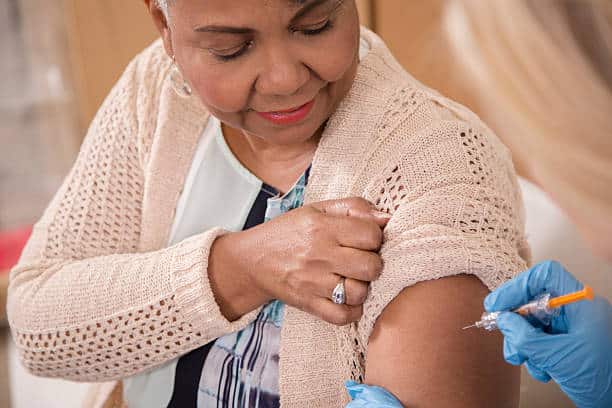
In a unanimous vote, the U.S. Food and Drug Administration’s vaccine advisory panel on Friday recommended that the agency grant emergency use of booster shots of Johnson & Johnson’s coronavirus vaccine.
The FDA is expected to make a decision within days that will help guide the 15 million Americans who have received the Johnson & Johnson vaccine, many of whom have felt left out of the booster shot debate. Friday’s vote recommends the J&J booster shot for anyone 18 and older, to be given at least two months after the first dose, The New York Times reports.
RELATED: ‘Mix and Match’? Study Supports Following J&J Vaccine With Pfizer, Moderna
Dr. Peter Marks, head of the FDA’s Center for Biologics Evaluation and Research, said during the meeting that the agency may at some point consider allowing Johnson & Johnson vaccine recipients to get a booster shot of the Moderna or Pfizer COVID-19 vaccines. Preliminary research published by the U.S. National Institutes of Health (NIH) this week found that booster shots of the Moderna and Pfizer vaccines provided a far greater boost to immunity than a J&J booster did.
Moderna won emergency use authorization for its booster shot from the advisory panel on Thursday, though the booster will actually be a half-dose of the original vaccine.
During the advisory panel’s Friday meeting, Johnson & Johnson officials argued that a second dose given either two months or six months after the first shot increased antibody levels, part of the immune response to vaccines. They also said that the single dose of the vaccine remained durable.
But FDA officials repeatedly pointed out flaws in the company’s data. They warned that the two-month booster trial only followed up with study volunteers for a short period of time after their second shot. They also note that a key test used by the company to measure the antibodies produced by a booster shot had a low sensitivity, so the results could not be completely trusted.
Federal regulators did not see any evidence of serious safety concerns in the booster trial, but they note that they didn’t have enough time to independently review much of the data that Johnson & Johnson provided in its application for authorization, according to the Times. That data included a trial looking at a second shot after six months, not two.
“The vote was not surprising, but it is interesting that there was some debate about the interval for boosting: two months [which is a de-facto two-dose vaccine] versus the six months that was asked for by J&J,” Dr. Amesh Adalja, a senior scholar with Johns Hopkins Center for Health Security, in Baltimore says. “There is some evidence that the J&J vaccine might be better as a two-dose vaccine and as vaccines are
improved, it will be important to look at all the data and options in order to optimize the vaccines that are available.”
An advisory committee to the U.S. Centers for Disease Control and Prevention plans to meet next Wednesday and Thursday to make recommendations on how the booster doses should be used. Some federal officials seemed dubious about the company’s claim about the efficacy of one dose.
Panel members expressed concern about the size of the study Johnson & Johnson used to ask for authorization of a six-month interval. “I’m not sure why you’re asking for an indication that would apply to millions of patients with a data set that includes 17 patients,” Dr. Eric Rubin, an adjunct professor of immunology and infectious diseases at the Harvard T.H. Chan School of Public Health in Boston says.
The panel will also hear from a scientist who helped lead the NIH study that found Johnson & Johnson vaccine recipients may benefit more from a booster of the Moderna or Pfizer-BioNTech vaccine.
RELATED: FDA Panel Supports Moderna Booster Shot for Older Adults, People at High Risk
Preliminary data from the “mix and match” study showed that those who got a Johnson & Johnson shot followed by a Moderna booster saw their antibody levels rise 76-fold within 15 days, while those who received another dose of Johnson & Johnson saw only a fourfold rise in the same period. A Pfizer booster raised antibody levels in Johnson & Johnson recipients 35-fold.
The trial only looked at antibody levels, which are only one component of the immune system.
Dr. Johan Van Hoof, a Johnson & Johnson executive, referred to that NIH data during the panel meeting, saying, “These findings are important, but only a piece of the puzzle, and they don’t give the complete picture.”
Even so, some experts said the evidence was still pointing to switching vaccines for booster shots.
“Prior to, I don’t know, November or December of 2019, the human species are immunologically naive to this virus. But any single-shot vaccine was likely to induce a primary response and the second shot would be necessary,” James E.K. Hildreth, president of Meharry Medical College, in Nashville, Tennessee says. It was always going to be necessary for J&J recipients to get a second shot.”


By subscribing, you consent to receive emails from BlackDoctor.com. You may unsubscribe at any time. Privacy Policy & Terms of Service.