
Changing the way you walk could offer relief from knee arthritis on par with common painkillers, clinical trial results show. Gait retraining involves making a small adjustment to the angle of your foot — a minor change that can yield major benefits, researchers wrote in The Lancet Rheumatology.
People who underwent this training experienced pain relief akin to that from either over-the-counter or opioid painkillers, researchers found. The gait retraining also led to less deterioration of knee cartilage, slowing the progression of participants’ arthritis, results showed.
“Especially for people in their 30s, 40s or 50s, osteoarthritis could mean decades of pain management before they’re recommended for a joint replacement,” lead researcher Scott Uhrlich, director of the Movement Bioengineering Laboratory at the University of Utah, said in a news release. “This intervention could help fill that large treatment gap.”
For the new study, researchers randomly assigned 34 people with knee arthritis to undergo gait retraining, and 34 others to take “sham” training that didn’t actually change their natural gait.
All participants had mild-to-moderate arthritis in the inside of their knee joint, which tends to bear more weight than the outside, researchers said.
This is the most common form of knee arthritis, but the ideal foot angle for reducing load on that part of the knee differs from person to person.
“We used a personalized approach to selecting each individual’s new walking pattern, which improved how much individuals could offload their knee and likely contributed to the positive effect on pain and cartilage that we saw,” Uhrlich said.
In their first two visits, participants underwent MRI scans and walked on a treadmill while motion-capture cameras recorded their gait.
This gave researchers the data they needed to calculate whether turning the patient’s toe inward or outward would reduce load more, as well as the most useful degree of adjustment.
The personalized analysis also allowed researchers to screen out participants who wouldn’t benefit from gait training.
After this initial analysis, participants returned to the lab for six weekly gait training sessions. Half were provided training intended to help their knees by changing their gait, and the other half were provided placebo training that replicated their natural gait.
A year later, researchers reached out to participants to evaluate their knee health. The patients also underwent a second MRI to assess their knee structure.
“The reported decrease in pain over the placebo group was somewhere between what you’d expect from an over-the-counter medication, like ibuprofen, and a narcotic, like OxyContin,” Uhlrich said. “With the MRIs, we also saw slower degradation of a marker of cartilage health in the intervention group, which was quite exciting.”
However, this program will need to be streamlined before it can be widely deployed, researchers said. The motion-capture gait assessment is time-consuming and expensive.
The team hopes the training eventually could be performed in a physical therapy clinic, with people practicing what they’ve learned while walking around their neighborhood.
“We and others have developed technology that could be used to both personalize and deliver this intervention in a clinical setting using mobile sensors, like smartphone video and a ‘smart shoe,'” Uhlrich said.
RELATED: A New Clinical Trial Shows Mixing Cannabis and Opioids for Knee Arthritis May Not Work as Expected
Knee osteoarthritis can be particularly burdensome for Black adults. Research has found that Black adults with knee osteoarthritis can experience greater pain, disability, and lower quality of life than white adults. The reasons are complex and can include differences in access to care, physical activity opportunities, socioeconomic factors, and how pain and symptoms are assessed.
For Black patients living with knee osteoarthritis, finding treatments that improve mobility without immediately turning to surgery could be especially meaningful.
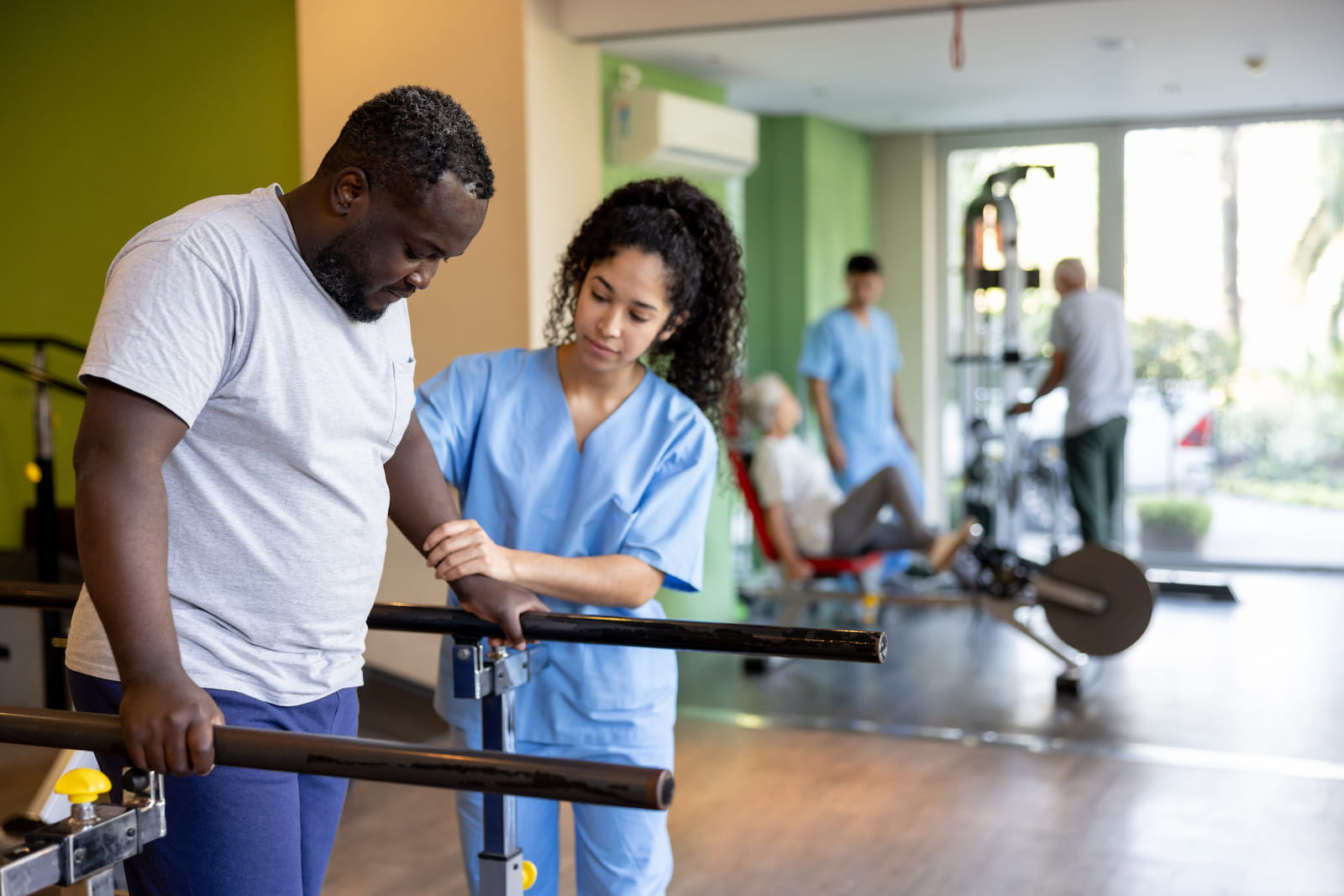
Gait training isn’t simply “learning how to walk again.” It involves changing aspects of how you walk to possibly reduce stress on your knee. While the study’s results are promising for treating knee osteoarthritis, it’s not something you should replicate on your own without a healthcare provider’s or physical therapist’s guidance. They can assess your walking mechanics and determine whether gait modification is appropriate. Additionally, gait training should be seen as a possible nonsurgical strategy, not a replacement for more established treatments.
RELATED: 9 Ways to Make Your Knees Young Again
Clinical trials need diverse participants to reflect the people who will ultimately use the treatment. Historically, Black patients have faced disparities in knee replacement and other aspects of osteoarthritis care. For example, research has identified racial disparities in physical therapy utilization after knee replacement.
When researchers can study interventions, such as gait training, across diverse populations, it can help them understand whether an approach works similarly across different patient groups. Representation in medical research matters not only for medications, but also for physical therapy, rehabilitation, devices, digital health tools, and other non-drug interventions.
Increasing Black participation in clinical trials can give researchers better insight into how certain medications and interventions may affect Black patients differently. However, trust, access, and knowledge of open trials are needed to increase awareness and greater participation.
If you’re interested in learning more about clinical trials, visit BlackDoctor’s Clinical Trials Resource Center.
More information
Johns Hopkins Medicine has more on knee arthritis.
SOURCES: University of Utah, news release, Aug. 12, 2025; The Lancet Rheumatology, Aug. 12, 2025


By subscribing, you consent to receive emails from BlackDoctor.com. You may unsubscribe at any time. Privacy Policy & Terms of Service.