“The message here is that you need to take care of yourself at an early age,” Delgado-Lelievre concludes. “You need to be aware of risk factors. You need to be talking to your doctor about your family history. Don’t wait until you’re 50 to do that.”


It’s been a long-time misconception that heart disease was a man’s disease, often causing women to be left out of clinical trials. But the fact of the matter is that heart disease is the number one killer of American women, causing about one in every five deaths, according to the Centers for Disease Control and Prevention. What’s more, the statistics are even more unsettling for Black women, according to the American Heart Association:
Despite the fact that more women die of heart disease than all forms of cancer combined, an online study of 300 randomly selected physicians (mostly primary care and obstetricians/gynecologists) found that these doctors were less attentive to women’s risk factors for both heart and cardiovascular conditions.
“Part of the problem is that it [cardiovascular disease] goes undiagnosed more in women,” says Dr. Mistyann-Blue Miller, an interventional cardiologist with Cleveland Clinic Florida in Weston. “They don’t present with the expected symptoms, and it’s not uncommon for those symptoms to be attributed to something else.”
The fact is that women often have different symptoms from men. Men tend to suffer pain or pressure in the chest during a heart attack, while women may experience dizziness, nausea, fatigue and shortness of breath. This often results in women getting a late diagnosis and/or suffering devastating consequences.
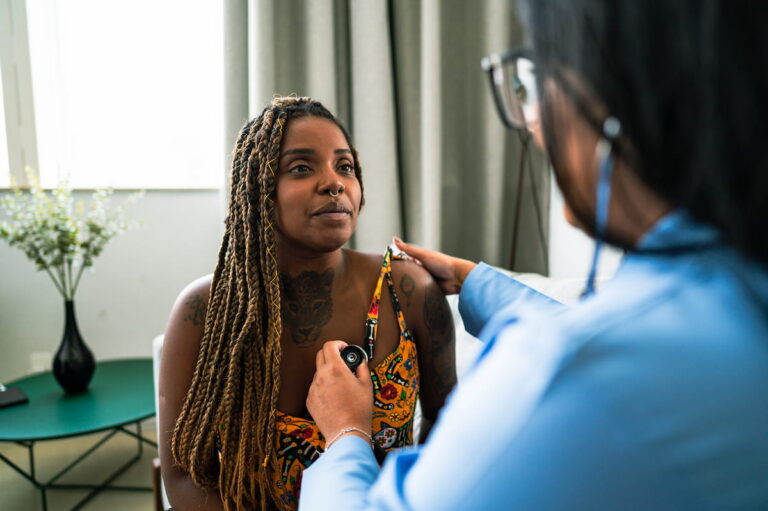
Dr. Marie Delgado-Lelievre, a cardiologist at the University of Miami Miller School of Medicine, remembers a time when this happened to one of her patients. The woman, who was in her 50s, came in to get her high blood pressure, which seemed to be her only symptom, checked. However, the consultation revealed that she was also suffering from shortness of breath and occasional chest pains.
Dr. Delgado-Lelievre ordered a stress test and cardiac catheterization procedure, which determined that the patient needed open-heart surgery.
“This happens more frequently than we think,” she shares.
RELATED: What’s the Best Diet for Preventing Heart Disease?
Cardiologists note that time is crucial when dealing with a heart attack or stroke and are urging women — and their physicians — to act quickly at the first warning sign of cardiovascular disease. Getting the appropriate care as soon as possible can prevent further damage.
The problem, however, is that many women put their own health on the back burner or may shrug off the symptoms. “Some women patients neglect their own health,” says Dr. Andrea Vitello, a cardiologist at Baptist Health’s Miami Cardiac & Vascular Institute. “They’re always doing for others.”
This is precisely why Dr. Vitello and her colleagues are keen on educating women and their physicians on the risk factors, how to prevent cardiovascular disease and how to get proper treatment.
This is a condition in which plaque blocks the arteries in your heart, leading to the narrowing of those heart vessels and diminishing the blood flow the heart needs. CAD can weaken the heart muscle over time, leading to heart failure. Although CAD has a strong genetic component, many young women with a family history of it are unaware of how dangerous it can be.
“They’re not aware they have certain risk factors,” says Dr. Lucia Blanchard, a cardiologist with Broward Health. “So, they can’t take the steps early on to limit the damage.”
Another challenge women face is that even if they control their risk factors and other health outcomes, they still fare worse than men. For example, women with diabetes fare worse than men who have already had a heart attack and female smokers are more likely to have a heart attack than men who smoke.
Additionally, menopause and age also affect women’s heart health. After 55, women have an increased risk of developing heart disease.
RELATED: The ABC’s of Heart Disease
For younger women, high blood pressure during pregnancy can be problematic, even fatal. A study found that the number of mothers who died of high blood pressure during pregnancy increased by up to 15-fold between 1979 and 2018. According to researchers, about 75 percent of these maternal deaths were preventable.
Even those who survive gestational hypertension aren’t in the woods. These women are at risk of having serious heart issues later in life. In fact, some women have developed chronic hypertension as early as three years after pregnancy.
High blood pressure, in general, is especially dangerous because people who suffer from it don’t always display obvious symptoms. It is one of the most common risk factors for heart disease, however, only 1 in 4 women with hypertension are adequately treated, according to studies.


By subscribing, you consent to receive emails from BlackDoctor.com. You may unsubscribe at any time. Privacy Policy & Terms of Service.