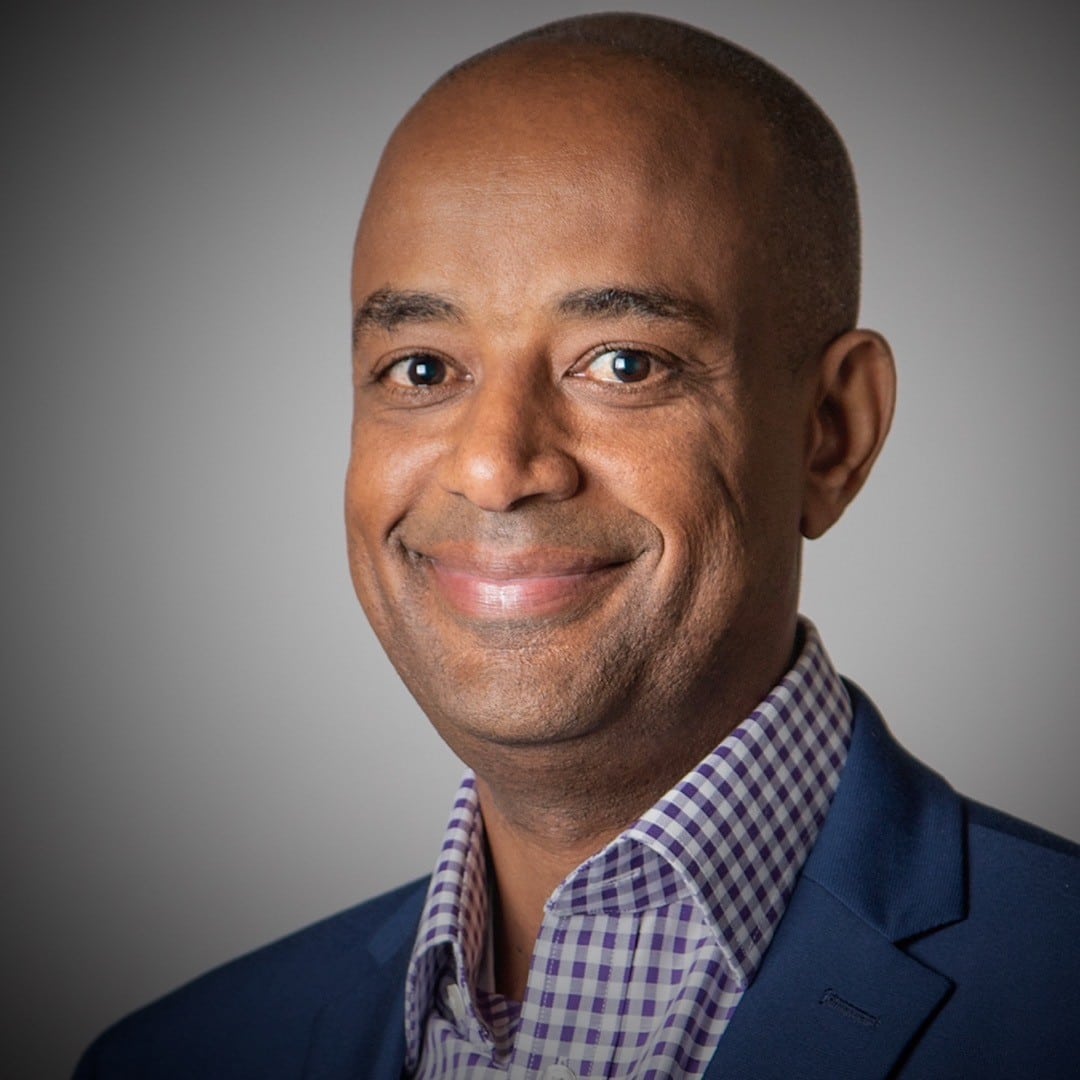
Despite representing only about 14 percent of the U.S. population, Black individuals account for nearly 20 percent of multiple myeloma cases, according to the International Multiple Myeloma Foundation. They are not only twice as likely to be diagnosed with the disease compared to White patients, but they are also diagnosed at younger ages and have lower survival rates.
Yelak Biru, who was diagnosed at 25 in 1995, is one of those individuals. A graduate student with persistent symptoms and no answers, he ended up in the emergency room thinking he had pneumonia.
“I had a bad cough that wouldn’t go away. I ended up going to the emergency room because I assumed I had pneumonia,” Biru tells BlackDoctor.org. “My cough had been going on for a few months. They ran a bunch of tests and said, ‘You don’t have pneumonia, but you are severely anemic.’”
Instead, he left with a diagnosis of multiple myeloma, a rare blood cancer, and a prognosis of just a few years to live.
“He called me at the place where I was doing an internship and said, ‘Hey, come to my office. We’ll discuss this.’ He told me, ‘You have multiple myeloma. It’s highly treatable, but not curable. And here’s what the course of treatment looks like,’” Biru recalls of the initial conversation with his doctor.
Nearly 30 years later, Biru is not just surviving—he’s leading, innovating, and inspiring a new era in cancer care.
Multiple myeloma disproportionately affects older Black adults, but Biru’s case was both early and aggressive.
“This was before Google, before social media—so you couldn’t just go on Facebook or Twitter to look things up. So for myself and my family, it was a mix of fear and uncertainty… Once I found out that this cancer affects elderly Black people twice as much as their white counterparts, there was this—what I call ‘turbo determination’—to fight. Almost a kind of happiness that it was me and not my father who had multiple myeloma.”
The treatments available in 1995 were limited to high-dose chemotherapy and stem cell transplants—brutal, broad, and barely effective.
“The only available treatment was what they called high-dose chemotherapy. It was really tough. It killed all your cells—including your healthy ones—with the hope that your healthy cells would come back, but the cancer cells would not,” Biru shares. “It wasn’t until around 2000 or 2003 that novel treatments started becoming available—treatments that specifically targeted multiple myeloma cells.”
For over two decades, Biru cycled through emerging therapies—novel agents, combination regimens, and targeted drugs—each one buying time.
Then, in 2022, after another relapse, Biru and his specialist at the Mayo Clinic decided to try CAR T-cell therapy. He underwent CARVYKTI® (cilta-cel)—a groundbreaking approach that engineers a patient’s own immune cells to kill the cancer.
CAR T didn’t just work. It changed everything.
“These newer treatments found ways to attach themselves directly to the cancer cells and kill them, while leaving other cells relatively unharmed. That was a huge breakthrough,” Biru says. “The way CAR T works is: they take your blood out through an IV, spin it to isolate your T-cells, then send those T-cells to a lab where they are genetically re-engineered. Then they reinfuse them back into your body—now ‘trained’ to recognize and kill your myeloma cells.”
These more intelligent T-cells are then able to find and destroy the cancer.
“I went through that process in November 2022, and I’ve been cancer-free, treatment-free, and enjoying a long remission ever since,” Biru adds. “It’s another example of how CAR T therapy has been a game changer—something I hadn’t experienced with any of the earlier therapies.”

Biru is often asked the secret to living this long with multiple myeloma. His answer isn’t a supplement or a secret diet—it’s a strategy.
“As a patient, I had to take ownership of my disease,” he says. “If it wasn’t me, someone in my family had to. You build your survival team—myeloma specialists, caregivers, experts. You manage the cancer and everything else that comes with living longer—cholesterol, heart health, emotional wellbeing.”
This approach is grounded in three principles:
Throughout his journey, patient communities have been Biru’s emotional infrastructure. From support groups in Texas to initiatives like the Iceland Cycling Expedition, Biru stays plugged in—learning from and giving back to others.
“Nobody should travel the cancer journey alone,” he says. “Support groups—online or in person—give us the playbook for surviving. Even in remission, I keep going. I learn what I’ll need if the cancer comes back…”
As the African proverb says, “If you want to go fast, go alone. If you want to go far, go together.”
As the former CEO of the International Myeloma Foundation (IMF), Biru was also instrumental in launching the IMF’s AI chatbot, Myelo™.
“The idea behind the Myeloma AI chatbot came from recognizing the amount of friction patients face when they’re initially diagnosed and begin navigating their myeloma journey. That friction can come from not knowing enough about their disease, not knowing where to find support groups, how to engage with key opinion leaders or their own doctors, or understanding what clinical trials are available,” he shares.
“This concept of ‘meeting the patient where they are’—which is common in the retail and CPG worlds—was missing in the world of myeloma care. My vision with the Myeloma AI chatbot was to give patients a personalized experience, similar to what they get when they use Google or shop on Amazon—something that feels like it was built just for them,” Biru adds.
Biru also co-authored a new educational guide, which debuted at the 2025 ASCO (American Society of Clinical Oncology) Annual Meeting, aimed at addressing racial and systemic disparities in clinical trials.
“For example, African Americans are significantly more likely to be diagnosed with multiple myeloma, and by 2034, one in four myeloma patients will be African American. But today, their representation in clinical trials is among the lowest we’ve seen,” Biru notes.
“This guidebook is about ensuring we look at clinical trial participation from multiple perspectives: through the eyes of the patient, the community physicians—who diagnose and treat around 60 percent of myeloma patients—the industry, which brings drugs to market, the clinicians who manage patients day to day, and the eyes of Key Opinion Leaders (KOLs) in multiple myeloma.”
To increase participation, Biru participated in the CAR-T Vision Steering Committee, where he co-authored the first CAR-T Vision report. According to Biru, the vision is that “Every eligible patient should get the opportunity for a cure with CAR T-cell therapy. By 2030, we aim to double the proportion of eligible patients treated with CAR T-cell therapy.”
Despite the promise of CAR T and other cutting-edge therapies, Biru warns of deep inequities.
“Therapies are becoming more effective—but they’re not reaching everyone,” he says. “Black patients are less likely to access CAR T therapy. There’s bias in how care is distributed.”
These therapies often require proximity to academic medical centers, complex logistics, and full-time caregivers—barriers that disproportionately affect underserved populations.
“Innovation means nothing if it’s not accessible,” he says.
Biru is optimistic—but realistic—about what’s next.
“This is the best time in history to be diagnosed with multiple myeloma,” he says. “That sounds strange, but it’s true. We have options now. We have hope.”
He urges patients to live fully, even in uncertainty.
“My message is this: while avoiding death, don’t forget to live,” he says. “Don’t just live with myeloma—live in spite of myeloma.”
Biru encourages young doctors and researchers to consider specializing in myeloma.
“This field is moving fast. If you want to stand on the shoulders of giants and push science forward, this is where you want to be,” he says.
Biru credits his survival to treatment advances—but also to trust in his medical team.
“There are now over 15 drugs available,” he says. “When guidelines fall short, I rely on my doctor’s judgment—and his willingness to seek other opinions when needed.”
That, he says, is where the art and science of medicine meet. And for patients like him, it’s where life begins again.

By subscribing, you consent to receive emails from BlackDoctor.com. You may unsubscribe at any time. Privacy Policy & Terms of Service.