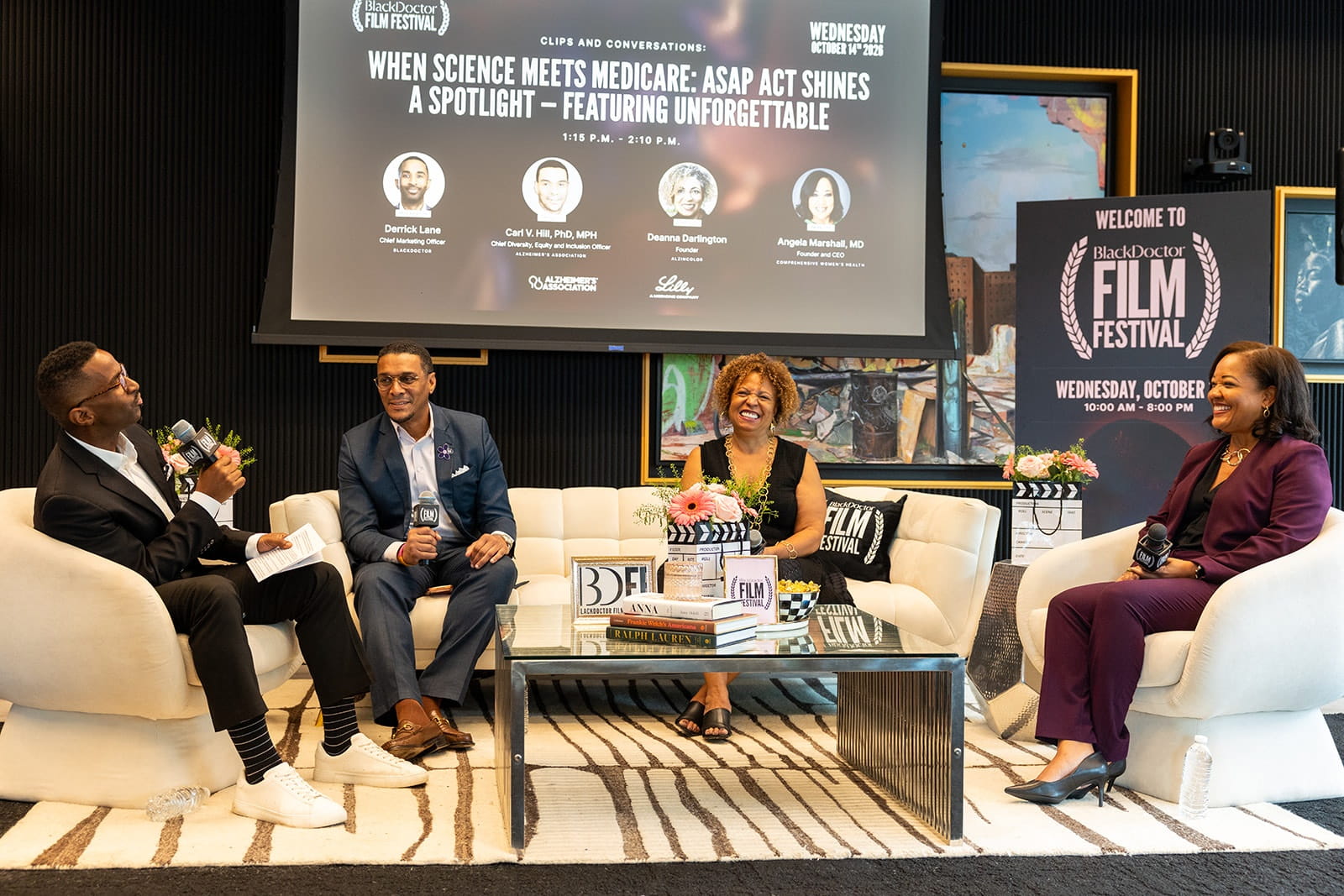
The science behind catching Alzheimer’s earlier is moving fast, and the panelists urged that Medicare policy in the United States can – and should — move with it.
The BlackDoctor Film Festival put a spotlight on the bipartisan Alzheimer’s Screening and Prevention (ASAP) Act. This is legislation is designed to help ensure Medicare can keep pace with blood-based Alzheimer’s tests.
Watch the “When Medicine Meets Medicare ASAP ACT Shines a Spotlight” Conversation here!
The ASAP Act, which has strong bipartisan support, would create a clear Medicare pathway for FDA-cleared blood tests that detect the disease earlier.
The urgency is the greatest in Black communities. Older Black Americans are about twice as likely as older white Americans to have Alzheimer’s or another dementia, yet they are reportedly also more likely to have warning signs missed or a diagnosis delayed. Blood tests could offer a lower-cost tool that reaches people across geographic and socioeconomic lines.
The bill has already cleared the House Ways & Means Committee with a unanimous bipartisan. The question now is: will Congress seize the opportunity this season and ensure policy keeps pace with the science?
It would open a Medicare pathway for FDA-cleared blood tests that detect Alzheimer’s early. It could bring diagnosis into primary care offices for Black families. The ASAP Act would authorize the Secretary of Health and Human Services to give Medicare beneficiaries access to these tests as detection tools, cutting the bureaucratic delays of waiting on the Centers for Medicare & Medicaid Services’ standard review.
The BlackDoctor Film Festival brought that question to the forefront along with a conversation that earlier detection shouldn’t have to wait for Medicare policy to catch up.
Nearly 7 million Americans are living with Alzheimer’s today, a number projected to reach 13.8 million by 2060. Meanwhile, new FDA cleared blood-based diagnostics and FDA approved disease-modifying therapies are creating an unprecedented opportunity to identify and address the disease earlier. The urgency is especially acute in Black communities: older Black Americans are about twice as likely as older White Americans to have Alzheimer’s or another dementia, yet evidence shows they are also more likely to experience missed detection signs or delayed diagnoses.
Earlier detection means earlier access to information needed to plan for support and care.
Blood tests have the potential to provide an important tool at lower costs, across geographic and socioeconomic backgrounds.
Alzheimer’s Disease was the main topic of Unforgettable, a film by Garrett Davis produced with the Alzheimer’s Association. The film portrays a Black family’s struggle with the reality that their beloved matriarch has Alzheimer’s Disease.
“Man, that brought back so many memories of my personal experience with Alzheimer’s,” Derrick Lane, BlackDoctor’s Chief Marketing Officer said, before explaining that his grandfather succumbed to the disease.
The conversation that followed was just one of the many “Clips and Conversations” discussions held at the 2026 BlackDoctor Film Festival in Washington, DC. on Oct. 14. The inaugural event brought healthcare and medical experts, physicians, patient advocates, filmmakers, students, and policy makers together for a day filled with screenings, compelling conversations, and the awarding of prizes to the top filmmakers of the 31 health, medical, and equity-themed shorts, features, animation, and documentaries — both in-person and online — that were selected.
(Watch the BDFF films online through Nov. 14 here.)
It didn’t take long for the conversation to expand beyond the film though and towards the new FDA-cleared blood tests to identify the disease and pending Medicare legislation, called the ASAP Act.
An expert-filled panel joined Lane for “When Science Meets Medicare: The ASAP ACT Shines a Spotlight – Featuring Unforgettable,” presented by the Alzheimer’s Association and Lilly. The panelists included: Dr. Carl V. Hill, PhD, MPH, Chief Diversity, Equity and Inclusion Officer, Alzheimer’s Association; Deanna Darlington, Founder, AlzInColor; and Dr. Angela Marshall, Founder and CEO, Comprehensive Women’s Health.
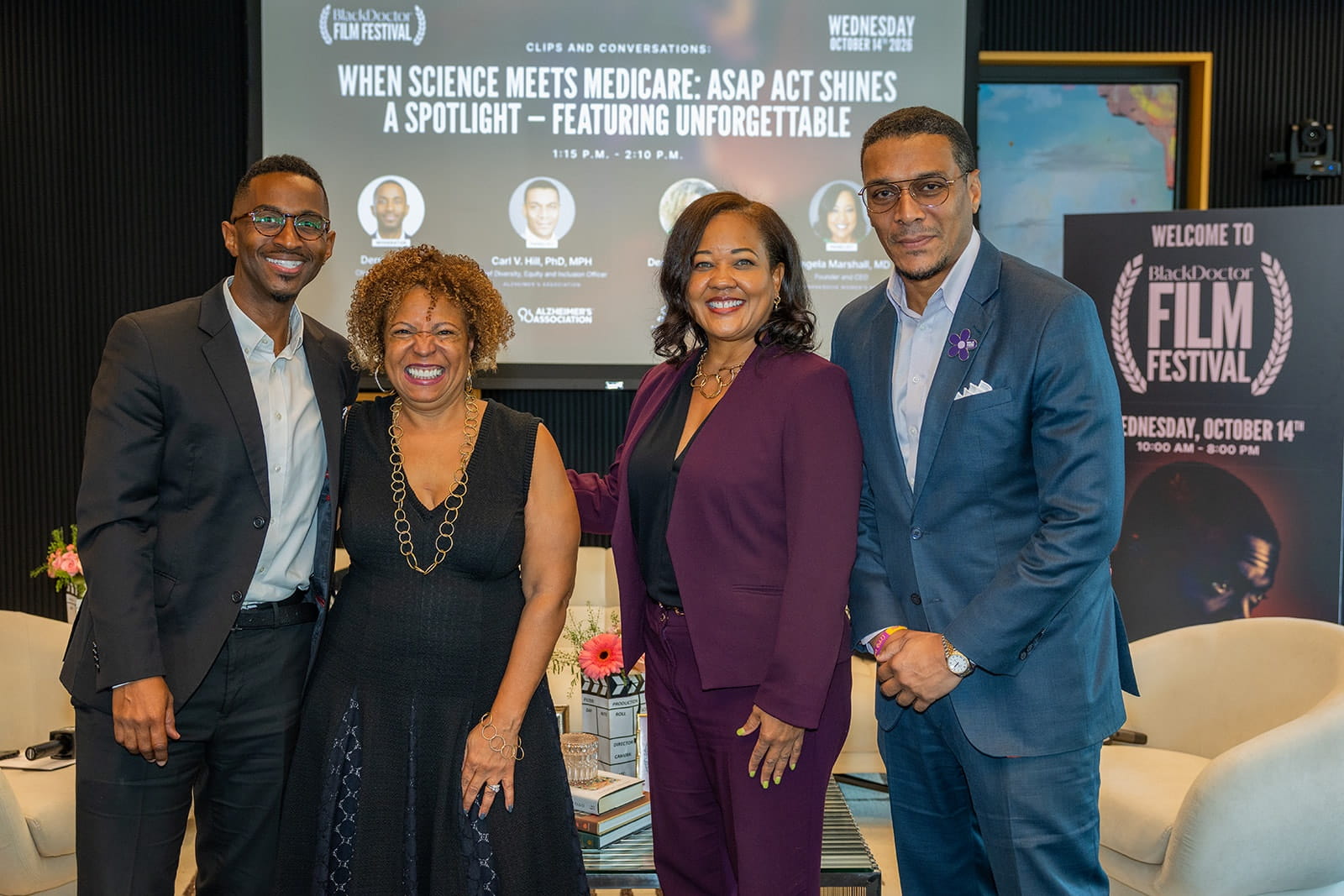
Dr. Marshall addressed how the film, which began as a stage play that toured 20 cities and is now shown through the Association’s 77 chapters, showed the all-too-often denial in one character.
“While I am happy about anything that raises awareness, I think in a lot cases, patients and family members are familiar with Alzheimer’s, but their familiar with how it ends,” Marshall said. “They’re not familiar with how it starts. Oftentimes, patients and families are not aware that this person is showing early signs of Alzheimer’s…[because] some of the signs can be very subtle and [patients] often will mask it and do a lot of covering up some of the early disease — and that further leads to lack of early detection.”
That means people learn about their risk and status sooner, with more time to plan, join clinical trials and potentially start care earlier, Hill explained.
“In practical terms, this is about access now for people,” Dr. Hill said. He added that the test could confirm biomarkers that determine eligibility for clinical trials, where Black Americans are largely not enrolled.
Darlington said the ASAP Act has about 230 House cosponsors and about 78 in the Senate. The bill has already cleared the House Ways and Means Committee with a unanimous, bipartisan 40–0 vote, and now awaits action in the Energy and Commerce Committee. With Congress returning after the midterms, there is a potential opening to attach the bill to end-of-year legislation, Darlington said.
“Knock on their door now,” Darlington urged, “so that they know this is important to you.”
She also pointed listeners to AlzInColor’s policy page for a summary and to the Alzheimer’s Association’s policy page, which includes a tool for identifying and contacting your members of Congress.
“It’s really going to bring the diagnosis straight to the primary care office, which will be huge for our communities,” Dr. Marshall said.
Timing is critical because, as Dr. Hill noted, the new disease-modifying treatments are only for people diagnosed early.
“If you miss that window right now, then you miss the opportunity to benefit,” Dr. Hill said.
In addition, he said, blood tests are an equity tool for rural patients and others who can’t reach a specialty center for a spinal fluid test or PET scan.
“What keeps me up at night is… the disparities widen because some people have access and others don’t,” Dr. Hill said. His “nightmare scenario” he described is that treatments prove less effective in Black patients because they weren’t adequately represented in the trials. He added that blood tests used in diagnosis need to be validated in study populations representative of the country at large.
With early detection being so important, Marshall shared warning signs to look for. Be on the look out for subtle signs and for patients to mask their behavior with humor instead of answering a question. Look out for changes in language, such as repeating themselves and when they struggle with multi-step tasks, such as paying bills twice or not at all, or preparing meals.
She advised starting with care, not accusation. “Hey, I’m concerned about you. I’ve noticed some changes and I wanted to talk to you about it,” Marshall said.
Expect denial, she said, and don’t argue. Instead, offer to come along to the next doctor’s visit and share concerns with the doctor ahead of time. She also warned that people with even mild dementia are targets for scams, recalling a patient who lost her life savings.
Darlington urged families to normalize the conversation. On AlzInColor webinars, she said, participants have incorrectly claimed Black people don’t get Alzheimer’s.
“The more we show our faces and share our stories, I think that helps ease that conversation,” Darlington
They urged audiences to push Congress to pass the Alzheimer’s Screening and Prevention (ASAP) Act. Contact your members of Congress about the ASAP Act, by phone, email or the Alzheimer’s Association’s lookup tool. AlzInColor offered to help people find their representatives’ contact details.
“We’re a strong community,” Dr. Marshall said. “We’re empowered, and there’s no one coming to save us.”


By subscribing, you consent to receive emails from BlackDoctor.com. You may unsubscribe at any time. Privacy Policy & Terms of Service.