As a registered dietitian nutritionist (RDN), and a certified diabetes care and education specialist (CDCES), I get questions all the time from my clients about the glycemic index (GI)—especially from those working with me for weight loss, and/or to manage their diabetes.
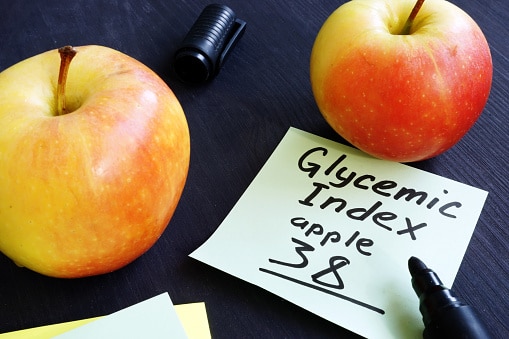
The GI is a measurement of how fast a particular carbohydrate raises blood glucose—also called blood sugar. Some carbohydrates trigger a quick spike in blood sugar, while others work more slowly, keeping blood sugar more even. The GI addresses these differences by assigning a number to foods that reflects how quickly they increase blood sugar, as compared to pure glucose.
The GI goes from 0-to-100. Pure glucose has the highest GI and is given a value of 100. Foods with a high GI are thought to raise blood sugar quickly, while a lower GI food, which is absorbed more slowly, will raise your blood sugar more slowly.
Unfortunately, a person’s GI is more complicated than it might seem. Even foods with the same carbohydrate content can affect your blood sugar differently, depending upon the GI of the food. And, a food may have a different GI depending on how it’s prepared; so, you count the GI of a potato differently if you boil it than if you bake it. It is a lot to keep track of, which is why many nutrition professionals don’t use the GI at all when counseling patients or clients.
A recent survey of more than 750 Today’s Dietitian readers, sponsored by Potatoes USA, found that 73% of nutrition professionals who responded don’t use the GI when counseling clients and patients, and among those who did report using it, 70% don’t use it often.
Moreover, researchers are concerned that people may think that foods with a low GI are healthier than foods with a high GI, and choose foods based only on the GI. In fact, 3 out of 5 nutrition professionals surveyed strongly agree that eliminating high GI foods from the diet and consuming only low-GI foods can cause people to exclude perfectly healthful foods from their diet. They also agree that the GI leads to misinformation about the healthfulness of fruits and vegetables. For example, potatoes, carrots, watermelon and ripe bananas have a GI categorized as “high,” and this GI might lead people to exclude them from their diets.
I counsel my clients about the general concept of fast and slow-acting carbohydrates, and help them to prioritize foods higher in fiber—as many low-GI foods are higher in fiber—rather than being concerned about the GI of a food itself.
The following tips are additional ways to manage blood sugar without focusing on the GI:
 Constance Brown-Riggs is a registered dietitian nutritionist, a certified diabetes care and education specialist, national speaker and author of the Diabetes Guide to Enjoying Foods of the World and the African American Guide to Living Well with Diabetes. She is also a paid partner of Potatoes USA. Follow her on social media @eatingsoulfully.


By subscribing, you consent to receive emails from BlackDoctor.com. You may unsubscribe at any time. Privacy Policy & Terms of Service.