

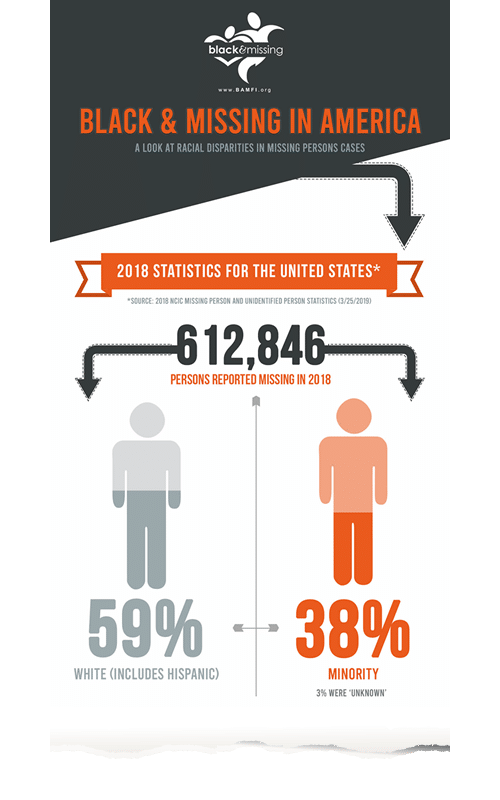
According to the site, Black and Missing Foundation, the FBI has reported a total of 230,302 Black people were reported missing in the United States (out of 612,846 for all races). That’s from January 1, 2018 – December 31, 2018). That number has gone up from 2017.
In 2017, there were 219,484 Black people reported missing in the United States — and black juveniles under 18 years old accounted for 169,426 of those missing people, according to the National Crime Information Center. In the U.S., black and African-American people make up just 13.4 percent of the county’s population, meaning they are disproportionately represented among the country’s missing persons.
With all these Black women and girls missing, why don’t we hear more about it?
The National Center for Missing And Exploited Children based in Washington D.C. is the most important agency in the country when it comes to tackling missing persons cases, and its director says that when it comes to finding missing Americans, there’s a color problem.
Robert Lowery, who leads the center, told ABC News that roughly 800,000 Americans go missing each year.
“About 60% of the reports that we see here in the U.S. that go in those databases are people of color,” he said. “I think it really breaks a lot of commonly held thoughts on who are really the missing children in the U.S.”
Missing black Americans are over-represented in the total number of missing people in the U.S. Despite making up only 13% of the total U.S. population, more than 30% of all missing persons were black in 2018, according to the U.S. Census Bureau.
Only about one-fifth of these cases are covered by the news, according to an analysis published in the Journal of Criminal Law and Criminology.
Black families searching for missing relatives say that their missing loved ones are more likely to be labeled as runaways, and that they are somehow not worth the focus of the police or the media.
Many reports are soaying that some of the missing have succumb to human trafficking or organ harvesting. But without sufficient data, it’s hard to know for sure.
Among the missing are:
Tim’Monique Davis, missing from Moorhead, Minnesota since Jan. 20.
Anya Washington, missing from Houston, Texas since Jan. 29.
R’Mahnee Williams-Turner, missing from Palmdale, Calif., since Jan. 26.
Whitney Elliseau, missing from Lakewood, Calif., since Feb. 5.
Jada Cyrus, missing from Boston, Mass., since Jan. 29.
Myla Abanda, missing from Fairfax, Va., since Nov. 16.
Zakiah Abdul-Khaliq, missing from Austin, Texas, since
Aug. 27, 2018.
Yasmin Acree, missing from Chicago, Ill., since Jan. 15, 2018.
Harmony Adams, missing from Columbus, Oh., since July 18, 2018.
Kelli Allen, missing from Atlanta, Ga., since Dec. 20, 2018.
Kelly Allen, Missing from Berkley, Miss., since March 13, 2007.
Kaaliyah Alston, missing from Hillsborough, NC., since Aug. 21, 2018.
Hazana Anderson, missing from College Station, Texas, since Oct. 28, 2018.
Karyn Anderson, missing from Walkersville, Md., since March 24, 2018.
Rae’vanna Anderson, missing from Duluth, Ga., since Nov. 3, 2018.
So what do you do? What do you do when someone goes missing?
You can of course report a missing person to the authorities, but also, Black and Missing Foundation also has a link to report the missing as well, click here


By subscribing, you consent to receive emails from BlackDoctor.com. You may unsubscribe at any time. Privacy Policy & Terms of Service.














