 (Photo credit: Youtube)
Ask any heart surgeon about Vivien Thomas and most will not only know his name, but they’ll probably be also to run down what he did for the health community and how it changed the landscape of heart surgery forever.
With no formal medical training, Thomas developed techniques and tools that would lead to today’s modern heart surgery. In operating rooms all over the world, great surgeons who received their training from Vivien Thomas are performing life-saving surgical procedures. We honor his legacy with the naming of the Vivien Thomas High School Research Program at the Morehouse School of Medicine. The Vivien Thomas Research Program for high school students was established to provide experiences in the research laboratories at the Morehouse School of Medicine. Students conduct research for six weeks under the direction of a medical school faculty member and learn the content, process and methodology involved in inquiry science. At the end of this summer experience, students present their research findings to the faculty and staff at MSM.
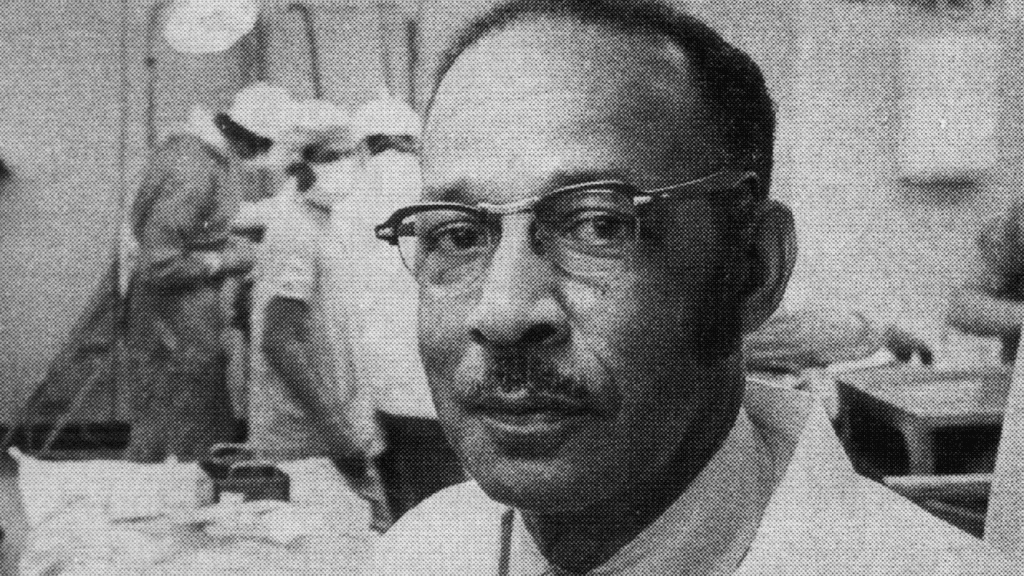
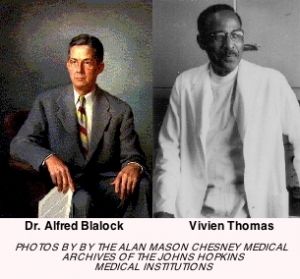
In 1941 the only other black employees at the Johns Hopkins Hospital were janitors. People stopped and stared at Thomas, flying down corridors in his white lab coat. Visitors’ eyes widened at the sight of a black man running the lab. But ultimately the fact that Thomas was black didn’t matter, either. What mattered was that Alfred Blalock and Vivien Thomas could do historic things together that neither could do alone.
In 1930, he took a position at Vanderbilt University as a laboratory assistant with Alfred Blalock. Thomas’ abilities as a surgical assistant and research associate were of the highest quality, and when Blalock moved to Johns Hopkins in 1941 he asked Thomas to accompany him. Thomas joined Blalock’s surgical team and helped to develop the procedure used in the “blue baby” operation— an operation to save infants born with a heart defect that sends blood past their lungs. He helped train many of the surgeons at Johns Hopkins in the delicate techniques necessary for heart and lung operations.
In 1943, while pursuing his shock research, Blalock was approached by pediatric cardiologist Helen Taussig, who was seeking a surgical solution to a complex and fatal four-part heart anomaly called tetralogy of Fallot (also known as blue baby syndrome, although other cardiac anomalies produce blueness, or cyanosis). In infants born with this defect, blood is shunted past the lungs, thus creating oxygen deprivation and a blue pallor. Having treated many such patients in her work in Hopkins’s Harriet Lane Home, Taussig was desperate to find a surgical cure.
According to the accounts in Thomas’s 1985 autobiography and in a 1967 interview with medical historian Peter Olch, Taussig suggested only that it might be possible to “reconnect the pipes” in some way to increase the level of blood flow to the lungs but did not suggest how this could be accomplished. Blalock and Thomas realized immediately that the answer lay in a procedure they had perfected for a different purpose in their Vanderbilt work, involving the anastomosis (joining) of the subclavian artery to the pulmonary artery, which had the effect of increasing blood flow to the lungs.
Thomas was charged with the task of first creating a blue baby-like condition in a dog, and then correcting the condition by means of the pulmonary-to-subclavian anastomosis. Among the dogs on whom Thomas operated was one named Anna, who became the first long-term survivor of the operation and the only animal to have her portrait hung on the walls of Johns Hopkins. In nearly two years of laboratory work involving 200 dogs, Thomas was able to replicate two of the four cardiac anomalies involved in tetralogy of Fallot. He did demonstrate that the corrective procedure was not lethal, thus persuading Blalock that the operation could be safely attempted on a human patient. Blalock was impressed with Thomas’s work; when he inspected the procedure performed on Anna, he reportedly said, “This looks like something the Lord made.” Even though Thomas knew he was not allowed to operate on patients at that time, he still followed Blalock’s rules and assisted him during surgery.
Thomas was a member of the medical school faculty from 1976 until 1985 and was presented with the degree of Honorary Doctor of Laws by the Johns Hopkins University in 1976. Today, in operating rooms all over the world, there are great surgeons performing life-saving surgical procedures who received their training from Vivien Thomas. His achievements stand as a testament to the power of research, discovery, and persistence to improve the health of generations to come, a legacy we honor with the naming of the Vivien Thomas High Summer Research Program at Morehouse School of Medicine.
A PBS documentary Partners of the Heart, was broadcast in 2003 on PBS’s American Experience detailing the impact of Thomas. In the 2004 HBO movie, Something the Lord Made, Vivien Thomas was portrayed by rapper and actor Mos Def. The film was received with rave reviews.
Although he may be gone, the life and legacy of Vivien Thomas lives on strong today and we have so many lives to thank for it.


By subscribing, you consent to receive emails from BlackDoctor.com. You may unsubscribe at any time. Privacy Policy & Terms of Service.