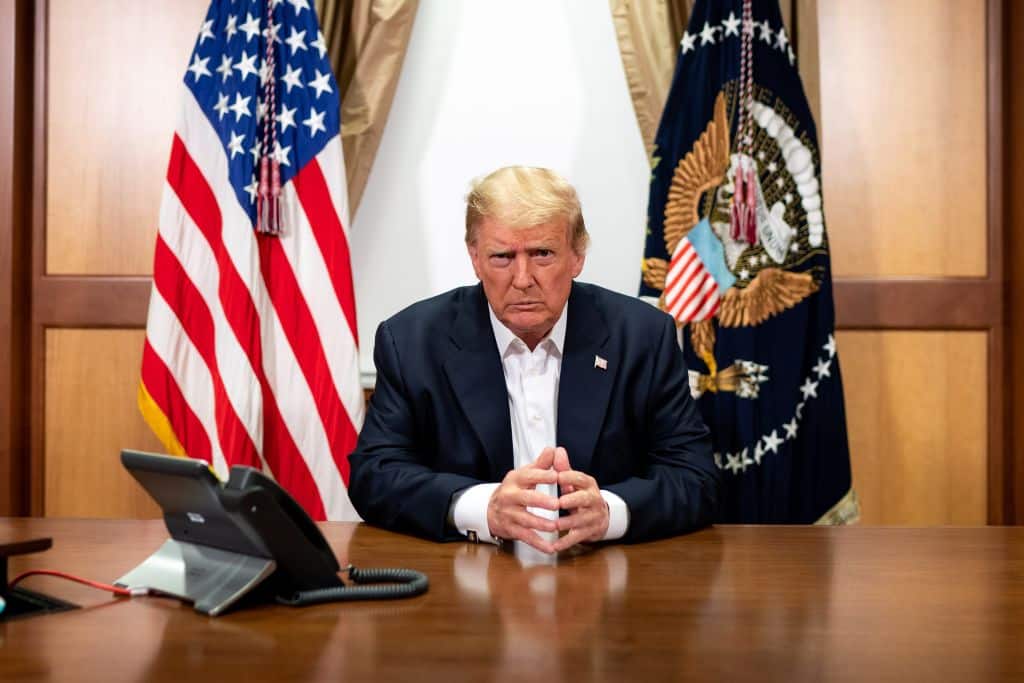
 (Photo by Tia Dufour/The White House via Getty Images)
This 2020 Presidential election is here and if you’re like most of America, you can’t wait until all these political ads stop running.
It’s hard to believe what many are claiming to do, including the president of current administration.
With so much at stake, one of the major issues being talked about is, of course, healthcare.
In September 2020, President Trump unveiled his America First healthcare plan for 2021, signing an executive order to deliver Americans better care, lower costs, and more choice, continuing the work that HHS has been doing under his leadership.
But as it turns out, there is a difference between what this plan actually does and doesn’t do.
As a matter of fact, there are no specifics to the “plan” at all.
“The President’s plan delivers better care, more choice, and lower costs for all Americans,” claims HHS Secretary Alex Azar. “Because of the President’s leadership, Americans will enjoy lower drug costs, lower insurance premiums, real access to prices of healthcare services and to their medical records, new protections from surprise bills, and the ability to work with their doctor to determine what treatments make sense for them.”
As part of the President’s plan, WhiteHouse.gov claims that Health and Human Services have:
Instead, it’s mostly a list of various incremental and modest things the president’s administration tried to do on health care after it became clear Trump wouldn’t be able to accomplish his main promise in 2016 of replacing the ACA.
These include some small tweaks to the health-care law – some that undermined the law and others that may have expanded its insurance offerings – and some cost reductions for seniors in the Medicare program.
According to the Washington Post, when President Barack Obama wanted to pass a health overhaul, he directed Congress to write extensive legislation, which included a requirement for insurers to cover people the same regardless of any preexisting condition.
He didn’t issue an executive order to do so. In order to have a sweeping change to healthcare, the president needs approval for that. He hasn’t gotten that yet.
In speeches, in tweets, in media interviews, President Trump keeps promising that he will preserve protections for Americans with pre-existing health conditions.
But while he recently signed an executive order committed to the idea, there was nothing behind it: No meat, no specifics, no real power. It’s a crowd-pleaser of a policy, but one entirely at odds with his administration’s legislative, regulatory and legal record to date.
Before Obama’s Affordable Care Act, Americans with a history of both serious and trivial diseases had trouble buying health insurance.
Health plans could omit coverage for addiction, could charge customers higher prices because of a history of acne, or could simply decline to sell insurance altogether to someone who’d had a cancer diagnosis.
All of those practices were eliminated as part of Obamacare, which requires insurance companies to offer the same, comprehensive health plans to everyone in a geographic area, varying the prices based only on the customer’s age.
This provision has long been one of the Affordable Care Act’s most popular features. Even when a majority of Americans who disliked the law overall, most supported this part of it.
Over time, as Obamacare has become more popular and more embattled, pre-existing-condition protections have become so popular that any politician who declines to support them is likely to pay a political price.
So what really is in the Trump plan? No one really knows. But what the September orders have done are:


By subscribing, you consent to receive emails from BlackDoctor.com. You may unsubscribe at any time. Privacy Policy & Terms of Service.