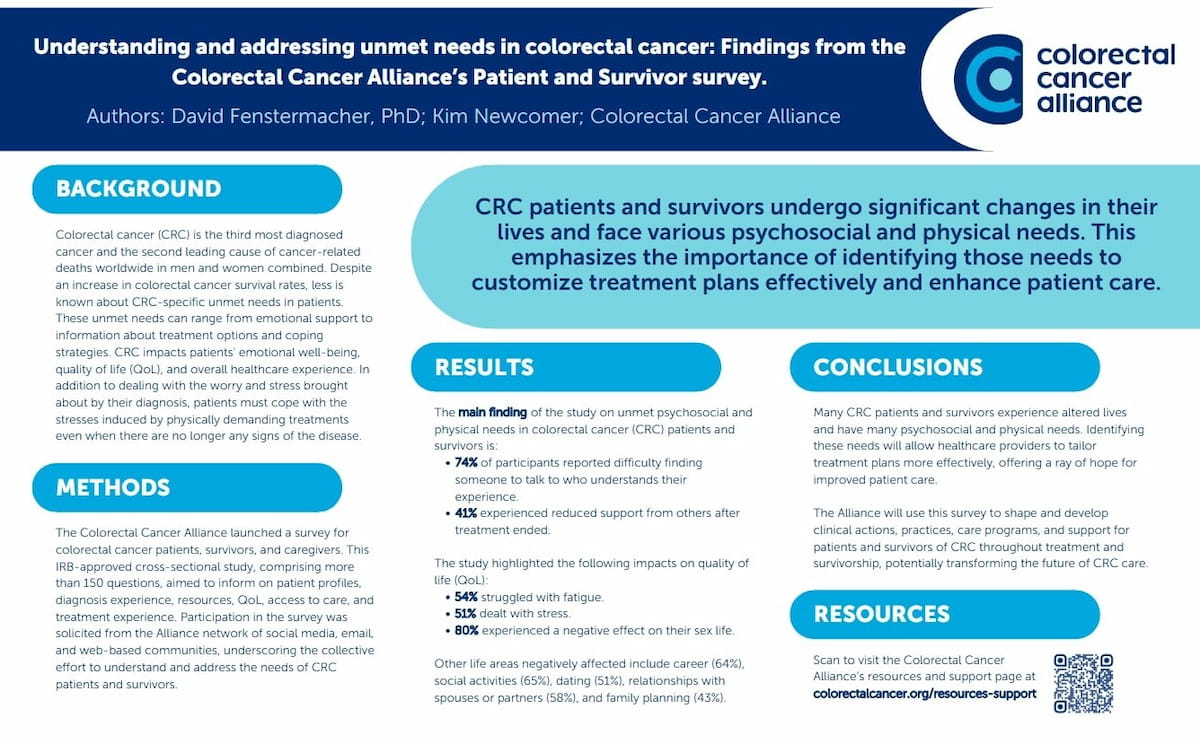
For millions facing a colorectal cancer (CRC) diagnosis, treatment is only part of the battle. The emotional weight—fear, loneliness, disrupted relationships, and life-altering physical side effects—often goes unaddressed. According to new data from the Colorectal Cancer Alliance presented at the 2025 American Society of Clinical Oncology (ASCO) Annual Meeting in Chicago, a staggering 74 percent of CRC patients struggle to find someone who truly understands what they’re going through. It’s not just an emotional void. It’s a healthcare gap.
Kim Newcomer, the author of the survey and a 16-year survivor of stage IV colorectal cancer, is a passionate advocate who understands this firsthand.“Sixteen years ago, there was nothing for patients,” Newcomer, Senior Director of Research Programs at the Colorectal Cancer Alliance, tells BlackDoctor.org. “We are getting better—but at the same time, nothing has changed.” The survey she helped lead confirms what many survivors already know: emotional and psychosocial support is often absent from the clinical equation.
The survey uncovered that 41 percent of patients feel their support systems diminish after treatment ends. Fatigue, stress, and sexual dysfunction haunt patients long after chemo and surgeries conclude. In fact, 80 percent of respondents reported that CRC had a negative impact on their sex life—a deeply personal side effect that’s rarely discussed.
“You survive cancer, and you want to live your best life,” Newcomer says. “But how can you, when no one warned you that survival might come with permanent losses like sexual function, or fertility?”
Especially for younger patients—many in their 30s and 40s—this silence is damaging. “Nobody talked to me about fertility or sexual health. No one gave me the power to choose,” she says. “Would I have made different treatment decisions? Maybe. But I didn’t get that option.”
RELATED: Q&A: Are Black Americans Facing a Silent Crisis with Colorectal Cancer?
A separate nationwide survey conducted by Wakefield Research and commissioned by the Alliance highlights alarming racial disparities in awareness and medical guidance, particularly for Black and Hispanic communities. Only 35 percent of Black adults know that CRC often shows mild symptoms until it’s too late, compared to 52 percent of white adults. Even more troubling, just 29 percent of Black adults know that CRC is one of the most preventable cancers.
This knowledge gap is not just academic. It’s deadly.
“Lack of awareness is a key factor in delaying potentially life-saving screening,” says Michael Sapienza, CEO of the Colorectal Cancer Alliance. Yet, 58 percent of Black adults say no doctor has ever recommended CRC screening to them, compared to just 36 percent of white adults.
Even a basic understanding of colonoscopies varies. While 79 percent of white adults know what the procedure involves, only 53 percent of Black adults do. One in four Black adults wrongly believe a colonoscopy requires a hospital stay, and 36 percent admit fear is keeping them from scheduling one. It’s a dangerous mix of misinformation and mistrust, exacerbated by historical disparities in care.
Despite these challenges, there’s reason for optimism. Among Black adults who haven’t yet been screened, nearly half say they plan to do so by age 45 or within the next year, more than double the rate of white adults. And despite stereotypes, 43 percent of Black adults say they’d rather get a colonoscopy than file their taxes, compared to just 27 percent of white adults.
The Alliance is leveraging this momentum through programs like LEAD FROM BEHIND and partnerships with trusted community organizations. Their goal: normalize conversations around CRC, dispel myths, and get people screened earlier. They offer culturally tailored materials, bilingual resources, and even a free personalized screening tool.
RELATED: Know Your Risk: 10 Things Blacks Need to Know About Colorectal Cancer
The Alliance’s support tools go beyond awareness. Their Buddy Program matches patients based on cancer stage and experience. Their BlueHQ platform creates personalized resource plans based on treatment, diagnosis, and patient input. These are lifelines—not just for managing cancer, but for managing life with cancer.
But Newcomer is adamant: it’s not enough. “Physicians have to be advocates too,” she says. “If you can’t talk about mental health, sexual health, or fertility at the point of diagnosis, you’re setting patients up to suffer in silence.”
The conversation has to change—and fast. The numbers prove that CRC isn’t just a medical issue. It’s an emotional, cultural, and systemic one. And addressing it means confronting the full reality of what patients face, especially those in underserved communities.


By subscribing, you consent to receive emails from BlackDoctor.com. You may unsubscribe at any time. Privacy Policy & Terms of Service.