
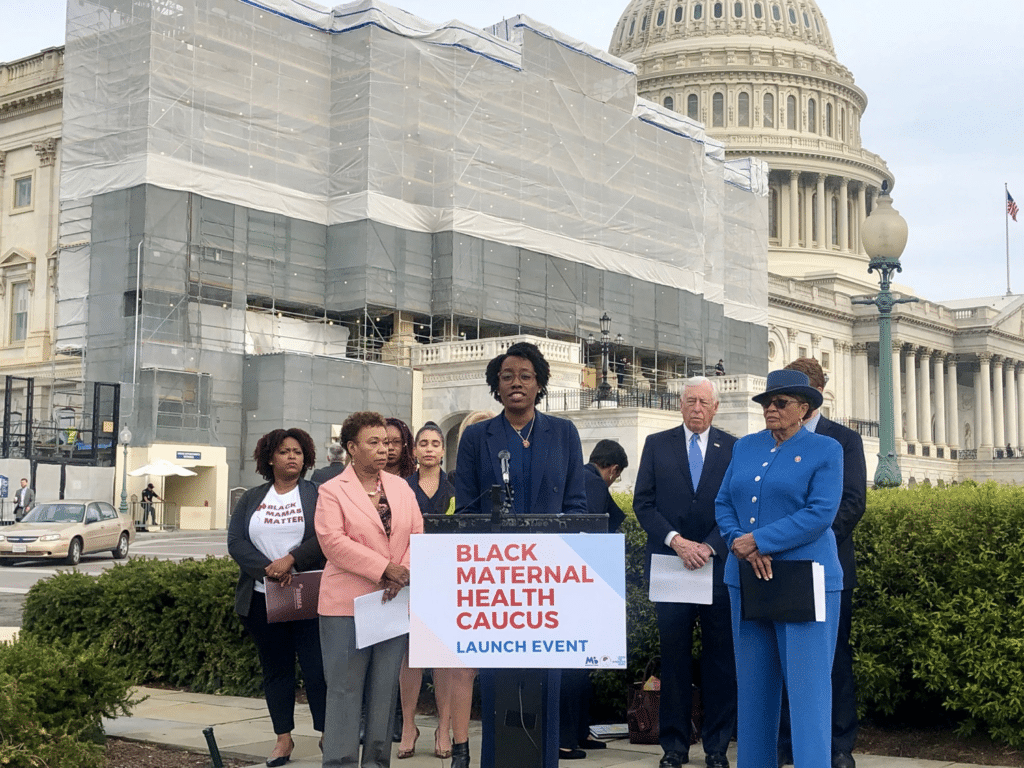
According to the Centers for Disease Control and Prevention, African American women are three to four times more likely to die of pregnancy complications than white women, irrespective of income or education. Those staggering numbers are why Freshman Rep. Lauren Underwood, D-Ill., and Rep. Alma Adams, D-N.C. announced the formation of a Black Maternal Health Caucus to assist in developing policies that combat the shockingly high black maternal death rate.
“As a Black mother and grandmother, Black maternal health is deeply personal,” Adams told GMA. “My daughter had serious complications with her pregnancies, and if not for the quality prenatal care she received, the outcome could have been different. Unfortunately, countless Black women do not have access to quality pre- and post-natal care or culturally-competent services.”
“It was personal for me,” Underwood tells ELLE.com of starting the caucus, which she hopes will shed light on the epidemic.
“I’m the youngest black woman to ever serve in Congress and I’m the only black woman of reproductive age in the Congress, so I’m really happy to be able to be a leading voice on this important issue,” she says. “[It’s heartbreaking] and this can happen to anybody, because the factors that would protect other women, like being highly educated, a high income, living in a safe neighborhood, going to prenatal appointments, having health insurance, all of these different things do not protect black women the same way they do other groups.”
The Caucus was launched with more than 50 founding members, including a number of Underwood’s freshman female colleagues, including Rep. Ayanna Pressley, D-Mass., and Rep. Lucy McBath, D-Ga.
About 700 women die each year in the U.S. due to complications from pregnancy or giving birth, according to the Centers for Disease Control and Prevention, and some 65,000 women nearly die of pregnancy-related complications. While every other developed country has seen a decrease in maternal deaths in recent years, the U.S. has seen an increase, data shows.
The numbers are even more staggering for African-American women.
“If you’re an African-American… your risks of dying in childbirth are three to four times higher than if you’re white,” Dr. Neel Shah, assistant professor at Harvard Medical School and an OB-GYN at Beth Israel Deaconess Medical Center in Boston, told ABC News last year. “It’s not tied to income. It’s not tied to education… It’s something about the lived experience of being African-American.”
A maternal death is defined as the “death of a woman while pregnant or within 42 days of termination of pregnancy from any cause related to the pregnancy or its management but not from accidental or incidental causes,” according to the World Health Organization (WHO).
The most common complications that women die of during and after childbirth around the world include severe bleeding, infections, high blood pressure during pregnancy like Serena Williams,…
… complications from delivery and an unsafe abortion, according to WHO.
Underwood says the caucus will come up with “creative” and “strategic” solutions to elevate black maternal health, which she calls a “unique issue.”
“Other issues have full NIH institutes. There’s a National Cancer Institute. There’s a National Child Development Institute. We don’t have that for this kind of a challenge,” she says. “We have to be strategic and work with our partners, community groups, and clinicians to elevate programs that we know work. Then we have to see if there’s models that we can develop to demonstrate projects, write and issue a bill, and give it a small pot of money. [We want to] see what works.


By subscribing, you consent to receive emails from BlackDoctor.com. You may unsubscribe at any time. Privacy Policy & Terms of Service.














