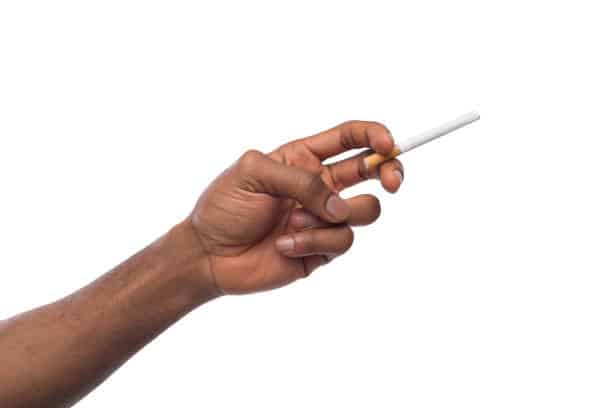
In the Roaring ’20s and beyond, smoking was promoted to women as a diet aid. “Reach for a Lucky instead of a sweet,” one ad for Lucky Strike cigarettes proclaimed. Another Lucky ad, which appeared in 1934, shows a svelte woman on a diving board shadowed by an obese one. “Is this you five years from now?” the ad copy warned. Somehow, smoking, it was implied, would ward off the lovely woman’s fat alter ego and help her maintain her “modern, ever-youthful figure.”
We know now that if we smoke, much more than our youthful figures are at stake. Unfortunately, many smokers hesitate to quit because they believe they’ll gain unwanted pounds along with those nice pink lungs.
In truth, people who stop smoking generally do gain weight, but it’s usually in the range of five to 10 pounds. The health effects of such a small increase, according to the American Lung Association, are infinitesimal compared to the benefits of giving up tobacco. And if you’re worried about those extra pounds, you can rest easy that even that small weight gain isn’t inevitable. With a little preparation, you can maintain your ideal weight as well as your heart and lungs.
Researchers have long known that worries about weight motivate some people to start smoking and are a frequent barrier to stopping. The weight gain associated with quitting is increasingly a tough issue for both genders, says Darlene Bahrs, former program director of the Stop Smoking Program of the San Francisco Department of Public Health’s Tobacco-Free Project. “It used to be a women’s thing, but it isn’t anymore. Now it’s equally important to women and men.”
Nicotine appears responsible for tobacco’s effects on weight, but precisely how it works remains unclear. The fact that most quitters find themselves wanting to eat more suggests that nicotine is an appetite suppressant, but it is not clear that this effect is sufficient — or lasts long enough — to account for smoking’s impact on weight. Research reported in the Journal of Family Practice and elsewhere suggests that smoking affects the rate at which the body uses energy, and perhaps alters a person’s natural regulation of calorie intake or expenditure.
In addition, some people eat as a substitute for the act of smoking. For someone used to sucking on a cigarette 20 times a day, food can be a satisfying and easy stand-in once they quit smoking.
In general, women gain slightly more weight than men, according to the U.S. Public Health Service. But fear of getting fat may play as much of a role in causing would-be quitters to relapse as actual weight gain. In one study published in the Journal of Consulting and Clinical Psychology, women who quit smoking were more likely to relapse than men. But, contrary to expectations, men — not women — were more likely to return to smoking as a way to curb their weight gain.
RELATED: What Happens to Your Body When You Finally Quit Smoking: A Complete Guide
Though some disagree, most experts advise smokers to quit now and worry about weight later.
In fact, a study published in the Journal of Consulting and Clinical Psychology suggests that avoiding diets may be the most effective strategy — both for quitting smoking and long-term weight control.
Women seeking to quit but concerned about weight were divided into three groups: one was given standard counseling on how to stop smoking; a second group was offered the counseling plus advice on losing weight through calorie control; and the third supplemented the stop-smoking therapy with counseling to ease concerns about weight gain (the latter emphasized the health benefits of quitting smoking and discouraged dieting).
A year after treatment, the group counseled against dieting not only had the highest rate of non-smoking, they also gained the least weight: 5.5 pounds, on average, compared to 11.9 for the weight control group and 16.9 for the standard therapy group.
Of course, this doesn’t mean you should ignore common-sense advice about diet and exercise. People kicking cigarettes should “maintain a healthy lifestyle, including engaging in moderate exercise, eating plenty of fresh fruits and vegetables, and limiting alcohol consumption,” according to U.S. public health guidelines.
Mindful that many people who are quitting reach for sweets instead of cigarettes, the American Lung Association recommends having non-alcoholic, low-calorie beverages on hand, such as club soda, vegetable juice, or diet soda. While the organization agrees that you shouldn’t go on a weight-loss diet while you’re quitting, it does have specific recommendations for healthy eating that will help you maintain your current weight. These include:
Since smokers put their hands to their mouths to take a puff 200 or more times per day, chewing on a nonfattening substitute like carrot sticks or toothpicks can help. “We suggest cinnamon sticks,” Bahrs says. Just suck on the cinnamon rather than puffing a cigarette or eating high-calorie snacks.
RELATED: Ready To Quit Smoking? Find A Class To Help You
Most experts agree that exercise is also helpful, both in terms of quitting smoking and controlling weight. “People successful in quitting smoking exercise,” says Terry Hess, who teaches stop-smoking classes for Kaiser Permanente in Northern California. “It becomes a part of their lifestyle.”
Bahrs also recommends exercise, noting that it doesn’t have to mean going to the gym. “Instead of getting off at your regular bus stop, get off four stops early and walk,” she suggests. “Take the stairs in your apartment instead of the elevator.”
Medicines, unfortunately, seem to offer limited help. Both nicotine replacement, especially in the form of nicotine gum, and bupropion (Zyban) can delay weight gain among quitters, but the benefit disappears once treatment is stopped. (Note that Zyban may worsen depression or suicidal ideation among patients with major depressive disorders. Such patients should be closely monitored while taking the drug.)
The key point, Bahrs says, is to not let concerns about weight derail your effort to quit. “We say, ‘Right now, focus on your tobacco [addiction],'” she says. “You’d have to gain 75 pounds or more to put as much strain on your heart as smoking does.”


By subscribing, you consent to receive emails from BlackDoctor.com. You may unsubscribe at any time. Privacy Policy & Terms of Service.