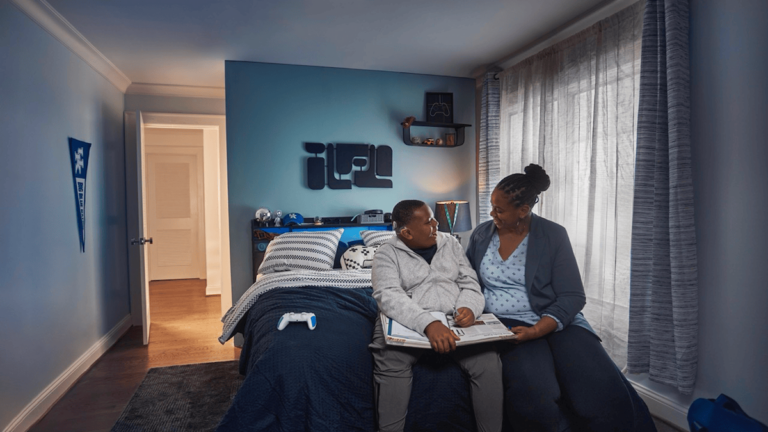
More than six million children in the United States have asthma. They’re everywhere. Look at a soccer field, walk in a mall, or take in a Saturday matinee, and you’re practically guaranteed to see asthmatic kids. You’d just never know it by looking at them.
Children with asthma don’t have to spend their days at home, wheezing and out of breath. In fact, the condition doesn’t even have to slow them down. With support from parents, doctors, teachers, and others, nearly every kid with asthma can play just as hard, accomplish just as much, feel just as good, and breathe just as easily as other kids.
Asthma control begins at home. You can help your child breathe easier by keeping the air clear of dust, perfume, tobacco smoke, and other irritants that could get into her lungs and set off an attack.
Vacuuming regularly and clearing their room of major dust traps such as potted plants, stuffed animals, and shag carpeting can be a big help.
If your child is allergic to pollen, you may need to keep the windows closed during the spring and summer and install a filter in your air conditioner.
Your child’s emotions can be just as important as their environment when it comes to controlling asthma. “Many children think they’re the only person in the world with asthma, and that can be very depressing,” says H. James Wedner, MD, chief of allergy and immunology at Washington University School of Medicine in St. Louis, Missouri.
Anxiety and depression can trigger asthma attacks in children and make the condition more difficult to control. If your child seems sad or distraught, reassure them that asthma is a very common — and very controllable — condition. If they still feel distressed, or are in emotional pain from other causes, counseling can give them new determination to fight asthma.
RELATED: Checking Your Peak Flow? Here’s How to Correctly do it asthma in kids
Your child can gain extra confidence with the help of a device called a peak-flow meter. This small, handheld device, available from a doctor, measures how well your child is breathing. The device tells them when their asthma is under control and when they need extra medication. In short, a peak-flow meter makes your child the expert on their condition.
Your child’s doctor will also prescribe medications to control asthma and prevent attacks. Of course, these treatments will only help if taken correctly. Make sure they know how and when to use their inhaler and any other medications.
RELATED: How To Protect Your Child From Common Asthma Triggers asthma in kids
Your child should be able to breathe just as easily at school as at home. Most states protect a child’s right to self-administer asthma medication at school. Find out if the school lets students carry inhalers.
If not, your child will have to keep their inhaler in the nurse’s office or another convenient location, a place that is unlocked and easily accessible after hours. (If you’re worried your child won’t have quick access to their inhaler, ask whether their coach or teachers can keep it within easy reach.)
You should make sure teachers and coaches can recognize the symptoms of an asthma attack. If they’re not familiar with the disease, you may also need to assure them, if appropriate, that your child can fully participate in any activities.
Asthma can be challenging for both you and your child, but don’t give up halfway to success. Until your child is at their best — both physically and emotionally — there’s still some room for improvement. When the asthma is finally under control, everyone can breathe easier.


By subscribing, you consent to receive emails from BlackDoctor.com. You may unsubscribe at any time. Privacy Policy & Terms of Service.