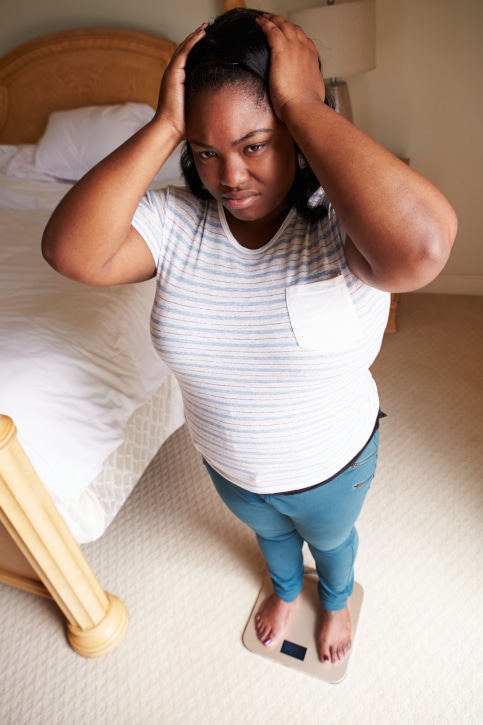
When it comes to weight loss, the scale can be a good measure of progress, particularly if you have a lot of weight to lose. But if you place too much emphasis on your weight and not enough on your body composition (the ratio of fat to lean muscle), you’re only getting half the story.
The scale doesn’t tell you how much fat you have. Your scale does exactly what it’s supposed to—it tells you how much you weigh. When the number on the scale goes up or down, it doesn’t represent only fat loss or muscle gain. In fact, the scale can’t tell if you’ve gained muscle. A pound of muscle is like a brick, small and compact. A pound of fat is like a fluffy feather pillow, bulky and lumpy. When you gain muscle and lose fat, your body gets smaller and tighter. Building muscle also makes it possible to drop clothing sizes without a big change in weight. Perhaps after a 90-day fitness program, the scale says you lost 7 pounds, which may not sound like much. But what if you actually lost 12 pounds of fat and gained 5 pounds of muscle? That’s a remarkable improvement in your body composition, but you wouldn’t know it if you only used your regular bathroom scale to track your progress.
Your body’s water levels are constantly changing. The scale can move up or down depending on how much water you drink, how much salt you consume, how much you sweat, and how many carbohydrates you eat. An average person can see a daily fluctuation in water weight of about 2 pounds, without any changes to diet or exercise habits. These fluctuations do not signify fat loss, and watching the scale move up and down every day can be frustrating for many dieters.
One of the best ways to keep track of your changing body is to use a tape measure. Record your chest, waist, hip, thigh, arm, and wrist measurements in a journal. Update the measurements every 30 days to see how your body changes. Pictures are also good indicators of progress. Have someone take front, side, and back photos of you every 30 days and keep these with your body measurements. Notice how your clothes fit. This is a foolproof way to prove that you’re losing weight. If your clothes are getting looser, your body is shrinking, even if you don’t see a big change in the mirror yet.
Many people on weight control plans rely on the bathroom scale to measure their progress. But this isn’t the only option. Lots of different techniques — some simple, others complicated — can be used to track your fitness and weight loss goals. Critics of the bathroom scale note that it’s important to track your body composition, including body fat percentage, rather than just your weight. Here are some examples of tests that go beyond the bathroom scale:
1. Body mass index, or BMI, is a calculation based on your height and weight. The calculation helps your doctor tell if you may be at risk for health problems because of your weight. It tends to be less accurate in people who are very muscular or very short. One disadvantage is that the BMI doesn’t provide any information about body fat.
2. Similarly, waist circumference is another simple test you can do right away. Measure around your waist at the level of the belly button in inches. If you’re a man with a measurement higher than 40, or a woman with a result higher than 35, you are at increased risk for certain health problems like heart disease and stroke. Of course, like the BMI, this doesn’t tell anything about your body composition or fat percentage…
3. Skinfold calipers have been available for years to measure body fat. A measuring device is used to “pinch” the skin and tissues at different places on the body, estimating body fat percentage. Results of this test can vary widely and depend on the quality of the calipers and the skill and experience of the person performing the test.
4. Body fat scales are available for home use. These work by sending a small, harmless electrical current through the body to detect fat and lean tissue, providing a reading of your body fat percentage. Because these measurements can change according to the time of day and fluid and food intake, the results are most accurate if you can take the measurements at the same time each day. The devices overall likely vary in accuracy, but they can be good for tracking changes over time.
5. DEXA, or dual-energy X-ray absorptiometry, is a test similar to that used to measure bone density. It has been used to identify specific fat deposits and to determine body fat percentage. DEXA scanning is an emerging technology in the fitness area and is typically offered by medical offices, although some experts feel it may be more widely available soon. It is more accurate than home body fat scales.
Hydrodensitometry testing involves immersion in a water tank to calculate your body fat and density based on the amount of displaced water. This technique is understandably cumbersome and is also not widely available. Some universities use this technique with athletes and may allow others to use it for a fee.
6. The Bod Pod operates on a similar principle, but you don’t have to be submerged in a tank. This is a new device based on air displacement plethysmography (ADP) that consists of a chamber in which air displacement is measured. Still being refined, this method can provide a good measurement of body fat percentage without the disadvantage of having to be submersed in water. Hydration level can also affect the results of this test, and the individual being measured needs to sit very still and control breathing during the measurement process. Like underwater measurements, this method is often used by university athletics departments.


By subscribing, you consent to receive emails from BlackDoctor.com. You may unsubscribe at any time. Privacy Policy & Terms of Service.