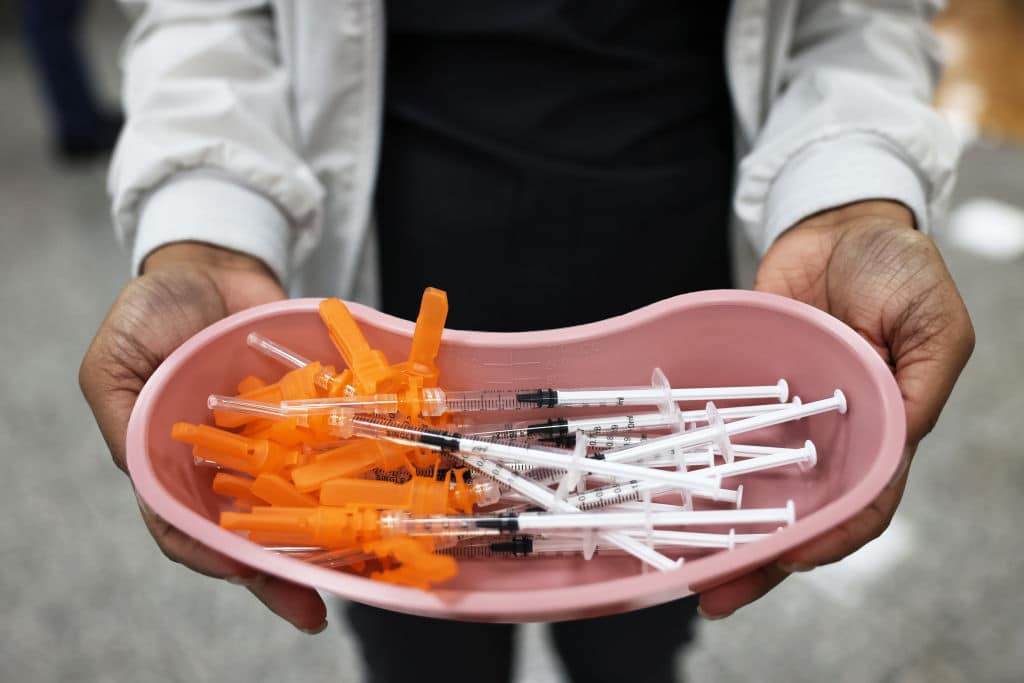
 (Photo by Michael M. Santiago/Getty Images)
The US Centers for Disease Control and Prevention and the US Food and Drug Administration are recommending that the United States pause the use of Johnson & Johnson’s Covid-19 vaccine over six reported US cases of a “rare and severe” type of blood clot.
In a joint statement Tuesday, the two organizations said they were investigating the unusual clots that occurred in women 6 to 13 days after vaccination. The clots occurred in veins that drain blood from the brain and occurred together with low platelets. All six cases were in women between the ages of 18 and 48.
The reports appear similar to a rare, unusual type of clotting disorder that European authorities say is possibly linked to another COVID-19 vaccine not yet cleared in the U.S., from AstraZeneca.
More than 6.8 million doses of the J&J vaccine have been administered in the U.S., the vast majority with no or mild side effects.
U.S. federal distribution channels, including mass vaccination sites, will pause the use of the J&J shot, and states and other providers are expected to follow. The other two authorized vaccines, from Moderna and Pfizer, make up the vast share of COVID-19 shots administered in the U.S. and are not affected by the pause.
“I’d like to stress these events appear to be extremely rare. However COVID-19 vaccine safety is a top priority,” FDA Acting Commissioner Janet Woodcock said at a news conference.
According to the Associated Press, the CDC committee will meet Wednesday to discuss the cases and the FDA has also launched an investigation into the cause of the clots and low platelet counts.
“Until that process is complete, we are recommending a pause in the use of this vaccine out of an abundance of caution,” Dr. Anne Schuchat, principal deputy director of the CDC, and Dr. Peter Marks, director of the FDA’s Center for Biologics Evaluation and Research, said in a joint statement.
They are recommending that people who were given the J&J vaccine who are experiencing severe headache, abdominal pain, leg pain, or shortness of breath within three weeks after receiving the shot contact their health care provider.
J&J said in a statement it was aware of the reports of blood clots, but that no link to its vaccine had been established. The company also said it is delaying the rollout of its vaccine in Europe.
“We have been working closely with medical experts and health authorities, and we strongly support the open communication of this information to healthcare professionals and the public,” the statement said in part.
U.S. health authorities cautioned doctors against using a typical clot treatment, the blood-thinner heparin. “In this setting, administration of heparin may be dangerous and alternative treatments need to be given,” the FDA and CDC said.
“It’s a very rare event. You’re talking about 1 per million, and when you give millions of doses of vaccines, you will see events like this that you couldn’t see in the clinical trial just because you didn’t have millions of people enrolled,” Dr. Carlos del Rio, executive associate dean of the Emory University School of Medicine at Grady Health System, told CNN.
“But I want to congratulate the CDC and the FDA for very quickly jumping on it, halting the vaccinations until we know more, and really trying to understand what’s going on,” del Rio said. “I think vaccine safety has always been a priority — and I think this is exactly the right move until we understand what’s going on and what’s the way forward.”
Normally, blood clots form when certain parts of your blood thicken, forming a semisolid mass. This process may be triggered by an injury or it can sometimes occur inside blood vessels that don’t have an obvious injury.
Once these clots form, they can travel to other parts of your body, causing harm. Factors and conditions that can cause troublesome blood clots, as well as serious conditions that are associated with blood clots, include:
Consult your doctor if you develop these signs or symptoms in an area on an arm or leg:
Seek emergency care if you experience:
To reduce your risk of developing blood clots, try these tips:
Avoid sitting for long periods. If you travel by airplane, walk the aisle periodically. For long car trips, stop and walk around frequently.
Move. After you’ve had surgery or been on bed rest, the sooner you get up and move around, the better.
Drink plenty of fluids when traveling. Dehydration can contribute to the development of blood clots.
Change your lifestyle. Lose weight, lower high blood pressure, stop smoking and exercise regularly.


By subscribing, you consent to receive emails from BlackDoctor.com. You may unsubscribe at any time. Privacy Policy & Terms of Service.