 series of Covid19 vaccine vials
If you’re like most people it seems as though as soon as it looks like we’re going to get rid of COVID, a new variant pops up. Right now, the new Omicron variant is making headlines because it seems to be infecting more people at a faster rate. So what are the symptoms to look for and how can we fight it?
The Omicron variant likely will spread more easily than the original SARS-CoV-2 virus and how easily Omicron spreads compared to Delta remains unknown. CDC expects that anyone with Omicron infection can spread the virus to others, even if they are vaccinated or don’t have symptoms.
More data are needed to know if Omicron infections, and especially reinfections and breakthrough infections in people who are fully vaccinated, cause more severe illness or death than infection with other variants.
Current vaccines are expected to protect against severe illness, hospitalizations, and deaths due to infection with the Omicron variant. However, breakthrough infections in people who are fully vaccinated are likely to occur. With other variants, like Delta, vaccines have remained effective at preventing severe illness, hospitalizations, and death. The recent emergence of Omicron further emphasizes the importance of vaccination and boosters.
Scientists are working to determine how well existing treatments for COVID-19 work. Based on the changed genetic make-up of Omicron, some treatments are likely to remain effective while others may be less effective. Vaccines remain the best public health measure to protect people from COVID-19, slow transmission, and reduce the likelihood of new variants emerging. COVID-19 vaccines are highly effective at preventing severe illness, hospitalizations, and death. Scientists are currently investigating Omicron, including how protected fully vaccinated people will be against infection, hospitalization, and death. CDC recommends that everyone 5 years and older protect themselves from COVID-19 by getting fully vaccinated. CDC recommends that everyone ages 18 years and older should get a booster shot at least two months after their initial J&J/Janssen vaccine or six months after completing their primary COVID-19 vaccination series of Pfizer-BioNTech or Moderna.
Masks offer protection against all variants. CDC continues to recommend wearing a mask in public indoor settings in areas of substantial or high community transmission, regardless of vaccination status. CDC provides advice about masks for people who want to learn more about what type of mask is right for them depending on their circumstances.
RELATED: What You Need to Know About the Omicron BA.2 Subvariant
Tests can tell you if you are currently infected with COVID-19. Two types of tests are used to test for current infection: nucleic acid amplification tests (NAATs) and antigen tests. NAAT and antigen tests can only tell you if you have a current infection. Individuals can use the COVID-19 Viral Testing Tool to help determine what kind of test to seek. Additional tests would be needed to determine if your infection was caused by Omicron. Visit your state, tribal, local, or territorial health department’s website to look for the latest local information on testing.
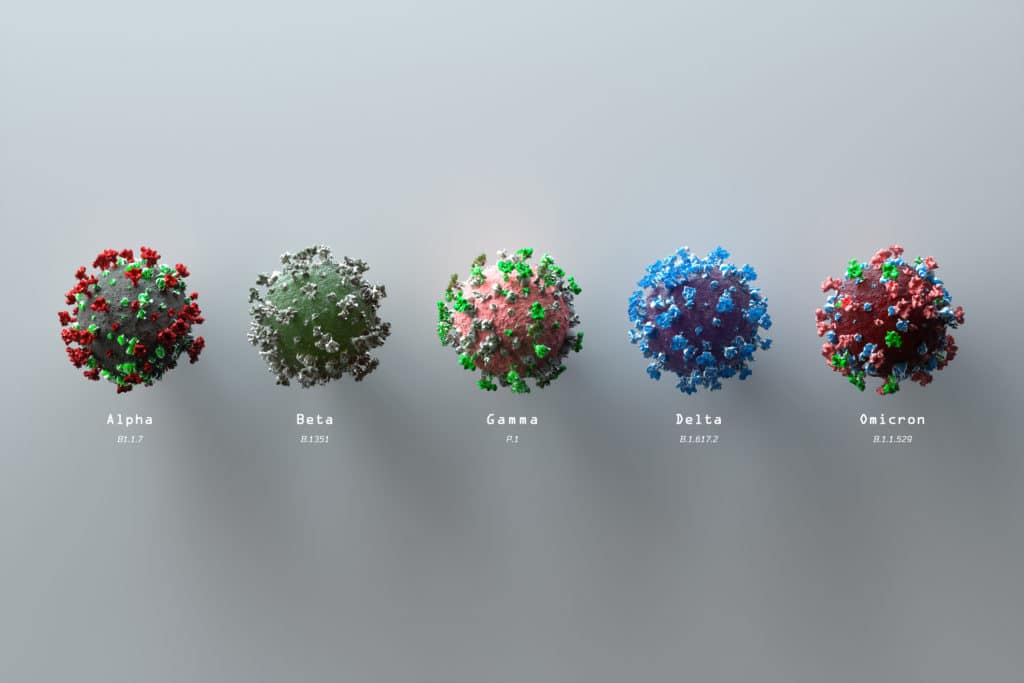 Digital generated image of different variants of COVID-19 cells against gray background. Omicron Civid variant concept.
RELATED: A Few Things You Should Know about the Omicron Variant
Digital generated image of different variants of COVID-19 cells against gray background. Omicron Civid variant concept.
RELATED: A Few Things You Should Know about the Omicron Variant
Mild symptoms have also generally been observed in cases emerging outside southern Africa, said UCSF infectious diseases expert Dr. Peter Chin-Hong. “In a recent report from the European CDC, of the first 70 cases of omicron in Europe, 50% have no symptoms and 50% have very mild symptoms,” he explained. “In the U.S. cases so far, most have been very mild.”
Fatigue, headache and body aches, symptoms that are common with the flu, are being reported by patients who tested positive for omicron, Chin-Hong said. “Some of the symptoms are very subtle,” he said.
Other symptoms typical with strains such as delta were less prevalent in the South Africa cases, including “no loss of taste or smell” and “less shortness of breath,” said Chin-Hong, referring to anecdotal reports on omicron cases from Dr. Angelique Coetzee, a private practitioner and chair of the South African Medical Association.
What’s more, in the first glimpse of hospitalized patients with omicron emerging from South Africa, hospitalizations have not increased dramatically, Chin-Hong said.
“And those who have been admitted to the hospital have not been very ill,” he said. “Most have been in the general wards, not in the ICU, and most have not required oxygen. Admitted omicron patients have been hospitalized for a much shorter period than delta or previous other variants.”
RELATED: Omicron vs. Delta: Three Key Differences Between the Two VariantsCDC is working with state and local public health officials to monitor the spread of Omicron. This map shows the states that have detected at least one case of COVID-19 illness caused by the Omicron variant. Omicron will be included in variant surveillance data on CDC’s COVID Data Tracker when it can be reliably estimated at a low frequency.


By subscribing, you consent to receive emails from BlackDoctor.com. You may unsubscribe at any time. Privacy Policy & Terms of Service.