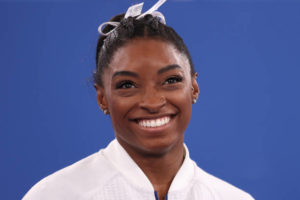
Fans have dubbed Simone Biles a “mental health hero” after her decision to pull out of the Olympic team finals. Biles, who was noticeably distraught, left in the middle of the competition after failing to land a vault. The vault she failed to land was a last-minute change. She had originally planned to do a Yurchenko double pike with two and a half twists. Instead, she attempted the stunt with only one and a half twists before she stumbled her landing.
Fighting back tears Biles expressed that she had planned for this year’s Olympic Games to be for her, but as the face of the team, it still became about other people. “This Olympic Games I wanted it to be for myself,” Biles says. “I came in and felt like I was still doing it for other people. That just hurts my heart that doing what I love has been kind of taken away from me to please other people.”
Fans noticed that her decision to change her routine last minute came directly after NBC aired an interview in which Biles expressed her concern over realizing how dangerous the stunts are as she gets older. “NBC aired an interview with Simone Biles just last night where she said, now that she’s older, she’s afraid of the crazy moves she does and she’s more aware of how dangerous they are. #Tokyo2020,” Twitter user Colin Steele writes.
Biles’ departure left her teammates Grace McCallum, Jordan Chiles and Sunisa Lee to compete without her. After pulling out of the competition Biles shared that she didn’t want to allow her second-guessing to hold her teammates back. “After the performance that I did, I didn’t want to go into any of the other events second-guessing myself, so I thought it was better if I took a step back and let these girls go out there and do the job and they did just that,” Biles says of her teammates who lost to Russia and earned the silver medal.
The gymnastics team has been noticeably struggling, including during qualifying. However, they still managed to make it into the competition after Chiles’ slips and falls and Biles’ rare 0.3-point penalty during her floor exercise routine.
Biles admitted that the stress and pressure to perform was getting to her in an Instagram post after Sunday’s low qualifying scores. “It wasn’t an easy day or my best but I got through it. I truly do feel like I have the weight of the world on my shoulders at times,” she says. “I know I brush it off and make it seem like pressure doesn’t affect me but damn sometimes it’s hard hahaha! The Olympics is no joke!”
View this post on Instagram
Biles cheered on her teammates in warm-ups from the sidelines for the final three events of the competition. Although they didn’t take home the gold, she’s proud of them for continuing to fight in her absence. “I think tonight they get a gold medal from me in fighting cause they never gave up and they just showed the world what they’re capable of,” Biles says.
Mental health has become a growing concern in the Black community. Black adults are more likely to report persistent symptoms of emotional distress, such as sadness, hopelessness and feeling like everything is an effort than white adults. Despite that, only one in three seek the mental health care they need.
Black people are also less likely to receive guideline-consistent care and would rather use emergency rooms or primary care than mental health specialists, according to the American Psychiatric Association’s Mental Health Facts for African Americans guide. There has been a stigma surrounding mental health in the Black community for years. A study shows that 63 percent of Black people believe that a mental health condition is a sign of personal weakness.
Conscious and unconscious biases also play a major role. Black men are more likely to receive a misdiagnosis of schizophrenia when expressing symptoms related to mood disorders or PTSD.
Regardless of the stigma, it is important that Black people recognize that seeking help is not a sign of weakness, put themselves first and receive the proper treatment much like Biles did. Seeking help can help you get your emotions in order if you are suffering from mental health challenges.
“Therapy has helped a lot as well as medicine. That’s all been going really well. Whenever you get in high-stress situations, you kind of freak out and don’t know really know how to handle all of those emotions especially at the Olympic Games,” Biles shares of her own experience with therapy.
If you are worried about finding the right mental health specialist, here are some questions you should be asking:
Tuesday morning Biles’ sister came to her defense and expressed the importance of mental health on Twitter. “Y’all are all about mental health until it no longer benefits you. I can’t imagine being that inconsiderate WHEWWWW,” Adria Biles, the athlete’s younger sister, writes.
Being there for a family member dealing with mental health illness can help them on their journey. If you have someone close to you that is suffering from mental health illness, you can support them by doing the following:

By subscribing, you consent to receive emails from BlackDoctor.com. You may unsubscribe at any time. Privacy Policy & Terms of Service.