For people of African descent, especially in the United States, the issue of health disparities is well-known, thoroughly documented and oft quoted in medical journals, media reports and issue briefs.
It is beyond dispute that there are precious few disorders or diseases that don’t impact us to any degree worse, and often far worse than the general population, and for countless reasons. The list of these is, in a word, ominous.
As for just some of the most glaring examples, Black Americans were devastated by the COVID-19 pandemic.
We are both contracting the virus, and dying from it at double the rate to be expected as proportionate to the national population.
Additionally, Blacks in this country suffer the highest rates of high blood pressure, are afflicted with diabetes at nearly twice the rate of white adults, have the highest number of deaths from heart disease and stroke and a Black person’s life expectancy is three years shorter than that of the average white person.
The outlook for countering health disparities like these, and many others negatively impacting the longevity of African Americans loom like a stationary dark cloud.
For Black men in particular, the narrative is even more foreboding owing certainly to the legacy of racism and discrimination, but also to their own historical reluctance to visit a doctor regularly—for any reason.
One of the greatest threats to African American men is prostate cancer, the equal opportunity disease which does not discriminate, and that has claimed the lives of Black men from all walks of life, notable and lesser-known alike.
To name only a few, luminary Black men such as late poet Langston Hughes, activists Stokely Carmichael and Eldridge Cleaver, Congressman Ron Dellums, Ghanaian President Kwame Nkrumah, actor Robert Guillaume, boxer Floyd Patterson and visionary music composer Leon Ware have all
succumbed to this disease—as have certainly many thousands of others.
In fact, as the second deadliest killer of Black men, prostate cancer exacts a far heavier toll on them than white men and men of any other culture, and the necessity of educating our men and their families about it, and all of its stages, is dire.
Simply stated, Black men have the highest prostate cancer incidence rate of any racial or ethnic group in the world.
The cancer is almost 60 percent higher in Blacks than in whites for unknown reasons, and Black men have a risk rate 74 percent higher than non-Hispanic white men—not to mention the highest risk of both developing this cancer and it being fatal.
Black men further are more likely to develop the more aggressive strains of prostate cancer, and our men’s prostate cancer death rates are more than twice those of every other racial and ethnic group in the U.S.
Prostate cancer is the most frequently occurring non-cutaneous cancer among men in this country, and it ranks only behind lung cancer among the leading causes of cancer-related deaths.
By years’ end, it is estimated that nearly 200,000 new cases of it will be diagnosed here, with almost 35,000 men dying from it.
Once diagnosed, a man’s treatment options and outlook are determined depending upon how extensively it has spread.
A numerical system called “staging” is how doctors assess the cancer’s status, its severity and how it’s affecting the gland.
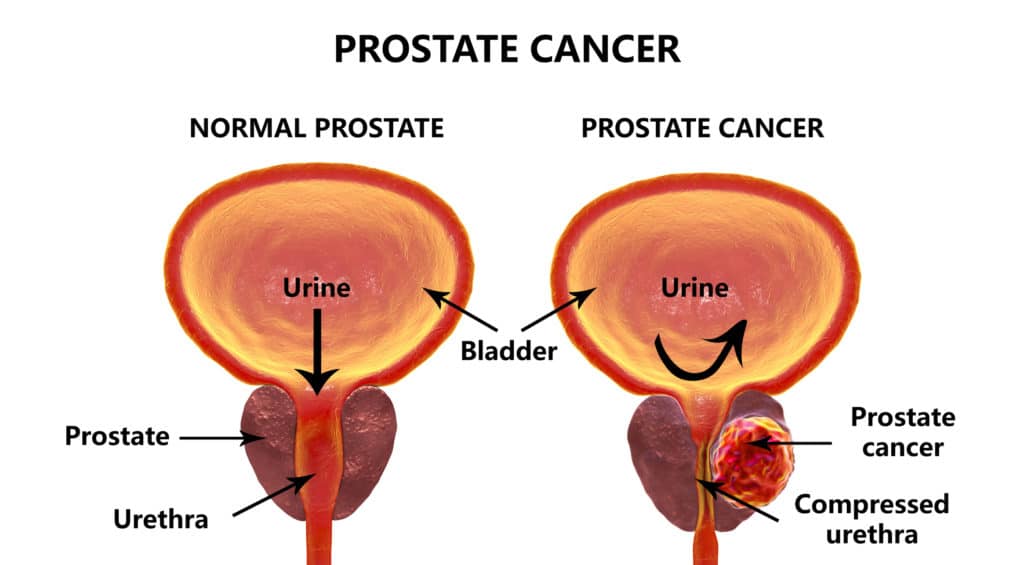
Prostate cancer grows from within the prostate gland usually over many years, and given enough time it begins its spread to
nearby tissues, as well as through both a patients’ lymph nodes and vessels toward other tissues via the bloodstream.
Regular, and early screening is an imperative, and is the pathway to saving yours and/or your loved ones’ lives. If a diagnosis is made, the next step will be tests to see the cancer’s extent.
Stage 1 prostate cancer signals that the disease is present in the prostate, but hasn’t yet grown beyond it.
Stage 2 reflects that the cancer still hasn’t gone beyond the gland, but the tumor could be in one or both lobes and the cell appearance is increasingly abnormal.
Stage 3 prostate cancer emerges when the cancer appears that it may or may not have spread beyond the gland to the lymph nodes, but has extended through the gland capsule and again, might involve nearby tissues.
Stage 4 prostate cancer is assessed when the diseased cells of course begin in the prostate, but then break off and spread to the lymph nodes and other areas of the body such as to the liver or bones.
While the medical establishment is still unsure of what actually causes stage 4—and for the record there is no cure—there is important research and development achieving results that Black men should be informed of.
Also, be aware that there are at least three subcategories under each of these stages, so be sure to listen closely and ask questions of your doctor to get the most accurate information specific to your case.
Frightening though it may be, stage 4 prostate cancer is not a common diagnosis, but getting screened and catching it as early as possible, and then starting treatment can reduce the symptoms and extend a man’s life.
Of paramount importance, of course, is to have your stage of cancer correctly verified because this is how your best treatment is decided and the rosiest possible outlook achieved.
Interestingly, brothers may have an advantage here now as recent results have shown that
compared with white men, Black men with advanced prostate cancer stand to benefit more from proactive screening and the treatment, immunotherapy.
Analyses of a recent real-world study reported earlier this year revealed that immunotherapy may be more effective in African American men with advanced prostate cancer, as compared with white men.
Black men who received this treatment lived more than 4.5 years, contrasted with only 2.5 years for Caucasian men—a difference of 20.9 months—and a 48 percent relative risk reduction of death.
Most importantly, no other prostate cancer treatment has shown this level of added benefit in African American men with advanced prostate cancer.
Dendreon Pharmaceuticals, a commercial-stage biopharmaceutical company and pioneer in the development of immunotherapy, announced these findings this past March from a sub-analysis of data from its PROCEED registry, comparing the overall survival of African American and white men with metastatic castrate-resistant prostate cancer (mCRPC) who were treated with the drug PROVENGE® (sipuleucel-T), in a real-world treatment setting. PROVENGE is the only FDA-approved immunotherapy made from a patient’s own immune cells for the treatment of prostate cancer.
To date, over 30,000 men have been prescribed PROVENGE, and via clinical trials it has been proven to extend life for certain men in advanced stages of the disease.
The PROCEED registry enrolled nearly 2,000 patients with mCRPC who received PROVENGE between the years 2011 and 2014, and tracked them for three years.
PROCEED evaluated the real-world use of PROVENGE in men with asymptomatic or minimally symptomatic mCRPC.
The registry was a multicenter, open-label observational registry conducted at urology and medical oncology clinics in private practice and academic sites.
So, there’s hope on the horizon, and certainly increasingly better news to come, but we repeat to Black men that the first step of this journey, as always, is to get screened and tested—extensively if you must.


By subscribing, you consent to receive emails from BlackDoctor.com. You may unsubscribe at any time. Privacy Policy & Terms of Service.