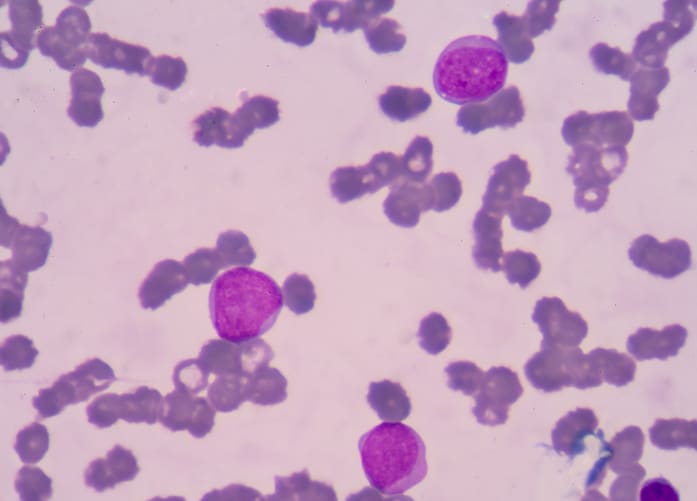
Despite receiving similar cancer treatment as other patients, African Americans with a common form of leukemia didn’t live as long in a 2013 groundbreaking study on health disparities. But another form of leukemia, Chronic Myelogenous leukemia (CML) is also becoming more familiar in the black community.
Chronic myelogenous (or myeloid or myelocytic) leukemia, also known as chronic granulocytic leukemia (CGL), is a cancer of the white blood cells. It is a form of leukemia characterized by the increased and unregulated growth of predominantly myeloid cells in the bone marrow and the accumulation of these cells in the blood. CML is a clonal bone marrow stem cell disorder in which a proliferation of mature granulocytes (neutrophils, eosinophils and basophils) and their precursors is found. It is a type of myeloproliferative disease associated with a characteristic chromosomal translocation called the Philadelphia chromosome.
Typically, being categorized as chronic indicates that this type of leukemia spreads and grows slowly. However, CML can change from slow progressing into a rapidly growing, acute form of leukemia that can spread to almost any organ in the body.
Unlike the three other main types of leukemia, CML has a significant difference that sets it apart from the rest. It has been shown that CML is associated with an abnormal chromosome known as the Philadelphia chromosome (Ph chromosome).
MUST READ: NBA All-Star Kareem Abdul Jabbar Shoots To End Leukemia
Chromosomes are structures in cells that contain genes, which give instructions to the cells. The Ph chromosome is an abnormality that occurs when a piece of chromosome 22 breaks off and attaches to the end of chromosome 9, which also breaks off and attaches to chromosome 22.
The link between the Ph chromosome and CML was discovered around 1960.
According to the American Cancer Society, there were approximately 5,050 CML incidences in the United States in 2009. CML accounts for 10 to 15 percent of all types of leukemia, with the average age of diagnosis being 67.
After chronic myelogenous leukemia has been diagnosed, tests are done to find out if the cancer has spread.
Staging is the process used to find out how far the cancer has spread. There is no standard staging system for chronic myelogenous leukemia (CML). Instead, the disease is classified by phase: chronic phase, accelerated phase, or blastic phase. It is important to know the phase in order to plan treatment. The information from tests and procedures done to detect (find) and diagnose chronic myelogenous leukemia is also used to plan treatment.
In chronic phase CML, fewer than 10% of the cells in the blood and bone marrow are blast cells.
In accelerated phase CML, 10% to 19% of the cells in the blood and…
… bone marrow are blast cells.
In blastic phase CML, 20% or more of the cells in the blood or bone marrow are blast cells. When tiredness, fever, and an enlarged spleen occur during the blastic phase, it is called blast crisis.
Treatment of chronic phase chronic myelogenous leukemia may include the following:
Targeted therapy with a tyrosine kinase inhibitor.
High-dose chemotherapy with donor stem cell transplant.
Chemotherapy.
Splenectomy.
A clinical trial of lower-dose chemotherapy with donor stem cell transplant.
A clinical trial of a new treatment.


By subscribing, you consent to receive emails from BlackDoctor.com. You may unsubscribe at any time. Privacy Policy & Terms of Service.