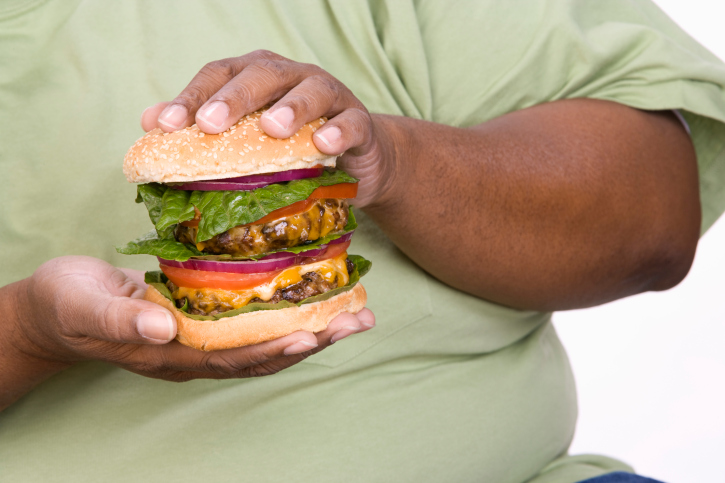
Many Americans are at increased health risk because they are obese. The U.S.
Surgeon General, in a 1988 report on nutrition and health, estimated that
one-fourth of adult Americans are overweight. Obesity is a known risk factor for
chronic diseases including heart disease, diabetes, high blood pressure, stroke,
and some forms of cancer.
How
Is Obesity Measured?
Everyone needs a certain amount of body fat for stored energy, heat
insulation, shock absorption, and other functions. As a rule, women have more
fat than men. Doctors generally agree that men with more than 25 percent body
fat and women with more than 30 percent body fat are obese. Precisely measuring
a person’s body fat, however, is not easy. The most accurate method is to weigh
a person underwater – a procedure limited to laboratories with sophisticated
equipment.
Body
Fat
There are two simpler methods for estimating body fat, but they can yield
inaccurate results if done by an inexperienced person or if done on someone with
severe obesity. One is to measure skinfold thickness in several parts of the
body. The second involves sending a harmless amount of electric current through
a person’s body (bioelectric impedance analysis). Both methods are commonly used
in health clubs and in commercial weight-loss programs, but results should be
viewed skeptically.
Using
Tables
Because measuring a person’s body fat is tricky, doctors often rely on other
means to diagnose obesity. Two widely used measurements are weight-for-height
tables and body mass index. While both measurements have their limitations, they
are reliable indicators that someone may have a weight problem. They are easy to
calculate and require no special equipment.
Body
Mass Index (BMI)
Body mass index, or BMI, is a new term to most people. However, it is the
measurement of choice for many physicians and researchers studying obesity. BMI
uses a mathematical formula that takes into account both a person’s height and
weight. BMI equals a person’s weight in kilograms divided by height in meters
squared. (BMI = kg/m2). The table printed here has already done the math and
metric conversions. To use the table, find the appropriate height in the
left-hand column. Move across the row to the given weight. The number at the top
of the column is the BMI for that height and weight.
Body
Fat Distribution:
Doctors are concerned with not only how much fat a person has but where the
fat is on the body.
“Pears”
vs. “Apples”
Women typically collect fat in their hips and buttocks, giving their figures
a “pear” shape. Men, on the other hand, usually build up fat around their
bellies, giving them more of an “apple” shape. This is not a hard and fast rule,
though. Some men are pear-shaped and some women become apple-shaped, especially
after menopause.
Problems
With Ab Fat
People whose fat is concentrated mostly in the abdomen are more likely to
develop many of the health problems associated with obesity.
Waist-to-Hip
Ratio
To find out someone’s waist-to-hip ratio, measure the waist at its narrowest
point, then measure the hips at the widest point. Divide the waist measurement
by the hip measurement. A woman with a 35-inch waist and 46-inch hips would do
the following calculation: 35 / 46 = 0.76
What
It Means:
Women with waist-to-hip ratios of more than 0.8 or men with waist-to-hip
ratios of more than 1.0 are “apples.” They are at increased health risk because
of their fat distribution.
What
Causes Obesity?
In scientific terms, obesity occurs when a person’s calorie intake exceeds
the amount of energy he or she burns. What causes this imbalance between
consuming and burning calories is unclear. Evidence suggests that obesity often
has more than one cause. Genetic, environmental, psychological, and other
factors all may play a part.
Genetic
Factors
Obesity tends to run in families, suggesting that it may have a genetic
cause. However, family members share not only genes but also diet and lifestyle
habits that may contribute to obesity. Separating these lifestyle factors from
genetic ones is often difficult. Still, growing evidence points to heredity as a
strong determining factor of obesity. In one study of adults who were adopted as
children, researchers found that the subjects’ adult weights were closer to
their biological parents’ weights than their adoptive parents’. The environment
provided by the adoptive family apparently had less influence on the development
of obesity than the person’s genetic makeup.
Take
Heart
Nevertheless, people who feel that their genes have doomed them to a lifetime
of obesity should take heart. As discussed in the next section, many people
genetically predisposed to obesity do not become obese or manage to lose weight
and keep it off.
Environmental
Factors
Although genes are an important factor in many cases of obesity, a person’s
environment also plays a significant part. Environment includes lifestyle
behaviors such as what a person eats and how active he or she is. Americans tend
to have high-fat diets, often putting taste and convenience ahead of nutritional
content when choosing meals. Most Americans also don’t get enough exercise.
What
You Can Change
People can’t change their genetic makeup, of course, but they can change what
they eat and how active they are. Learn how to choose more nutritious meals that
are lower in fat. Learn to recognize environmental cues (such as enticing
smells) that may make them want to eat when they are not hungry. Become more
physically active
Psychological
Factors
Psychological factors also may influence eating habits. Many people eat in
response to negative emotions such as boredom, sadness, or anger.
Binge
Eating
While most overweight people have no more psychological disturbance than
normalweight p


By subscribing, you consent to receive emails from BlackDoctor.com. You may unsubscribe at any time. Privacy Policy & Terms of Service.