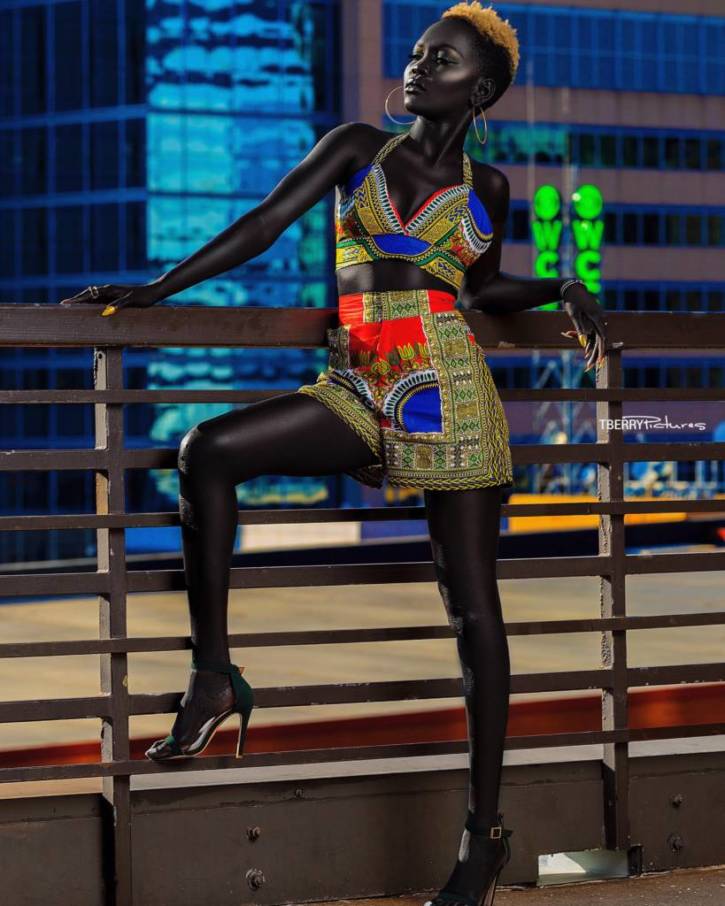
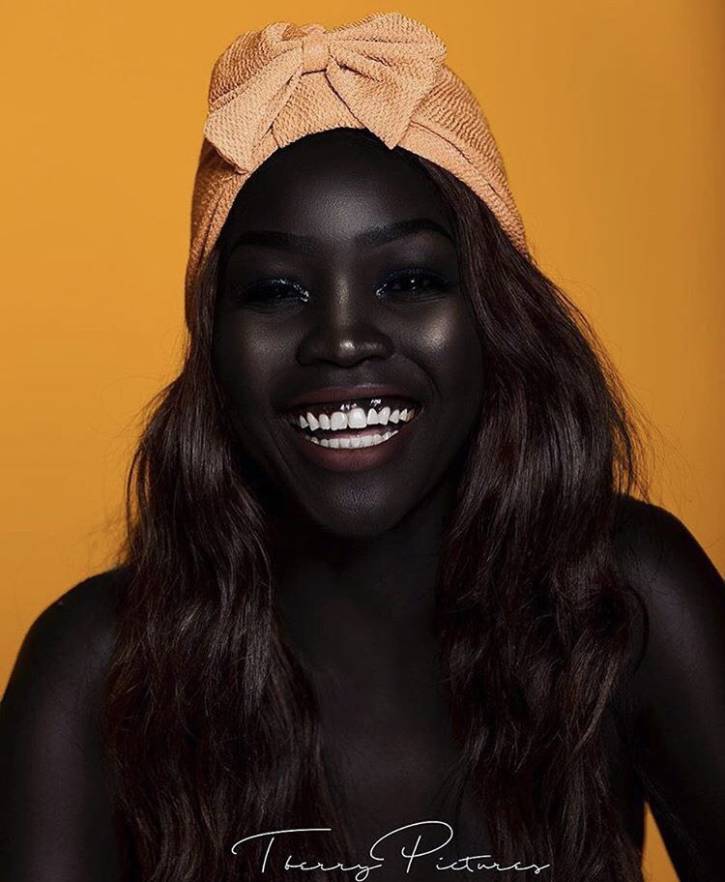
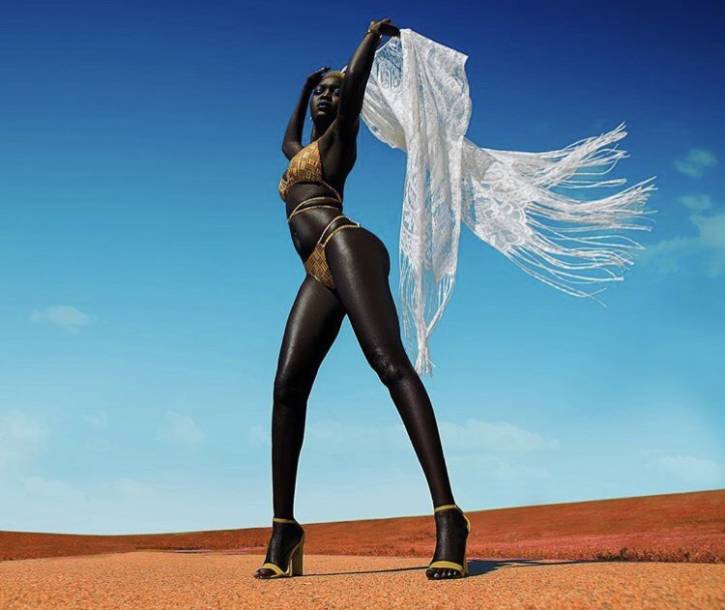
When you visit Nyakim Gatwech’s Instagram, you’ll first notice her many captivating images revealing her unique dark skin as well as her motivational captions, inspiring her more than 900k followers to embrace self-love regardless of your eccentricities.
She shut down the 2018 Emmy awards with her incredible style and grace in a beautiful colorful gown. Now, in 2021, she’s worth a reportedly $4 Million based off of her modeling career.
Named “Queen of Dark” by her fans, the South Sudan model (born in Ethiopia) became an international sensation through the power of the Web for many reasons.
Initially, she gained recognition after posting an image of herself posed in between two light-skinned Black models.
The image, representing the various shades of melanin, was from a photoshoot in Minneapolis, Minnesota, where she currently resides.
Photos from the ‘Different Melanin’ shoot, captured by photographer and creative director Isaac West, went viral quickly.
But it wasn’t until after a bold Uber driver asked her about bleaching her skin for $10,000 that she amassed a large fan base from the coverage of her baffling experience on just about every major platform, including Yahoo and Teen Vogue, to name a few.
Nyakim’s clever response to the question from the Uber driver was simply, “I would never do that. I consider my skin to be a blessing,” sparking dialogue about societal views on beauty standards.
Her fans quickly reminded her that her stunning dark complexion is
acceptable in America and beautiful.
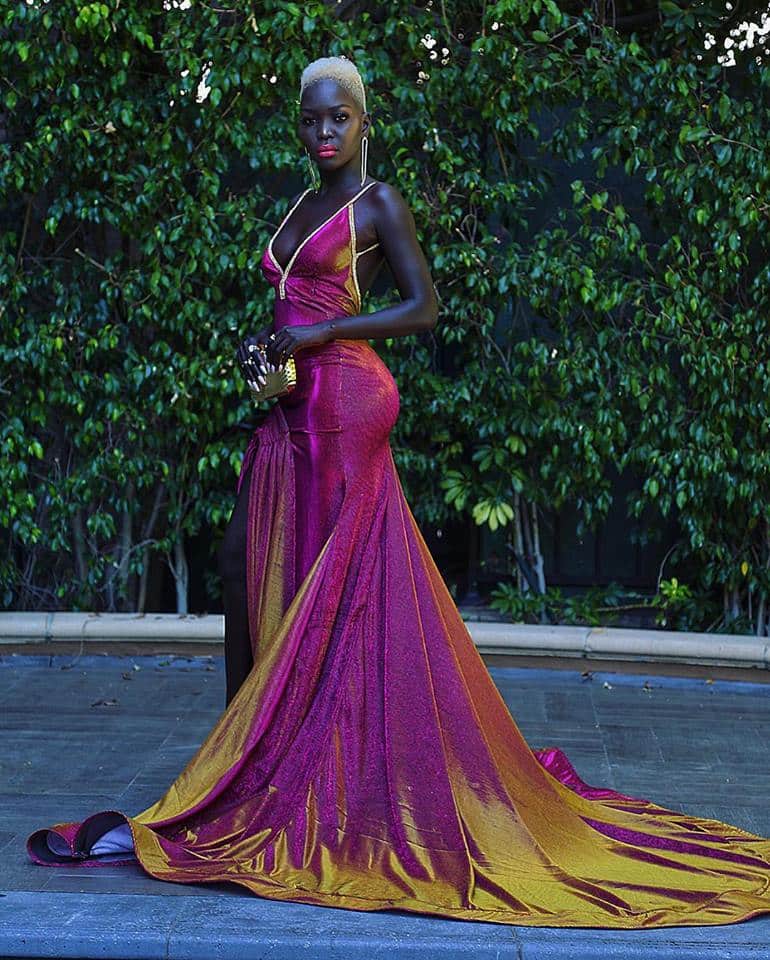
Ever since this experience, she has become a public figure, icon of beauty and a true inspiration to young women across the globe. However, this wasn’t an easy journey for Nyakim to embrace her melanin-rich tone.
As a model, Gatwech has faced discrimination. After hiring Gatwech, a local designer changed her mind the day before the gig. “The dress fit perfectly, but she was panicking because the color of the dress did not go with my skin color,” Gatwech says. “She said, ‘No, this is not going to work. I have to find somebody else.’”
As she gains more exposure, Gatwech hopes she can be a role model for others. “I hope to speak to young girls about accepting who you are and loving who you are. I wish there had been somebody when I was younger to tell me that,” she says. “You are black and beautiful. You’re different, and there’s nothing wrong with being different.”
Nyakim and I had a long conversation about her journey to self-love, almost bleaching her skin, advancements in her career and the truth about that fateful Uber ride.
On Nyakim’s struggles with dark skin color in the U.S., compared to her home country:
Nyakim Gatwech: It all started when I was [young]. I never actually had a problem with how I look or question like I’m different or I’m not beautiful because I’m dark until I came to the U.S.
Because when I was back home, in Ethiopia, Ethiopian people, they all have fair skin and look more like mixed people. There are more light-skinned people. And then, I lived in Kenya and Kenyan people too, they’re black but they are a different shade, lighter than me.
So I never questioned it because it’s like I was accepted. I feel like this is normal. God created all of us with all different shades and it is alright. Until I came to the U.S. in 2007.
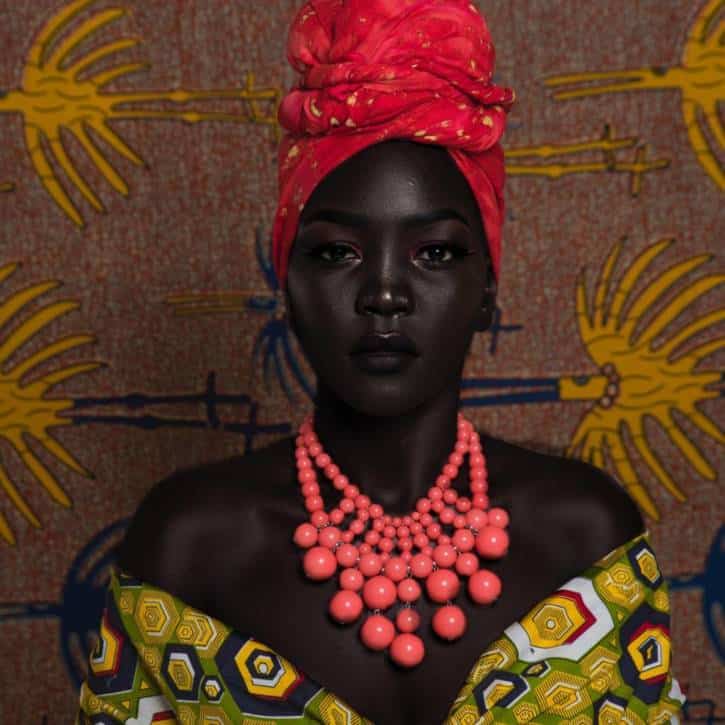
I was 14 years old. Came to Buffalo, New York. That’s where we landed before we moved to Minnesota…
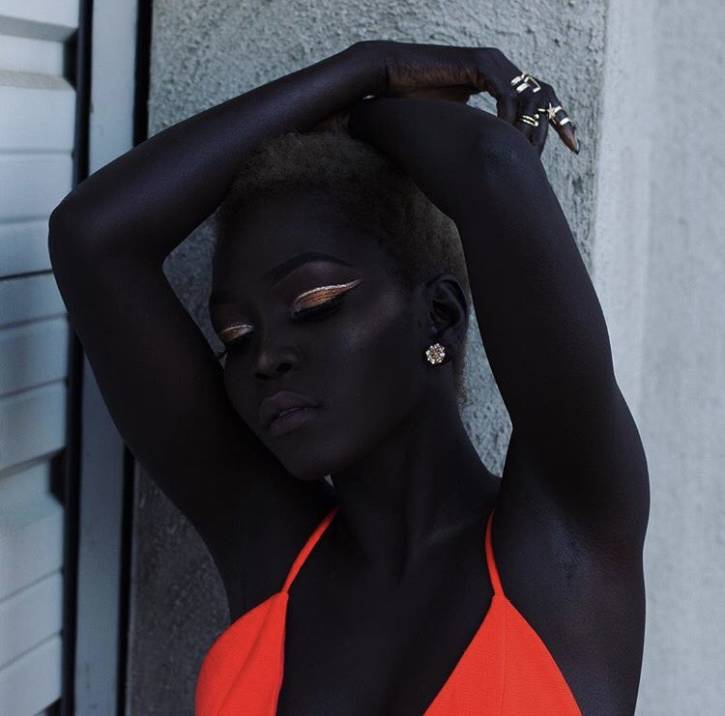
These kids, some of them would just stare. Some of them will stare at me and I was like, “Why are they looking at me? Something wrong with my teeth? What’s going on?” Some of them, like, when I’m walking in the hallway, they literally, like, would walk far away from me or try to go the opposite direction. They avoid getting close to me.
And some of them will come to me and ask to touch my skin, saying things like “Can it cover? Can it come off?” I’m like “What come off? What are you talking about?” I was so confused. They would just make fun of me. Sometimes they would laugh at me.
At lunch, I would sit and then they would be on the table next to me, talking about me really loud, laughing. Some of them would go, “Shit! [she’s] the ugliest thing I’ve ever seen. You look like a monkey.”
So that was every day, from 7th grade until 8th grade. I would come home and I would just cry.
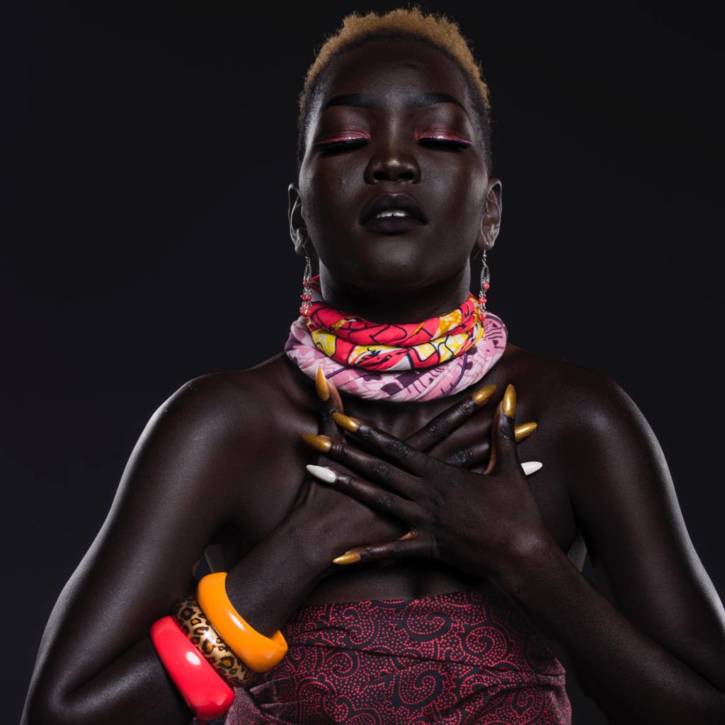
And I would always tell my mom that, because of my skin, because I’m black, they see my black as ugly. My mother would say, “What? That doesn’t make sense. You are mild black. Why are you crying? Those kids are not making fun of you because you’re black.”
And I’m like, “I don’t know. They think my black is ugly. They say it’s too dark, too ugly. It’s not beautiful. Like it’s a monkey. Looks like I don’t take a shower or I should smile so they could see me.”
I would confide in my sister and she would tell me this is society, because she came to the country in 1999 and been through this. But my sister bleached her skin.
When she came to this country, she did bleach [her skin]. So I talked with her and that’s when she would say I should consider bleaching. A huge amount of people from my country bleach their skin.
On almost bleaching her skin and how she managed to embrace her natural beauty:
Nyakim Gatwech: “So back to school at the end of next year, the same thing, and I would come home and try this stuff [cream for bleaching], and there came a time when I said, yes, go ahead, and do it. But I’m just like, no, no, that’s not right.
And then we moved. We moved from Buffalo, New York to Minnesota. When I was in Buffalo, New York, there were not that many Africans. It was just mostly African-American or Latina, white people.
Like, there was not enough black people, especially in my school. There were two families that were Sudanese.
And then [when] we came to Minnesota – we went to St. Cloud in Minnesota – there was Africans. There was Somalians, there were Kenyans, little bit of people that I was familiar with. That even though they’re lighter than me, they were raised in a country where they don’t look at skin color in a bad way.
So I started to surround myself with friends that were Africans that I know were not going to make fun of me. In high school, 9th grade, I started hanging out with Somalians and other Sudanese kids.
I started to hang out with the people who accept me for who I am. And I started thinking like I don’t care anymore.
And then so, I just started to look at myself, and working on me and say ‘you know what? I’m beautiful the way I am. I would wake up everyday and look in the mirror and tell myself ‘you are beautiful. You are beautiful just the way you are.’ So it became something I repeated.
And I used to call my sister and she would say, ‘aren’t you glad you did not bleach your skin now?’ And I would say, ‘Yes, I am.’ And so, I just then started embracing who I am.
On becoming an international model:
Nyakim Gatwech: Junior year in high school, I did a fashion show with this local designer that was holding a fashion show for an African line. It was a local event in St. Cloud Minnesota.
So, I did a fashion show, after she finally convinced me. She was one of my tutors. She would tutor me in high school when I was in the same class. And she was into designing or whatever and she said, “You should wear one of my dresses.” And I was like, “No I’m not a model. I mean I love myself, I don’t care what people think about me but I don’t want to be in front of people, like people are going to criticize me, people are going to say things about me.” She was like, “No Nyakim, you are beautiful. You shouldn’t care about this.”
So when I did the show, it was amazing, I loved it. I’m like this is fun. This was my first fashion show. She’s like, “How did you do that?” I’m like I think I just saw my sign. I could see myself doing this regularly and I am into fashion. Then I did a photo shoot with a photographer, a local photographer and the pics came out and it was amazing. I was like, wow, I look beautiful; I look like a real model.
I’m from South Sudan, a country in Africa where my people are really black but they’re human. They’re just like you. They just have a different shade of skin. So then, after the shoot and I am getting all these amazing comments and emails and letters from all these people who are like wow. A lot of people do accept me and think I’m beautiful for being different.
On the Uber story being misconstrued:
Nyakim Gatwech: I feel like it got twisted a little bit. The Uber driver was not offering me 10K. He was asking me if you were given 10K, would you bleach your skin color. It was a question from the guy. Because I was like why are you asking me that type of question?
And he said like, “Because as dark as you are it is hard to live in this society that we live in and that light skin is considered to be more beautiful. You are really, really dark. So you would have a hard time even getting a job or a guy finding you attractive. It will be hard for you.”
And I said to this guy, “It is. It is hard for me and I once considered bleaching at one point but I learned to love myself and that doesn’t affect me as much as people walk up to me and don’t want to offer, give the job also because of whatever they think the case might be.” So he was asking me to see how comfortable I am with myself and he said, “Wow. That is amazing.”
Literally he wasn’t trying to offend me. So that was it. Some people are saying I got offered 10K. No, no. He was asking if I was given 10K [would I bleach my skin].
On becoming an influential public figure and people reaching out for inspiration:
Nyakim Gatwech: There are so many messages right here like from these beautiful little girls. Some of them are younger, some of them are older. So many touch my heart. It was a great feeling. Like, I have so many of them. I don’t even know how to describe this feeling.”


By subscribing, you consent to receive emails from BlackDoctor.com. You may unsubscribe at any time. Privacy Policy & Terms of Service.